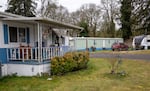
FILE - A manufactured home at the Horseshoe Lake Community in Woodland, Wash., on Feb. 18, 2025.
Erik Neumann / OPB
Clark County is again looking for ways to protect residents of manufactured and mobile home parks from losing their housing. On Tuesday, the council will hold a public hearing about whether to extend a rule that prevents the parks from being redeveloped.
An existing moratorium is set to expire on March 14. The proposed extension could last for up to one year. During that time, the county would explore new land use rules to preserve these parks, which serve as one of the few forms of natural, non-government-created, low-income housing in Clark County.
There are 2,033 manufactured homes in parks across unincorporated Clark County, according to county documents prepared for Tuesday’s meeting. Many more people live in these communities in Vancouver city limits and in other nearby cities, though the county has no authority over the land use rules within city limits.
Manufactured home park residents are uniquely vulnerable among homeowners.
While manufactured home park residents may own their homes, they pay rent on the dirt beneath them. In recent years, the cost of that “lot rent” has steadily risen in parks in Clark County and elsewhere. In many cases, rents have more than doubled, from several hundred dollars per month to more than a thousand, in just a handful of years.
But policy makers have been unable to craft comprehensive solutions, including a rent stabilization law passed in Washington last year.
While rising rents make it hard for homeowners to afford to stay, they also make mobile homes unattractive to new buyers, trapping residents in homes that cost progressively more each year. Despite being called “mobile homes,” these structures cannot be easily moved. The situation is complicated by the fact that many parks cater to residents who are 55 years and older and rely on Social Security.
Advocacy groups in Washington state successfully helped get a rent stabilization law passed by the state Legislature last year. It caps rent increases at the lower of either 7% plus inflation or 10% per year. But because that law now limits park owners’ potential profits, the Clark County council fears owners might evict their residents and redevelop the land to build more valuable housing.
“These folks are vulnerable from so many directions,” said Glen Yung, a Clark County councilor working on the moratorium.
If the county extends its moratorium, any property owner who tries to redevelop their land would have their application rejected. The moratorium is intended to “give county staff time to explore options and draft new land use regulations regarding the preservation of mobile home and manufactured home parks.”
The policy is proactive. There have been no recent applications to redevelop mobile home parks in Clark County, according to Land Use Review Manager Brent Davis.
If Clark County extends its moratorium, manufactured home parks within the boundaries of local cities like Vancouver would not be affected.
The city of Vancouver has been designing a new zoning category specifically for mobile and manufactured home parks, which will be released in the coming weeks in the city’s draft comprehensive plan.
More cities are learning that there are problems that need to be solved with this category of housing, according to Bryan Snodgrass, a planner with the city. Vancouver’s approach is modeled after a policy in Bellingham, Washington.
“You could change the zoning to something else, but it would be harder to do,” Snodgrass said.
The challenge of protecting manufactured home park residents comes as the county struggles to address a housing shortage and rising evictions. Clark County topped Washington state for eviction filings per capita in 2025, according to The Columbian, amidst what the newspaper called a “widening gap between residents’ incomes and rental costs.”
Solving this problem, at least when it comes to manufactured home parks, will require a balance between protecting residents and allowing redevelopment options for park owners, according to Yung. The combination of capping rent increases and permanently restricting redevelopment could create a downward spiral at parks, if owners can’t make enough money to keep investing in their properties, he said.
“There has to be some allowance under certain circumstances for redevelopment, otherwise you’re not helping anyone,” he said.
The Clark County public hearing will be held at the county building in downtown Vancouver at 6 p.m. Tuesday.