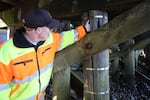
Frank Kemp, maintenance coordinator for the Astoria Riverfront Trolley, works on a repair as the trolleys sit parked in the maintenance and storage garage in Astoria, Ore., on Feb. 12, 2026.
Eli Imadali / OPB
The Astoria Riverfront Trolley started running along the town’s river almost 30 years ago, on an old railroad line that had been used to ship the city’s canned salmon and logs out to the world.
Since the trolley started running, it has attracted all kinds of businesses and visitors. But the old line is much, much older and in need of repair.
And the necessary repair and maintenance need to happen among the federally protected sea lions that hang out under the trestles.
Frank Kemp is the trolley’s maintenance coordinator. When he retired from the Navy in Seattle in the ‘90s, he searched to find the perfect coastal spot for his golden years.
“Astoria was the last town that we could find that was a real town. It’s not completely tourism, if you know what I mean,” he smiled. “It’s still got lumbering, fishing. All that stuff.”
‘We Ain’t Quaint’
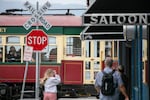
FILE - People walk towards the Astoria Riverfront Trolley, Astoria, Ore., Aug 10, 2024.
Anna Lueck / OPB
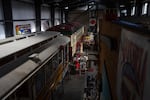
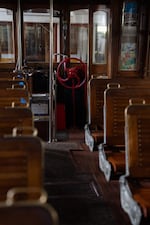




He and his wife loved the gritty atmosphere of Astoria and all the history. So it was no surprise Kemp soon started volunteering at the trolley. By that time, the fishing and timber industries were shells of their former selves, and the waterfront was full of closed canneries, shuttered mills and half-empty docks. It was not exactly a tourist destination.
But if you squinted past the economic stress, there were still fantastic views of the Columbia River. There were sea lions, massive ocean-going ships steaming by, the stunning Astoria-Megler Bridge and the verdant hills of Washington.
So, Astoria created a riverwalk.
“There was a push to get rid of the tracks so that the riverwalk could be wider,” said Kemp.
But Astorians didn’t want to lose the track. They wanted to remain true to their industrial history. So they kept the tracks and instead added a trolley. It proved a real success, attracting curious visitors, new restaurants, breweries, shops and hotels.
Now, the trolley showcases Astoria’s success and history, ringing true to the city’s spirit best summarized on a popular old bumper sticker: “We Ain’t Quaint.”
A trolley running on rotten pilings
But there’s still a problem: The trolley’s rail line dates back to the 1940s and was built of wood, a material that doesn’t do great on the water’s edge.
“There’s certainly decay,” said Nathan Crater, Astoria’s city engineer. “And that’s why we keep on top of this.”
Each trestle is made up of big wooden pilings, like telephone poles, but bigger. They were pounded into the river’s edge 70 or 80 years ago. Most pilings are fine, but some are rotten.
Walking down to one riverfront trestle, Crater knocks on different pilings to hear whether or not they’re rotten.
“It’s just varying tones. How it echoes, you’re going to hear a little bit of difference,” he said. “I’m certainly not an expert in that area. We do hire folks to do that.”

Astoria City Engineer Nathan Crater shows an area where they installed metal bracing around an old and splitting wood piling supporting the trolley tracks in Astoria, Ore., on Feb. 12, 2026.
Eli Imadali / OPB
He slips his hand into a big crack in a piling to illustrate the problem.
When workers come across a rotten piling, they’ll cut it out, probably down to the water line. The wood under the water hasn’t been exposed to oxygen, so it’s still in good shape.
Then they’ll bolt a metal beam onto that good wood, tie the pile back into the trestle, then move onto the next rotten piling.
The city doesn’t have the money right now to cover all $1.6 million of total work needed, but they’re doing the critical stuff now and will catch other problems as they arise.
Crater said people don’t need to worry about the safety of the rails. Even when packed full with cruise ship visitors, a trolley car weighs a fraction of the massive freight trains that the line was built for. So the safety margin is large. But there is another problem.
Working around the sea lions
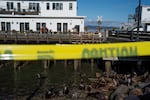
People watch as sea lions gather below the Astoria Riverfront Trolley tracks in Astoria, Ore., on Feb. 12, 2026. The area is cordoned off with caution tape to keep the animal and people alike safe.
Eli Imadali / OPB
Scores of sea lions have made a home under the trestles, and they are federally protected, which means they can’t be hunted, captured or even harassed.
Crater says luckily, the trestles they’re about to work on are well away from the sea lions’ main gathering area. But workers will have to be careful.
“We generally can slowly migrate down to the area and they will basically avoid us,” he said. “They don’t want to be close to us any more than we want to be close to them.”
Getting ready for Astoria tours by spring break
Back at the Astoria Trolley maintenance building, Frank Kemp is fixing the undercarriage of the historic “Old 300” trolley car, and he’s looking forward to reopening in the spring.
“We run in teams of two,” he explained. “One drives and one handles the money, lets people on and off and does a narration the whole way.
“For instance, this end of town used to be called Finn Town. Because when the place was first settled, the Finns settled on the west end of Astoria and the Norwegians, Danes and Swedes settled in Uppertown.”

Frank Kemp, maintenance coordinator for the Astoria Riverfront Trolley, works on a repair as the trolleys sit parked in the maintenance and storage garage in Astoria, Ore., on Feb. 12, 2026.
Eli Imadali / OPB
The seasonal trolley gives visitors a fascinating glimpse of a busy industrial waterfront. On one end, there are the working docks, where fishermen still bring in salmon and crab. Then a three-mile ride past condos, restaurants, shops and hotels, all squeezed in next to crumbling fish processing plants, working breweries, canneries, old mills and stunning views.
“The Cannery Pier Hotel, which is out here over the water, was originally Union Fish. It was a fish processing plant and cannery,” he said.
The trolley is scheduled to reopen in March, in time for spring break. People in the area during the busy season need to be careful, because the walking trail, the bike lane and the trolley rails all run along the same space.
Anyone who wants a ride can wait at one of the many stations or just wave a dollar at the driver.