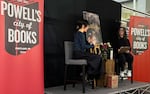
Portland author SenLinYu (left) discusses their dark fantasy novel "Alchemised" with Powell's bookseller Carly Jonathan during a sold out event at Powell's Cedar Hills Crossing in Beaverton on Feb. 10, 2026.
Jess Hazel / OPB
The war is over, her side lost. But Helena Marino is still fighting.
Marino is the main character of the new dark fantasy novel, “Alchemised,” by Portland author SenLinYu. The book follows a healer under interrogation in captivity in a time of war, exploring themes of women’s unrecognized labor and the violence of losing one’s autonomy. And if that already sounds dark, the story is also full of necromancy, magically altered memories and unflinching descriptions of the horrors of war.
It’s also really, really popular. Sen adapted the book from a very popular fan work they originally published online. Their debut novel released in September 2025 and has now sold more than a million copies in the U.S. and Canada.
OPB Morning Edition host Jess Hazel spoke with Sen about the book.
This conversation has been edited for length and clarity.
Jess Hazel: While everybody is familiar with fantasy as a genre, I think dark fantasy is still kind of new for quite a few people. Can you explain what makes dark fantasy distinct?
SenLinYu: Grimdark and dark fantasy gets a lot more into the grittiness of humanity and the fact that especially in things like war, you don’t have those perfect decisions. You don’t get to make harmless choices because you’re good or you have good intentions.
Hazel: Well, and I think the magic system for “Alchemized” really lends itself to the genre because necromancy plays such a prevalent role.
Sen: Well, there’s such a big thing in the story, both within the war and within the themes of the story, is the idea of the exploitation. Whether that is by the narratives we feed them, tricking them, coercing them, manipulating them into believing. Or by taking dead bodies and saying, “Well, I don’t care what you wanted in life. You are useful and convenient to me now, and so I’m going to utilize you to do whatever I want.”
I knew for this story that I needed an interesting moral conflict at the heart of the story, and it was actually a conversation with a friend about organ donation that kind of inspired this idea because she was very opposed to it. And then I started thinking, “Oh, that would be such an interesting conflict point in a war.” One side believing that this is great… utilitarian, to use the dead instead of risking the living. And then you have this other side that has this very deep moral sense of, no, there’s never going to be any justification for that kind of thing, that anybody who’s willing to do that needs to be eradicated because they’re a danger to all of society and morality.
Hazel: I think that the scenes in the hospital work really well because most fantasy, you go to the front lines, you are with the heroes fighting the bad guys, in the thick of it. But with Helena, she is working in the hospital. She has seen the casualties, and it really played into just how horrifying a lot of the war aspects of this book are.
Sen: It was a big priority for me that I didn’t want to write a story that was supposed to feel aspirational. For me personally — I’m half Japanese, and my grandparents were interned during World War II — I was always aware of the fact that my grandmother basically lived in the desert when she was 16 years old and basically lived in a barn where they had to poke paper in between the slats because the wind would just blow. And blow sand all over them at night when it would get incredibly cold.
So that awareness, that the good guys, the people that, for me in the world that I was in narratively, that the U.S. saved the day in World War II, there are imperfections to that narrative. I wanted to write a story that kind of touched on that.
Hazel: Are there ways that plays out in your life that made it important for you to explore through a work of fiction?
Sen: Yeah. When I first started I had a baby, an infant at the time, and they did not sleep, and I also had a toddler. There’s so much riding on you, and there’s also a really weird sense of invisibility. But then as soon as you make a mistake, as soon as your baby is being noisy in the grocery store or crying, then all of a sudden there’s all this attention of like, “Oh, you’re failing as a parent. You’re not a good mother.”
So wanting to kind of explore those feelings that I was dealing with, but not in the context of motherhood. And writing about a healer, like feminine-coded labor, that was the place that I defaulted to using as a context to explore those conflicting feelings that I had.
Hazel: Did living in the Pacific Northwest influence the atmosphere of this book at all?
Sen: I really enjoy utilizing the seasons to explore the emotional state that the character is in. When I was researching for “Alchemised,” I did genre research, and one of the things that they talk about for feminine gothic literature in particular is that the environment mirrors the interiority of the female character.
I grew up out in the country, and so I spent a lot of time experiencing the elements and the outdoors. Also, when I was initially working on the story, we didn’t have a car, and I live in Portland proper now, but walking everywhere… I think I’m always so aware of the weather that it sneaks into my writing.
Hazel: A literary trend that’s been seeing a big boost recently is the transformation of fan works into original fiction. The wave pretty much started with “50 Shades of Grey” and the most recent one I think people would be familiar with would be “Heated Rivalry.” Where does your work fit into that trend?
Sen: It was not something that I intended to do. It kind of got into this weird situation where it got really, really popular and so people were trying to buy it because they didn’t understand how fandom worked. So I started thinking, “OK, well, is there a way to take the things about this that are speaking to so many people and making it into my own story?”
So even when it went really viral and it was getting really popular online, I wasn’t thinking, “Oh, I can take advantage of this! I can take this now and I can publish it.” It was much more of a slow process of like, “I can’t keep sending cease and desist letters to all of these people that are selling it online. I need to figure out a way to create some space here and pull it away from fandom.”
So this was the process I chose to go with because it’s a story that’s really special to me, and it wasn’t like I wanted to just delete it off the internet or something like that, because it’s something that I really am passionate about. I wrote it from a place of really caring about sharing this story, sharing these ideas with other people.