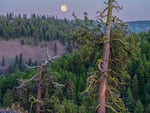
In July 2025, the moon rises over what may soon become the Qapqápa Wildlife Area to be co-managed by the Oregon Department of Fish and Wildlife and the Confederated Tribes of the Umatilla Indian Reservation. The state will own the land in Union County once it finalizes its real estate purchase using a federal grant.
DAVID JENSEN / Photo courtesy of the Rocky Mountain Elk Foundation
A historic state-tribal collaboration in Oregon has stalled after a charitable foundation pulled out of a potential land deal.
The Oregon Department of Fish and Wildlife was preparing to purchase 11,438 acres of private timberland using a federal grant. The area is about 10 miles southwest of La Grande in the Blue Mountains.
The agency planned to manage the land alongside the Confederated Tribes of the Umatilla Indian Reservation — the first such collaboration in Oregon.
But the landowner, the Harry A. Merlo Foundation, has withdrawn from the deal “for undisclosed reasons,” according to a press release from the Oregon Department of Fish and Wildlife on Monday.
A spokesperson for the foundation declined to comment.
The state wildlife department and tribes had secured $22 million in federal funding to acquire and co-manage the land.
The area would have been called the Qapqápa (pronounced cop-COP-a) Wildlife Area.
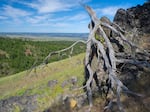
Oregon state and Umatilla tribal leaders aim to co-manage the Qapqápa Wildlife Area in the Blue Mountains in Union County, Ore., pictured here in July 2025. They're awaiting on a property appraisal before finalizing the purchase using a federal grant.
DAVID JENSEN / Photo courtesy of the Rocky Mountain Elk Foundation
“While it is with heartfelt regret that we share this news, we remain committed to pursuing opportunities—here or elsewhere—that benefit wildlife, habitat, and public access,” the state and tribes said in Monday’s press release.
The Qapqápa project attempted to open thousands of acres of private timberland to the public. It would have connected existing portions of the Wallowa-Whitman National Forest.
It also would have restored tribes’ access to part of their ancestral land.
The plan was to restore this swath of forests and meadows for elk and salmon habitat. Elk and mule deer often migrate through this area, as do bull trout, Chinook salmon and steelhead.
The land had been owned by timber businessman Harry Merlo. The Harry A. Merlo Foundation took over ownership after he died in 2016.
On its surface, the deal appeared to align with Merlo’s land management philosophy. He often hosted student tours of this property, showing university and high school students how to manage a landscape for fish and wildlife habitat alongside logging and cattle grazing.