Oregon farmers will soon have a clearer path to run a retail store and host agritourism events on their land, despite strong opposition from land policy watchdogs — and from other farmers, too.
The Oregon Senate passed House Bill 4153 with bipartisan support on Friday.
It cleared the House Tuesday, and will soon head to Gov. Tina Kotek’s desk. The governor has expressed support for the bill, as have the Oregon Farm Bureau and property rights groups.
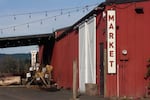
A produce market at a farm in Sauvie Island, Ore., Feb. 4, 2026.
Alejandro Figueroa / OPB
Backers say the bill reflects the needs of modern farm businesses and gives growers an easier path to an alternative stream of revenue while also protecting Oregon’s landmark land-use system.
They also acknowledge it may not be perfect — or what everybody wants.
“I think we’re going to have to let it roll for a while and see whether the fears that some folks are expressing become true. And if they do, we’re going to have to respond. That’s the way legislation works,” said state Rep. Ken Helm, D-Beaverton, who’s the co-chair of the House Committee on Agriculture, Land Use, Natural Resources and Water, and voted “yes” on the bill.
But opposing land conservation advocates, including farmers, aren’t convinced, saying the bill was crafted by special interests behind closed doors, with little input from working farmers and argue it could put farmland at risk of losing its primary purpose: to grow crops and raise livestock. They say the bill could invite tourist attractions with no connection to agriculture into rural farming communities.
“After more than a decade of building a healthy farm and farm business, I worry that the significant loopholes in this bill will turn my area into a tourist destination rather than the productive farming region it is,” said Aaron Nichols, a Hillsboro farmer.
The legislation, sponsored by state Rep. Vikki Breese Iverson, R-Prineville, creates what’s called a “farm store” permit, and clarifies how farm owners can operate retail space on land zoned for exclusive farm use and host agritourism events, a catch-all term for any activity that invites visitors to the farm — think a rural market selling farm-grown goods, snacks and drinks, farm-to-table dinners, hay rides or music events.

FILE - Apples for sale at the Liepold Farms produce stand in Boring, Ore., on Friday, April 3, 2020. Legislation passed Friday, March 6, 2026, opens the door to more sales of non-agricultural products at farms across the state.
Bryan M. Vance / OPB
It does not eliminate farm stands or the farms visitors go to pick pumpkins, apples or berries — that’s already an allowed farm use under Oregon law.
For farm stores, as opposed to farm stands, however, the bill gets rid of an existing rule that requires farmers to show that at least 75% of their annual sales come from products grown at the farm or nearby farms. No more than 25% of their revenue could come from events they charge a fee for, or from selling snacks and bottled drinks or branded products.
The new rules change the math. Now, only 25% of an indoor farm store may be used for retail merchandise such as gifts or souvenirs. The farm store will be capped at 10,000 square feet. And at least half of a farm owner’s land needs to stay as a working farm, for farms up to 80 acres in size.
Land policy watchdogs take issue with that last part. That’s because any farm that is larger than 80 acres would technically only have to farm 45 acres to meet the working farm requirement in the bill. The average farm size in Oregon is 430 acres.
“I want to support appropriate opportunities for farms of all sizes to stabilize revenue. Unfortunately, this bill does not do that,” Sen. Courtney Neron Misslin, D-Wilsonville, said Friday as she urged lawmakers to vote against the bill. “It risks opening up our agricultural lands to commercial use.”
But Oregon’s property tax rules already prevent people from turning entire swaths of land into commercial uses that have nothing to do with farming, Breese Iverson said. She explained that the state gives farmers a special farm tax deferral, in exchange for using agricultural land for farming — that means they pay a lower property tax than they would if their land were taxed at a fair value.
“However, to obtain and keep that tax break, the land must be used for farming,” Breese Iverson said at a Tuesday House session. “So at the point of which you change that use on your land, the special tax assessment goes away.”
Farm stores can’t be used as hotels, full-service cafes or drive-thru fast food restaurants. Counties also have the ability to regulate their traffic, noise and store hours.
Editor’s note: This story has been updated with additional comments on the farm stand bill, and to clarify details of rules the bill imposes specifically to farm stores, which are distinct from farm stands.