A federal judge in Oregon on Friday ordered federal officers at the U.S. Immigration and Customs Enforcement building in Portland to greatly restrict their use of tear gas until a lawsuit over the crowd control munitions is settled.
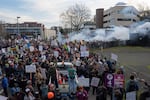
Thick clouds of tear gas, deployed by federal immigration officers, fill the air hundreds of protesters, including children and elderly people, demonstrate outside of the ICE building in Portland, Jan. 31, 2026.
Eli Imadali / OPB
The case that prompted the ruling by U.S. District Court Judge Amy Baggio is one of two parallel lawsuits in federal court — before two different judges — to limit the use of tear gas, pepper balls and other chemicals outside the city’s ICE facility.
The lawsuit before Baggio was brought by tenants at a nearby apartment complex who alleged their rights have been violated by chemical munitions seeping into their homes.
U.S. District Judge Michael Simon is expected to rule by Monday on another lawsuit over federal officers’ use of tear gas brought by protesters who sued. A three-day mini-trial in that case ended Wednesday and Simon took the case under advisement.
Baggio’s order prevents the officers from using chemical munitions except in cases where they reasonably fear for their lives. The judge acknowledged her decision Friday is “an extraordinary remedy.”
“But this is an extraordinary case,” she wrote in the 57-page ruling. She wrote that the gas deployments made it “difficult or impossible for (tenants) to eat, sleep, or simply breathe normally while in their own homes.”
While she acknowledged that some protesters have trespassed, vandalized the property and even assaulted officers, the federal officers’ documented tactics have gone beyond crowd control.
Officers have been recorded on video deploying gas hundreds of yards away — sometimes firing it high into the air well over the crowds themselves. Baggio said those broke with use of force manuals that govern how much gas to deploy and how far to deploy it.
Representatives for the U.S. Department of Homeland Security did not immediately respond to requests for comment.
The tenants’ attorneys cheered Baggio’s ruling. In a statement, they wrote that Baggio’s ruling recognizes “that poisoning a residential community with toxic chemicals is a profound abuse of power.”
The apartment building, Gray’s Landing, is kitty-corner from the Portland ICE building. Since last spring, protesters have held consistent demonstrations staged against the Trump administration’s deportation efforts. Federal officers frequently use tear gas as a crowd-control tactic.
Tenants recently testified in federal court about the impacts of that gas: Some wear gas masks to bed, others have tried to escape the pervasive fumes by staying in their bathrooms or using wet towels to prevent the gas from seeping under doors. They compared their exposure to past incidents where cities ignored dangerous levels of lead in public drinking water.
Justice Department attorneys, who represent Homeland Security officials in court, bristled at the comparison. During a February hearing, they blamed the tear gas clouds on protesters — not federal law enforcement.
“The court is going to have to say that this is akin to the Flint water crisis, which would just be quite an astounding holding,” said Justice Department attorney Samuel Holt.
Holt had signaled that the Justice Department planned to file an appeal.
Tear gas like lead in the drinking water?
The Gray’s Landing tenants, as well as REACH Community Development, the nonprofit that manages the building, first filed suit in late December.
The tenants’ unique legal argument rested less on civil rights violations and more on public health. Basically, the tear gas invaded their bodies and homes without their consent.
At a hearing last month, four of the tenants described ailments they blamed on tear gas exposure: doctor visits and trips to urgent care, particularly for pre-existing conditions that seemed to worsen.
Three Justice Department attorneys lightly cross-examined the witnesses about the effects they described. They highlighted that the tenants hadn’t yet submitted medical records to the court.
The gas exacerbated Diane Moreno’s Cushing Disease, she testified. The disease causes an overproduction of cortisol, leading to muscle breakdown, heart problems and cognitive impairment.
Her cortisol levels spiked so badly in recent months, Moreno testified, that her doctor recommended surgery to remove the gland producing the hormone. She said she planned to have surgery in March, even though living with one less adrenal gland invited its own, separate health risks.
“I don’t have a choice,” Moreno said. “My body is not doing well.”
Erica del Nigro, another tenant, said the chemicals worsened her mast cell activation syndrome. The condition puts a person’s immune response on a hair-trigger as though constantly fighting allergies.
The tear gas has left her with inflamed eyelids, styes, and a six-week full-body rash between September and October. That’s when protests outside the Portland ICE building hit their apex, until Trump’s National Guard deployment efforts were halted by a federal judge.
On the witness stand, del Nigro described having issues with her gastrointestinal and urinary tracts. The tear gas affected her menstrual cycle, she said Visits to urgent care, her primary doctor and a second doctor all sourced her recent flare-ups to tear gas in her apartment. They recommended she move.
“I was hoping for a different explanation,” she testified, adding that it’s a struggle to find low-income housing.
Dr. Rama Rao, an attending physician at a New York hospital and a professor of medical toxicology, gave corroborative testimony that tear gas exposure was wreaking havoc on the apartment’s tenants.
She noted that long-term exposure to tear gas isn’t well understood because it would be unethical to inflict it upon test subjects. Justice Department attorneys questioned her motivation for testifying by highlighting her attendance at the 2017 Women’s March against Donald Trump.
Justice Department attorneys didn’t disagree that tear gas exposure can be harmful. But they disputed that their tactics amounted to depriving the tenants of their “bodily integrity.”
There are cases in recent legal history where government actors elsewhere in the U.S. have been held accountable under depriving a person’s bodily integrity. Those cases include medicating prisoners against their will or drawing blood from an unconscious suspect.
Holt said those cases show intentional intrusions, while the tear gas exposure is “incidental” to the federal officers’ main aim of dispersing protesters.
“I think the throughline in all of those cases is forcible bodily intrusions,” Holt told Baggio during the hearing.
But Baggio, like the tenants’ legal team, probed whether the Homeland Security department’s goal was, in fact, dispersing crowds.
Crowd dispersal or propaganda
Some protests outside of the Portland ICE facility have seen huge crowds and instances of vandalism, rock-throwing and other disorderly conduct.
The plaintiffs in the case, however, argue that federal officers have deployed excessive amounts of tear gas without warning.
Videos entered into the court record documented agents dropping tear gas canisters in the driveway without alerting protesters.
One video showed an agent firing a canister from near the driveway west down Bancroft Street, parallel to Gray’s Landing. Holt, with the Justice Department, later theorized the officer shot such a high arc so as to not accidentally strike a protester with the projectile.
Dan Jacobson, a lead attorney for the tenants who is based in Washington D.C., argued in court that the government has had many months to find ways to breakup protest crowds without gas. The officers’ continued use suggests they’re indifferent to nearby residents, he argued.
Even after the government was notified of the Gray’s Landing lawsuit in December, Jacobson noted, they still deployed tear gas on at least five separate days in January and early February.
“The government isn’t going to stop on their own accord,” Jacobson told Baggio. “They’ve proven that. Only the courts can stop them now.”
Supervisors at the ICE building gave exclusive access to the facility late last summer to multiple conservative media figures, including a reporter from The Post Millennial and freelancer Nick Sortor, multiple weeks before opening its doors to any local media.
Jacobson, the tenants’ attorney, alleged in court that the Trump administration intentionally inundated the neighborhood with tear gas to create “propaganda” for those livestreamers and for its own content creation to reinforce Trump’s portrayal of Portland as a “war-ravaged” city.
The tactic, he said, “shocked the conscience.”
A video produced by OPB that documented federal agents’ crowd control efforts featured in the court arguments. That night, federal agents pushed nonviolent protesters hundreds of feet away from the federal property.
Around 8:15 p.m., OPB reporters saw agents lead a systemic push, driving protesters hundreds of feet away from the driveway. The two-pronged push sent groups east on South Bancroft Street and north on South Moody Avenue.
A reporter witnessed agents ignoring repeated questions as demonstrators backpedaled all the way to the intersection of South Bancroft Street and Bond Avenue — more than a football field away. Officers then began to walk backward toward the building, dropping tear gas the entire length of the street next to the apartments.
Meanwhile, OPB reporters noted small drones swooping overhead and saw people standing alongside the federal agents with cameras filming their interactions with demonstrators.
By 8:50 p.m., the federal agents had retreated behind the ICE facility’s gates.
When questioned by Baggio about OPB’s video, Holt said officers that night were facing “a lot of different threats” that may not have been captured in the video. He noted that while he couldn’t speak to their intentions, he said the agents submitted reports into the evidence.
“I do think those reports show they were acting reasonably,” Holt told Baggio.
The Justice Department called no witnesses during the February hearing, nor did they submit any of their own video evidence. The reports submitted on Oct. 4 do not mention any chemical munitions deployed between 1:30 p.m. and nearly 10 p.m.
Baggio highlighted the evening as an example of officers acting indifferent.
“This conduct of a coordinated, organized, operation in which Defendants deployed significant quantities of chemical munitions on a group of people over a block from the Portland ICE Facility and in front of a large residential apartment building is in and of itself troubling,” the judge wrote.
On Oct. 6, two days later, Homeland Security’s official Instagram account posted a 50-second montage, set to swells of violin music, of federal law enforcement pushing, gassing and firing pepper balls at protesters. The video prominently featured Sullivan.
The video also showed aerial footage of Gray’s Landing that night in a fog bank of chemical gas.