
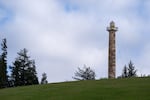
The Astoria Column stands 125 feet above the ground on a hilltop in Astoria, Ore., on Feb. 12, 2026.
Eli Imadali / OPB
In the gift shop at the Astoria Column, manager Meredith Barlow-Spry stands over a big box of balsa wood airplane parts.
“This is our workstation here,” she smiles. “This is where we build them — any downtime we have.”
While the column offers plenty of history and stunning views, many visitors vividly remember the balsa wood airplanes.
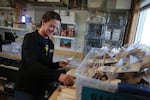
Astoria Column gift shop manager Meredith Barlow-Spry assembles balsa wood airplanes for people to throw off the top of the column, Feb. 11, 2026
Kristian Foden-Vencil / OPB
Thanks to an anonymous benefactor, these planes have remained at just $1 each for years. Visitors love to throw them from the top of the 125-foot-tall column and watch how far they fly.
“A little tip for the planes,” Spry tells a customer. “If you have the wings all the way to the back, that’s going to be set for a longer flight. And then push the wings forward and it does loops and tricks.”
The launching pad for these planes, the Astoria Column, was built in 1926 to commemorate the exploration and settlement of the Pacific Northwest. Astorians are celebrating the column’s 100th anniversary this year.

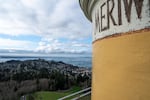
Astoria, Ore., is seen from the top of the 125-foot-tall Astoria Column in on Feb. 12, 2026.
Eli Imadali / OPB
The landmark, high on a hill, is visible from just about anywhere in Astoria, a historic fur-trading town at the confluence of the Columbia River and the Pacific Ocean that’s the oldest permanent American settlement west of the Rocky Mountains.
On a clear day, the column offers stunning vistas of the ocean, the river and Washington state.
The town will hold a fair, a rededication ceremony and a gala for the Astoria Column on July 18. But other events or themes are also being organized for just about every month of the year.
In January, people were encouraged to write their New Year’s resolutions on the little planes then release them to the wind. In February, they were writing love notes on the planes for Valentine’s Day. The theme for March is “It’s your lucky day,” with giveaways and contests throughout the month.
Other upcoming events include sunset yoga at the column, stargazing nights, concerts and Easter egg hunts. There’s even a fitness challenge, with people invited to climb the column’s 164 steps 20 times in a month.
“There’s a local artist named Ronnie, and she’s doing 80 before she turns 80,” Spry said. “It has turned into something bigger, and it’s given people a sense of community.”
Chelsea Vaughn, the curator of the Clatsop County Historical Society, is setting up a new exhibit at the Heritage Museum on the column and how it was decorated.
The artwork on the Astoria Column
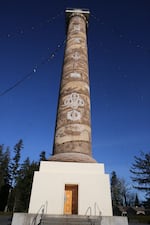
164 steps will take visitors to the top of the Astoria Column. Entrance is free, and there's no lift, but parking is about to go up from $5 to $10. Feb. 11, 2026
Kristian Foden-Vencil / OPB
The artwork on the outside of the column portrays 14 different historic scenes, from Native American tribes to the arrival of the railroad.
Italian immigrant and artist Attilio Pusterla used a technique called “sgraffito” to create the scenes. The technique involves coating the column in different colors of plaster and then etching through the layers to create images.
Vaughn thinks the technique may have been better suited to sunny Italian climes than the horizontal rains of the Oregon Coast; the images began to fade within three years.
She said people tried a variety of things to improve the artwork after that, some were more successful than others.
“Tung oil was applied two different times,” she said. “And that had the effect of physically darkening the column, accelerating the loss of pictures.”
White latex paint was applied in the 1960s to the sections featuring Meriwether Lewis, William Clark and John Jacob Astor.
“The original lines weren’t really followed and, somehow, either Lewis or Clark got mutton chops,” Vaughn smiled. “Elvis was suddenly on the column.”
Friends to the rescue
Portland businessman and philanthropist Jordan Schnitzer created the nonprofit Friends of Astoria Column in the 1990s, after noticing the artwork was again fading away. He helped raise more than $1 million to clean it in 1995 and to cover it in a special paint.
“It’s sort of like Gore-Tex,” he said. “It lets the moisture out, but keeps the moisture from coming in.”
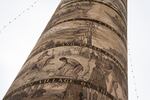
Stories of Lewis and Clark’s expeditions and other more colonial parts of Northwest history are chronicled on the Astoria Column as it stands 125 feet above the ground on a hilltop in Astoria, Ore., on Feb. 12, 2026.
Eli Imadali / OPB
He says one of his relatives was a peddler who walked the streets of early Astoria, collecting old rubber boots and metal. He’d then sell it in Portland.
Schnitzer says standing at the top of the column fills him with emotion.
“If one is religious, I guess one could say, ‘I feel close to God,’ being up there,” Schnitzer said. “If one is a humanist, one would feel that you are part of this cosmos.”
The column also honors Astoria’s role in the construction of the northwestern railways.
But for some, it’s a symbol of colonization and a testament to the displacement of Native Americans.
A tribute to colonialism?
Tony Johnson, chairman of the Chinook Indian Nation, said the stories the column tells about the tribes are inaccurate. But he’s not too worried about the misrepresentation.
“Were we to do it again in 2026, we know folks would approach it differently” he said. “We would have a much more historically accurate depiction. But just to be clear, we are not losing sleep over it.”

Tony Johnson, Chinook Indian Nation chairman, poses for a portrait at the Comcomly Memorial burial canoe replica, just below the Astoria Column, in Astoria, Ore., on Feb. 12, 2026.
Eli Imadali / OPB
He says the Chinook Nation knows its own connection to the area, and he’s confident things will change over time.
“I mean, the United States is a baby. It is very young,” he said. “In my household we certainly talk about the fact that America has to grow up still. It needs to mature.”
While the pictures on the column start with Native Americans, they quickly move onto Captain Robert Gray, the Boston fur trader who named the Columbia River. Then they move to Lewis and Clark, and to Astor, the principal investor of the Pacific Fur Company. They also portray Tonquin, the sailing ship that brought workers and supplies for Astor’s fur-trading post. The stories culminate with the arrival of the railroads in Astoria.
While the column has suffered from some graffiti over the years, nowadays it seems relatively unscathed and well-loved by locals, who use it as a spot for picnics and momentous events, like proposals.
But the vision of its creators was much grander.
Part of a PNW railroad tour
The president of the Great Northern Railroad in the 1920s, Ralph Budd, dreamed of a grand railroad tour, Vaughn said, where people would stop across the Pacific Northwest to visit monuments commemorating westward expansion and the railways.
In researching the column, Vaughn found there were supposed to be 12 monuments.
“I was coming up short, because there are not 12 monuments,” she said. “Not even close. So officially there are six monuments, of which the Astoria Column is, by far, the most grand and spectacular.”

Chelsea Vaughn, the curator of the Clatsop County Historical Society, arranges a game for her exhibit on the Astoria Column. Kids can stack blocks to see how high their column can be before being blown over by the wind (a household fan.) Feb. 11, 2026
Kristian Foden-Vencil / OPB
Other monuments include a granite orb, 5 feet in diameter, in North Dakota. It’s dedicated to explorer David Thompson, who helped map North America. There’s also the Marias Pass Obelisk in Montana, dedicated to Theodore Roosevelt.
Other monuments along the tour ended up being not much bigger than a gravestone.
How it started. How it’s going
Money for the Astoria Column came from the Astor family, but also from the town, which had money left over from its own 100th anniversary, back in 1911. Mac Burns, with Friends of Astoria Column, said that’s when the town bought the site on Coxcomb Hill.
“If they had not chosen to celebrate our centennial in 1911, that land may not have been available to put the Astoria Column on,” Burns said. “There might be three or four big, giant houses up there with the best view in town.”
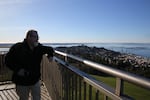
Mac Burns, from Friends of Astoria Column, Feb, 11, 2026. “This is the perfect view of Astoria, how it’s a peninsula,” he said.
Kristian Foden-Vencil / OPB
Climbing to the top of the Column, Burns gestured to the impressive view with open arms.
“This is the perfect view of Astoria, how it’s a peninsula,” he said. “You can see the 8 miles out to the Pacific Ocean. You can see the 6 miles across the river to Washington State, our beautiful Astoria-Megler Bridge.
“Then you can peek over to the south and see Saddle Mountain, you’ll see Youngs River, you’ll see Fort Clatsop, where Lewis and Clark spent their winter. You really get a sense that we’re surrounded by water.”
A visit to the column is free. But there is an annual parking fee. According to The Astorian, it’s going up from $5 to $10 by May. Visit the Astoria Column website or follow @theastoriacolumn on Instagram to learn more about the events celebrating the centennial.

A tourist looks out from atop the 125-foot-tall Astoria Column in Astoria, Ore., on Feb. 12, 2026.
Eli Imadali / OPB