Four years after it shuttered — and almost nine months after being deemed a Superfund site — the J.H. Baxter wood treatment plant in Eugene is still well short of its “deep clean” phase.
For roughly 80 years, the facility processed countless telephone poles, railroad ties and other chemically-treated wood products, with mounting complaints of odors and contaminants from residents of the neighboring Bethel community.
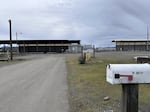
In this February 13, 2026 photo, the J.H. Baxter wood treatment plant lies still and empty after ceasing operations in January 2022.
Brian Bull / KLCC
J.H. Baxter faced lawsuits, probes and multiple violations, and narrowly avoided being designated a Superfund site back in March 1993. When it closed the facility permanently in January 2022, the company said rising operating costs, market volatility and diminished margins were behind the decision.
Today, the plant is a barren shell of its former self: truck traffic has ceased, its tank farm is gone and its workforce is down to one employee who runs the stormwater and groundwater treatment systems.
Anne Christopher is the U.S. Environmental Protection Agency’s remedial project manager for the J.H. Baxter Superfund site. Both the EPA and the Oregon Department of Environmental Quality have done extensive dismantling and removal of old equipment, with many metal tanks being recycled and barrels of hazardous waste being shipped to a facility in Utah.

In this EPA letter to the J.H. Baxter company dated March 31, 1993, the EPA's Superfund Response and Investigations Branch informed Baxter company officials that remedial work at the wood treatment plant in Eugene, OR resulted in them from being designated a Superfund site. 32 years later, the same site would be listed on the National Priority List for Superfund cleanup.
U.S. EPA (obtained by FOIA request) / KLCC
Christopher told KLCC that there’s still extensive soil sampling to do on the property, which may go 30 to 45 feet deep.
“So that could take a couple years, and we do the remedial investigation, and then combine it with what’s called the feasibility study,” said Christopher. “And that’s how we determine which technologies are the best to use to clean up the site.”
Examinations of where the infamous retorts stood last February showed a broken concrete liner a few feet under the surface, with chemical product that had seeped into areas including the basement area of a nearby building.
“It was a pretty gnarly basement,” said Christopher. “It was from the boiler room. I personally did not go down into it, but just looking down the staircase, you could tell it was not pretty down there.”
Christopher added that EPA crews put an intact liner down, as well as clean backfill, “so that we don’t get continual surface water percolating through that. It’s basically temporarily capped until we get out there and do more work.”
There remains a lot of concern and skepticism about how safe the defunct J.H. Baxter wood treatment plant is, with many residents remembering how the DEQ tested 62 yards and gardens for dioxin contamination, then trucking away and replacing soil at seven of those homes.
“The good news is that because the plant isn’t operating anymore, there’s not a continual source that would be at least from air deposition from that perspective,” said Christopher. “We will look into the groundwater migration pathway and the surface water migration pathway. That will all get incorporated into the remedial investigation. So we look at every potential pathway for sources of contamination to move off site.”
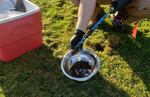
In this undated photo from either fall 2021 or spring 2022, contractors working for the Oregon DEQ gather soil samples from yards near the J.H. Baxter plant in Eugene's Bethel neighborhood. Concerns over dioxin levels resulted in more than 60 residences being sampled, with seven getting their soil replaced due to the health risks.
Courtesy of Oregon DEQ / KLCC
Christopher added that the remedial investigation also includes a human health risk assessment and an ecological risk assessment.
Christopher works with another project manager, Randy Nattis, as well as a hydrologist, a human health risk assessor, a site attorney, and a community involvement coordinator to help keep locals and media informed on the EPA’s progress.
Once the Superfund cleanup gets underway, it could still take decades and cost billions of dollars before the site is suitable for use again. The J.H. Baxter site remains zoned for industrial use, so once it’s rehabilitated it could feasibly be host to any number of operations.
Brian Bull is a reporter with the KLCC newsroom. This story comes to you from the Northwest News Network, a collaboration between public media organizations in Oregon and Washington.
It is part of OPB’s broader effort to ensure that everyone in our region has access to quality journalism that informs, entertains and enriches their lives. To learn more, visit our journalism partnerships page.