At 80 years old, Gary Harris is proud to call himself the oldest farmer in Jefferson County.
A second-generation farmer, he’s seen a lot change, even more so in recent years.
The beginning of April usually marks the time of year where he and other neighbors in his irrigation district will begin taking water from the Deschutes River system and diverting it through canals to water the thousands of acres of farms and ranches that blanket Central Oregon’s high desert.
But over the last eight years, constant droughts and federal conservation rules that require the irrigation district to release water for endangered species habitat have left growers with less water for the growing season.
Now, Harris in Central Oregon, as well as farmers across a broad stretch of the state, are facing a season that could be even drier. With already widespread drought and low snowpack levels, some fields will have to go fallow in Southern Oregon. Some farmers may have to get water elsewhere in the central region of the state. And while in far Eastern Oregon the outlook is slightly less bleak – farmers there worry next year could bring more pain.
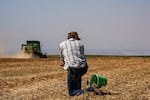
FILE - Phil Fine checks for carrot seeds in the soil left behind in a combine while harvesting a field North Unit Irrigation District on Tuesday, Aug. 31, 2021, near Madras, Ore. In 2026, irrigators in the North Unit district will get roughly 57% of the water they average when conditions are good.
Nathan Howard / AP
Harris figures he’ll have to write a check to bring more water to his farm, if it gets bad enough.
“Going out and buying extra water is more expensive than the water we already get, and it’s not cheap,” he said.
Underpinning that unwelcome expense is an unusually warm and dry winter that has brought with it little snow across much of Oregon.
“We had such a low snowpack starting in the irrigation season, what that means is that’s gonna translate into lower natural flows of the Deschutes River system,” said Jeremy Giffin, a water manager with the Oregon Water Resources Department. “And so this year we expect curtailments and we also expect to draft down our reservoirs a little more than we normally do.”
Statewide snow water equivalent – measured by how much water is trapped in the snow up in the mountains – is at 29% of normal for this time of year. It’s the second-worst snowpack on record, only behind the 2015 winter season. And half of Oregon is currently experiencing some form of drought.
The start to this year’s irrigation season sits in stark contrast to last year, when much-needed snow brought a glimmer of hope that things might turn around.
“Last year we were hoping that this was the end and that we were coming out and coming into more favorable conditions,” said Josh Bailey, general manager of the North Unit Irrigation District in Central Oregon. “But that’s certainly not the cards that Mother Nature dealt us [this year].”
This year, the North Unit district will begin pulling water from the Deschutes River system on April 13. In a good year, the natural flow of the river can meet the demands of all the irrigation districts in the region until early June, Bailey said. But the river’s flows are so low right now, they’ll likely switch to stored water from the Wickiup Reservoir by the later half of May.
Irrigators this year in the North Unit district will get roughly 57% of the water they average when conditions are good.
Other irrigation districts in Central Oregon could have a more challenging season.
Oregon water law, like much of the Western U.S., is based on “prior appropriation.” That means irrigators with the oldest water rights take priority over junior water right holders.
Even though the Wickiup Reservoir is 92% full, some of the districts with junior water rights will run out of water.
“Many of the storage accounts will be exhausted. They will run out of water,” Giffin said. “I think it is a scary thing, especially if I was an irrigator in the Madras area.”
Southern Oregon fields could lie fallow
In Southern Oregon’s Klamath Basin, snowpack conditions aren’t much better. And there might not be enough water to meet the demands of all irrigators in that basin.
In its 2026 annual operations plan, the U.S. Bureau of Reclamation outlined a goal to set aside up to 350,000 acre-feet of water for farmers from Upper Klamath Lake. That is not final, and could change.
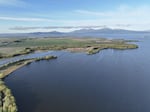
FILE - Aerial shot of Agency Lake, Upper Klamath Lake, May 19, 2024.
Todd Sonflieth / OPB
With continued droughts and a 2024 federal government plan that outlines how water will be managed in the Klamath Basin, Gene Souza, the executive director of the Klamath Irrigation District, said it will be tough to make enough water available to farmers and preserve water for endangered fish species critical to the Klamath Tribes.
“I’m not seeing the water availability to meet all my legal and contractual obligations,” Souza said. “And so we’re discussing amongst ourselves and with our neighbors on how to best address these shortfalls, and to find a way where the Klamath Irrigation District can best meet our community needs and ecological needs without getting ourselves into a legal battle.”
He said farmers should make decisions about their crops and whether to leave fields fallow now. About 40,000 acres will need to go fallow this year for the district to have a balanced water budget, he said.
“I’m encouraging folks to really think before they apply a drop of water onto their land, to look at all their options,” Souza said.
Worries for next year in far Eastern Oregon
In southeast Oregon, the Owyhee Irrigation District has reduced water allotments by just 12% for this year’s irrigation season.
Farmers in that dry corner of the state grow mostly sugarbeets, onions, grains and hay.
“For most of our guys, that’s not gonna really affect them too much,” said Clancy Flynn, the general manager of the Owyhee Irrigation District. “It just means that they’re gonna have to tighten up their waste and make sure that they’re ordering [water] on and off exactly when they need it.”

FILE - A center irrigation pivot sits on agricultural land in Harney County, Ore., on Dec. 18, 2025.
Eli Imadali / OPB
The Owyhee basin currently sits at 0% snow water equivalent, as of late March. The district usually relies on some flows from the Owyhee River, though it depends more on saved up water from its reservoir.
“Usually right now is when we’re getting our big run of water to come to us. It’s not happening, so that’s a problem,” Flynn said.
One glimmer of hope, the Owyhee Reservoir is currently 65% full – mostly with water carried over from last year’s winter. The worry: If Oregon doesn’t get a strong snow season later this year, it will put the district, much like all other districts across the state, in a tough spot.
“This is just kind of the way it is in a year like this. There’s not much you can do about it,” Flynn said. “You just kind of watch it happen to you.”