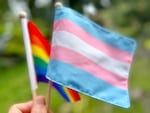
The rainbow flag, also known as the gay pride flag, is a symbol of LGBT and queer pride, left, along with the transgender flag, right, June 2, 2022.
Kristyna Wentz-Graff / OPB
LGBTQ+ people have long lived in rural Oregon. A new statewide effort wants to make that fact count, and only has a few months left to do it.
Pride in Numbers is a statewide survey of Two-Spirit and LGBTQ+ Oregonians sponsored by the Pride Foundation and supported by a coalition of partner organizations. Through May 31, Pride in Numbers is asking survey takers questions about their health, safety and community connections, among other topics.
Survey responses are anonymous and Pride in Numbers has promised not to share the data with the government or outside institutions. Although questions about location are optional, the group is also trying to collect demographic data that it hopes will shed more light on rural LGBTQ+ communities.
At a practical level, leaders with the research project think that better data can help leverage more grants for Two-Spirit and LGBTQ+ people across the state.
JD Hermann, a member of Pride in Numbers’ Community Leadership Advisory Team, said LGBTQ+ residents east of the Cascades are often undercounted and aggregated together under the umbrella of Eastern Oregon. He said the survey is a chance for people like him to share their experiences.
Hermann remembered how unenthusiastic he was when his husband wanted to move them to Lake County to take a job a decade ago. At the time, Hermann saw himself moving to Portland, not to a frontier county in south-central Oregon.
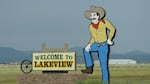
The Iconic sign welcoming visitors to Lakeview, Ore.
Flickr/ Fremont-Winema National Forest
A lot has changed in the past 10 years. Hermann is now a behavior specialist for the Lake County School District. A member of the Klamath Tribes, Hermann said he can’t imagine living in Portland now.
“It’s just not my vibe, not my energy,” he said. “I need the woods and the trees and I need the calming lake to read my book next to. I need nature, and it’s just a part of who I am and who my family is, and it’s what was passed down to me by my grandparents.”
Nimisha Jain works as an outreach lead with Pride in Numbers. She said it was refreshing to see the survey’s acknowledgement of varied and intersecting identities within the LGBTQ+ community. It’s part of what drew her to the research project. Jain said the survey aims to encompass more people of color.
“It was really meaningful for me, because I feel like I’ve been used to seeing one portion of my identity isolated, separated by itself, and not connected to the other parts of my identity,” she said.
Jain said Pride in Numbers is tailoring its outreach efforts depending on the community. While the group might rely on emails, social media and volunteers distributing flyers in urban areas, she said rural outreach is more focused on local community members who can act as “hubs” for potential survey takers.
Jain highlighted a Klamath Falls resident who hosted a birthday party and included taking the survey as one of the activities.
Hermann said spreading the message about Pride in Numbers is important.
“Where I live, if there’s any urban-based thing connected to it, it’s an automatic ‘Nope,’” he said. “We’re not even going to give it a chance.”
Pride in Numbers does have several partnering organizations to help give them a chance.
Among them is the Eastern Oregon Center for Independent Living. While the group focuses on harm reduction and independent living services, it also hosts an LGBTQ+ resource center and youth drop-in centers in Ontario and Pendleton.
The nonprofit People Like Us was founded in Wallowa County in 2023, growing out of queer advocacy being done at a local domestic violence organization. People Like Us organizes pride events in the county and offers support groups to youth and older adults as well as transgender and nonbinary community members.
According to Jain, the survey will remain open through May with the goal of releasing a report about the data over the winter.
She said she hopes the survey results will help continue the sense of statewide solidarity Pride in Numbers has started.
For Hermann, he wants to show that rural life and being queer are not incompatible.
“I think pieces of what I hope it does is build community awareness around rural queer life, that you can live a nice life in a rural frontier area,” he said. “You can be immersed within a community with other people across the state of Oregon.”