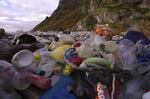
Nearly 9 million tons of plastic waste pollutes the ocean each year, according to a new report.
courtesy Bo Eide
The U.S. generates more plastic waste than the rest of the globe. A startling 8 million metric tons of that waste ends up in the ocean, according to a new report commissioned by Congress. That’s the equivalent of a dump truck full of plastic going into the ocean every minute of every day. Margaret Spring is the chief conservation and science officer at the Monterey Bay Aquarium and chaired the committee that wrote the new report. She joins us to explain the genesis and scope of the problem and share the recommendations for a national strategy to keep this waste out of the ocean.
The following transcript was created by a computer and edited by a volunteer.
Dave Miller: This is Think Out Loud on OPB. I’m Dave Miller. Almost nine million metric tons of plastic end up in the world’s oceans every year, and the US makes more of that trash than any other country. These are two of the headlines from a recent report to Congress. Margaret Spring is the Chief Conservation and Science Officer at the Monterey Bay Aquarium. She chaired the committee that wrote this plastics report, and she joins us now. Margaret Spring, welcome to TOL.
Margaret Spring: Thanks Dave. It’s great to be here.
Miller: It’s great to have you on. Can you help us understand what close to nine million metric tons actually means? It’s a big sounding number but it’s just an abstraction to me. What does it look like?
Spring: Well, that is really one of the challenges, is translating numbers into what it might feel like. What we reported was there’s an estimated eight million metric tons, which may be a little more than that. It’s the equivalent of dumping a garbage truck of plastic waste into the ocean every minute. And so that might give you an idea of what we’re talking about and that’s globally.
Miller: What are we talking about in terms of the plastic, for each of those dump truckloads?
What’s going in?
Spring: Let me take a step back and talk about the report for a second, because this was a report commissioned by Congress and sponsored by NOAA, and the National Academies of Science convened us. It’s 10 experts who put this report together, and they are experts in their field. So that was fantastic. But what we were tasked to do, was asked by Congress to figure out the US role in this problem. And so, a lot of these scientists have been trying to figure this out for years. And not only the global scale but also the US role. And most of the data that’s available to us about volume, is what we would call municipal solid waste. The trash that you’re talking about. There’s also lots of other sources, but a lot of what these measurements are or even looking at is our solid waste, things that sort of escape from a landfill or escape through a river. We don’t have a full, perfect accounting of what’s going into the ocean. But just these numbers are staggering. And so that’s what it’s looking like. It’s the trash that doesn’t make it into the garbage pail. It is something that falls on the ground. But it also could be something that’s dumped at sea. So there’s a lot of sources of it, it’s ubiquitous and it’s coming from inside the United States, and in the United States’ case, but also from the coast and in the ocean. So many many sources. But what we are able to count is what we’re able to measure. One of the signal recommendations from our report is that we need to measure more, because we don’t know exactly ALL the places it is coming from. But what we know of, meaning what we pick up on the coast when we’re doing beach cleanups versus what we’re picking up in the ocean, a lot of it looks a lot like trash, but it breaks down into tiny, tiny pieces.
Miller: What happens to it then, in those tiny, tiny pieces?
Spring: If it’s in the ocean, it weathers and it breaks down and breaks down and breaks down and into pieces. But also when it’s actually floating around, it becomes food for animals. They will starve, they’ll be entangled by some of this trash. It depends on how big it is when it goes into the water and where it lands. And that was one of the challenges we had in the report, was identifying exactly the transport pathways, but we do know it’s rivers, it’s streams, it’s direct discharge. It’s airborne particles. It’s also runoff from roads and others. So some of that comes into the ocean, into our streams and rivers directly as microplastics, maybe from our driving on the road, or from our textiles. But a lot of it is …
Miller: You mean like putting a fleece shirt in the wash and then tiny bits of that shirt go into the sewer system and from there on through the entire water system?
Spring: Right. And so there’s so many different ways that it can get in. But one of the reports showed that as far as we can tell, a lot of it is coming from trash. And our number one recommendation was to reduce the amount of trash we create. Because the United States not only creates the most plastic waste, but we are the number one generator of solid waste in the world. And so with plastics increasing as a proportion of that, it was only going to start increasing. So, definitely there’s a lot of work to be done on figuring out how to reduce the inputs from other sources. But one of our number one recommendations is that we need not only an integrated and comprehensive strategy across the nation, but also number one is reducing our amount of the amount of trash we create.
Miller: You mentioned that we’re not just talking about oceans, we’re talking about water that flows into oceans. It’s worth mentioning, there was a recent study which we covered at OPB, of 30 rivers and lakes across Oregon, and that study found a detectable amount of microplastics in every one of those bodies of water. I’m talking right now with Margaret Spring, Chief Conservation Science Officer at the Monterey Bay Aquarium. She chaired the committee that wrote a recent plastics report for Congress. One of the alarms in this new report that you’re sounding, isn’t just – if I understand this correctly – isn’t just about the current level of plastic waste that the US is contributing to the global stream, but the rate at which that waste is increasing. What we can talk about is the possibility of reducing the waste and what that would take. But it seems like it’s fair to say we’re actually going very much in the opposite direction right now, right?
Spring: Well certainly globally that’s the case. This is a global phenomenon as well as a US phenomenon. And the production of plastic generally is a global scale issue. So we were asked to look only at the US portion. But that’s because there’s a lot of Interest. The good news is [there is] a lot of interest in what’s going on and what we can do about it. So production itself is projected to increase, just of the plastics, 200% by 2035 and 350% by 2050. So it’s something that’s a global phenomenon. And the good news is that the United States is going to be joining in a global treaty discussion starting next month. This is very much on the front page and the front burner for many countries. And so, this is not something that we can do alone. Certainly the alarm has been sounded. Just before we were issuing our report the United Nations Environment Program issued their report to inform these treaty discussions. So while I would say that yes, that we are very alarmed and concerned about the increase and we have to do something now, we can’t wait to have perfect knowledge, we know enough to really take action. And what we did say in this report, which is super important, is [that] there’s a lot of cool stuff going on in the United States to try and address marine debris. A lot of it’s in the clean up space, but basically, we have to start from where plastic is produced, all the way to how it gets into the ocean. We have to intervene along six different paths simultaneously. And the good news is, that’s exactly the approach that’s being taken by some other countries like the EU and like Canada. And so we’re in good company to do something like this. And we recommended taking this on quickly, because we have to start getting at the front of the production scheme, versus waiting for it to get into the ocean. We have to start intervening earlier.
Miller: It seems like that’s necessarily going to mean getting the companies that are making these plastics to make less of them. Oil and gas companies have been really eager to find new markets for the plastics that they’ve been able to create, largely because of the fracking boom. They had all this, this natural gas and oil that they had access to and basically new ways to sell it. What are the conversations like to upend that business model?
Spring: Well, it’s interesting. We did identify that as a major barrier to, for example, recycling. Industry is very, very active in supporting recycling as a solution, but the fact is, is that virgin plastics are so much cheaper to use, because not only in the United States – the booms and busts come and go – but [are] also large subsidies to oil and gas, which is sort of undermining the financial model of the recycling business. Yes, that will have to be attended to. And we left the specifics of what [and] how you would reduce plastic. But there is a strong interest in creating a different kind of plastic. And the door’s open to figuring out how you could create a plastic and what the components would be. Bio-based plastic may or may not be non-biodegradable. So, the way you formulate plastic is one of the second sort of step, the second stage that we ask people to look at this strategy, which is how do you reformulate, so that plastic is useful as a product. But how is it made? What are its components? How can it be reused endlessly? Can that happen? Because it’s the leakage of the plastic into the environment and into people that is the major concern. And so plastic if it can be plastic forever and not be thrown out – so that’s the circular economy model – is one that a number of big companies are very interested in and are engaging in discussions on now. Those are many of the brands. But you’ve got a US plastic strategy group. So I think that this is the tip of the conversation that’s going to have to happen around creating this strategy, is how do we get there? How do we reduce? And what we can reduce now is what we’re making that’s going straight into the ocean. A lot of it is single use products, which is why you’re seeing the priority being in other countries and, and in the states and particularly Oregon and California too, you’re seeing bans on single use products because a lot of those are touched once and move right into the waste stream and maybe not even make it into your garbage can. So what we do recognize is that the government alone can’t deal with this. We have to work across sectors, but the government must take a leading role in bringing these groups together, because it’s not happening on its own.
Miller: In terms of climate change, fossil fuel companies did a really good job over decades, after they lied to us about what they knew about the reality of it. But then they made it seem like it was our job to solve this by reducing carbon emissions, to buying the right light bulb or making various consumer choices broadly, when we know the issue is much more systemic involving major federal policies and subsidies and global political questions. How similar does that feel to you in terms of the plastics conversation? I’m thinking about a question that Oregon grocery store consumers don’t get any more paper or plastic, but that’s still a question people get asked all over the country. What role in other words do individuals play in this?
Spring: Well, there are a couple of important roles that individuals play. But I take your point and we did recognize in the report that there’s been too much pressure and responsibility at the receiving end of the plastic supply chain and value chain, and there has to be more responsibility at the beginning. So, to your point, yes, that phenomenon has occurred and we document it. We think that the committee report identifies where there might be some ways of shifting that. And those are things like what the law Oregon implemented, was the extended producer responsibility rule, a law that came into effect last year which basically has the producer of the product paying for the recycling of that product. So those kinds of schemes are very active, because the flow of plastic waste has been a huge burden on communities and cities and individuals. Now, we have to reverse that burden in some way. And those are why we recommended economic incentives, or economic instruments to help right that, because the cost is being borne by the end of the pipe. Now the other thing is that individual action is important by signaling change, a requirement for change. So the things you choose … I’ve changed all of my purchasing decisions, not only based on climate change but also based on the plastic, and so is the aquarium. One of the other things that’s happened, the reason we even have this report is because a bipartisan law was enacted. One of the co-sponsors was your representative Bonamici. And so there’s bipartisan support because of pressure from people who were in the voting booth asking for change. Now the other thing that’s happening, is the choices you’re making in the marketplace are sending signals into the marketplace. And so you’re seeing a lot of energy around trying to find alternatives that will be more useful to people but also to the planet. And so we’re not there yet, but it’s all beginning, all this energy is beginning and people’s awareness. Anytime I tell people about this, they ask more questions and they want to know more and you can find products that are not disturbing to the environment, that are non-plastic or and I think that they’re just harder to find. And I take your point that it’s really hard. You can’t do it alone but as a group, collective action and collective input yes, I think that there is a power there and it’s being demonstrated. And now with this negotiation going on starting next month globally, certainly every country has felt that as well. So people have the power to make a difference too.
Miller: Margaret Spring, thanks very much for your time today. I appreciate it. Thank you. Margaret Spring is the Chief Conservation and Science Officer at the Monterey Bay Aquarium. She chaired the committee that wrote a recent report about plastic trash in the world’s oceans and the US role in that.
Contact “Think Out Loud®”
If you’d like to comment on any of the topics in this show, or suggest a topic of your own, please get in touch with us on Facebook or Twitter, send an email to thinkoutloud@opb.org, or you can leave a voicemail for us at 503-293-1983. The call-in phone number during the noon hour is 888-665-5865.