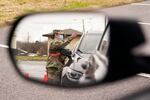
As infection rates begin to decline, Oregon's National Guard is leaving hospitals to return to civilian life.
Mark Humphrey / AP
As coronavirus infection rates from the omicron variant decline, Oregon’s National Guard has scaled back its troops in hospitals. While stationed, their duties ranged from administering tests and vaccines to folding towels and sheets so nurses and other healthcare workers could focus on more pressing needs. Joe Lontai is a lieutenant colonel for the Oregon National Guard. He shares with us what it was like in the hospital and being deployed during a pandemic.
Contact “Think Out Loud®”
If you’d like to comment on any of the topics in this show, or suggest a topic of your own, please get in touch with us on Facebook or Twitter, send an email to thinkoutloud@opb.org, or you can leave a voicemail for us at 503-293-1983. The call-in phone number during the noon hour is 888-665-5865.
Note: The following transcript was computer generated and edited by a volunteer.
Dave Miller: This is Think Out Loud on OPB. I’m Dave Miller. In January, when the omicron wave smashed into Oregon, 1,200 Oregon National Guard members were deployed to dozens of hospitals around the state. They were sent in to help understaffed and overworked hospital employees manage yet another surge of patients. Earlier this month, when the omicron wave passed and case numbers plummeted, the last of the guard members ended their hospital deployments. Joe Lontai is one of the members who was called in. He is lieutenant colonel in the Oregon National Guard.
He spent two months at Legacy Emanuel Hospital in Portland and he joins us now to talk about his time there. Lieutenant Colonel Lontai, welcome to TOL.
Joe Lontai: Thank you very much, Dave. Great to hear from you.
Miller: When you signed up for the Oregon National Guard, did you have an idea in your mind of the kinds of places you’d be sent to?
Lontai: No, I can’t say that any of us would have foreseen the hospital support mission. I don’t think that that was something that I really would have anticipated. But on the other hand, I knew that you have to be ready for those unknowns. So I think when I joined, Hurricane Katrina and that state support, reaching into those reserves was kind of a template for a major disaster where the National Guard was called out.
Miller: Where have your previous deployments been over the years, both when you’re active duty and as a member of the National Guard?
Lontai: So 23 years in the military, and I’ve had deployments in Iraq, Bosnia and Kuwait. Within our state, I’ve been to four separate wildland fires, working with the Oregon Department of Forestry. This was my first hospital support mission. And my current role in the National Guard is the director of our state partnership program, and we work with the Vietnamese and the Bangladesh militaries.
Miller: So as I noted, two months at Legacy Emanuel Hospital. What was an average day like for you there?
Lontai: They of course varied, depending on what was going on at the hospital. And there were 62 Oregon National Guard members assigned to Emanuel Hospital right there in Portland, and primarily we were care coordinators. That means we would go to these different units and different floors of the hospital, and we would do everything we can to support the health care providers, within the limits of not being certified healthcare providers. So a typical day might mean you have to manage the supplies, and take the burden off of a nurse or certified nurse assistant. You’re communicating with the patients. You’re sometimes handling some of the mountains of paperwork that are involved in healthcare. We took a lot of phone calls from the family visitors walking them through the process of visiting their family members who are patients in the hospital. We might escort the discharge patients out of the hospital. We provided Covid testing. And so there were many different tasks we were doing.
In particular, one that I bring up to anybody who asked that question, is we worked with the respiratory therapy. This involved ventilator equipment that is a very high profile news event of how many ventilators were in the hospitals early on in the pandemic. The Oregon National Guard people, my assumption, when you first heard the word ‘ventilators’, you might just turn it on and it works. But you really do have to transport them in a proper way. You have to sterilize the ventilator, calibrate them and prepare them for the next patient. So that was something that we managed, or we took that burden off of some of the other healthcare providers. So then they were able to do their jobs.
Miller: I was struck in the list you just gave of how much of that actually really did involve direct time with patients. Not that you were doing frontline care, but communicating with patients, or helping them with paperwork, or talking with families, or answering the phone. What was it like to have that much contact with patients?
Lontai: That would have been one of the major adjustments we had to make to this role within the hospital. [It] can kind of give you whiplash, because National Guard members, they might have been college students one week, they might have been teachers, they might have been mechanics, they might work for the National Guard on a full time basis.
And you can imagine the whiplash to be brought into patient care, when you haven’t had the chance to adjust to that. But really, the National Guard is trained in finding solutions and finding ways to work within the scope of our abilities. And so I think people adjusted to it quickly. Thankfully, the nursing staff of Emanuel Hospital was really willing to invest time in us, to make sure that we were asking the right questions or just
doing the right tasks.
Miller: Did this deployment change the way you think about health care workers, whether nurses or other folks working at the hospital, people who are doing this work day in day out?
Lontai: I think it did change how I would perceive that. I think in the military we perhaps perceive our sense of service to our state and to our nation. It’s kind of like we wear it on our sleeves with our uniform, but health care workers are cut from that same cloth of service. That means they are seeking to resolve any issues for the patients. But ultimately, all of that work, all those long hours that health care providers are putting in, is to the benefit of someone else. And oftentimes that’s a patient who will not even remember who that was helping. And so I really think that is the spirit of service. And my hat comes off to all the healthcare workers who are in there throughout this pandemic. They obviously don’t get the recognition they need. They don’t have the same medal ceremonies that we do in the military. And so I just would say, I am now an advocate for any resources we can provide to the health care community.
Miller: What was your uniform during this deployment?
Lontai: In some roles, we were wearing our camouflage uniform, but for the most part, when we were patient facing then we would just wear the regular hospital scrubs and there was some discussion on that, on what would be appropriate. But mostly since we’re there working with the health care providers, we were wearing the scrubs with them.
Miller: We’re obviously talking about this recent hospital deployment, but Guard members were also brought in, in recent years, to fight wildfires, which you’ve done over the years as well. And at the beginning of the pandemic, some were sent to answer calls for the Oregon Employment Department when they were slammed. It was really a mess there. They could not handle all the people seeking unemployment benefits. Looking back, what are the last two years for the Oregon National Guard been like?
Lontai: Well, I think overall, speaking generally, I think that everyone has kind of had an upheaval in their lives, and I think the Guard members are absolutely not immune to that. On the other hand, we were called to a number of different roles within the state. And I think that has its own reward, that we were able to help in those ways: the unemployment, and of course the wildland fires, and the hospitals. But really we don’t get to choose those missions. We work at the behest of our civilian leadership and the governor of our state as our commander in chief. So those are the sort of decisions that are made for us. And I think that we just manage our own responses to it.
Miller: Joe Lontai, thanks very much for joining us.
Lontai: Thank you very much for having me. I appreciate it.
Miller: Joel Lontai is a lieutenant colonel in the Oregon National Guard.