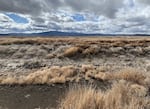
Lower Klamath National Wildlife Refuge in October, after a year of exceptional drought.
Erik Neumann / JPR News
The federal Bureau of Reclamation recently announced that water for irrigators, which comes from Upper Klamath Lake, would no longer be available for the rest of this irrigation season. This has left some water agencies, including the Klamath Irrigation District, scrambling. We hear more from Erik Neumann, the interim news director at Jefferson Public Radio, and Gene Souza, the executive director and district manager of the Klamath Irrigation District, about how limited water supplies in the Klamath Basin continue to affect the region.
Note: The following transcript was created by a computer and edited by a volunteer.
Dave Miller: From the Gert Boyle studio at OPB, this is Think Out Loud, I’m Dave Miller. We turn now to the latest drama in the Klamath Basin. The US Bureau of Reclamation, which manages the vast system of canals that supply water to farmers and ranchers, recently told those irrigators that they can’t get any more water this year. The Klamath Irrigation District refused to shut off the canal until the feds ratcheted up the pressure and said that they would withhold about $20 million in emergency drought relief to all the irrigators served by the district. We’ll talk to the executive director of the Klamath Irrigation District in just a few minutes, but first I’m joined by Eric Neumann, he is the interim news director at Jefferson Public Radio. Eric, welcome back.
Eric Neumann: Thanks.
Miller: Can you remind us just how we got here to this current situation? What has this irrigation year been like?
Neumann: Sure. It’s been another year of extreme drought in the Klamath Basin, which is this heavily agricultural area that’s along the Oregon/California border. Just to step back a little bit so people understand, there’s a very large lake there called Upper Klamath Lake that supplies water to thousands of acres of farmland throughout that basin. This is the third year of really exceptional drought in the area, and the water is just in demand by lots of different users. And that’s just created tension every single year about who’s going to get to use it.
Miller: The Bureau did allocate more water to irrigators this summer than they had originally said they would, right?
Neumann: Right. Initially, I don’t know if there was no water going to be allocated initially, but the spring turned out to be more wet than expected. There was initially I think 50,000 acre-feet that we’re going to be given to farmers and that got bumped up to like 80,000 acre-feet. So things got somewhat better, and I think changed expectations among a lot of the people that need water in that area. But still, out of the overall amount of water they would like, that’s only about 20% of what the ag community would really prefer to have in a good year.
Miller: And then came the announcement about a week and a half ago. Why did the Bureau of Reclamation say that no more water could be diverted from the Upper Klamath Lake?
Neumann: They basically said that they had met the limit for how much water could be let out of this lake. Many people probably know, but water is maintained in Upper Klamath Lake to protect a variety of endangered species that live there that are also culturally important to the Klamath tribes, they’re one of the other big users of water people that need water in this area. So Reclamation basically said “you’ve had all the water we can give you.” They have these lake elevations that they create to protect the endangered species, and those lake levels can kind of change based on how much water’s coming into the lake from rainfall or snowmelt. And they changed the numbers that they said should stay in the lake in the spring. And so again, there was sort of some expectations I think that were created earlier in the year, and then those expectations were changed, and that’s what’s led to a lot of this frustration about people just not getting what they think they should have for their businesses.
Miller: What have you heard from native tribes in the region?
Neumann: The tribes say that the water levels still don’t meet their tribal treaty agreements. There are these requirements that are set out under the Endangered Species Act to protect these couple of fish species that are important to the Klamath tribes. And they say that these lake levels are really a minimum under the Endangered Species Act in order to basically keep these species from going extinct. They also just see this as another violation of their treaty rights to have these rules broken and water diversions continuing, even in light of the rules that the federal government say need to be upheld, having those be ignored.
Miller: And then there are the wildlife refuges. How do they play into what’s happening right now?
Neumann: So this year, as in many years, the wildlife refuges kind of get the short end of the stick. This has not affected the status of the wildlife refuges in any way. Lower Klamath National Wildlife Refuge in Tule Lake National Wildlife Refuge, which are the biggest refuges among this complex of migratory bird refuges in the area, are still 100% dry. They really have fewer people to advocate for them, essentially.
Miller: Eric, thanks very much.
Neumann: Thank you.
Miller: Gene Souza is the executive director and district Manager of the Klamath Irrigation District, and he joins us now, welcome to Think Out Loud.
Gene Souza: Well, thank you sir, and thank you for the invite.
Miller: Thanks for joining us. How did your irrigation district decide one week ago to disregard the order from the Bureau of Reclamation to shut off water to the Klamath project?
Souza: Well, I think there’s a lot to unpack here, and I need to kind of clarify some of the statements that Eric made.
First off, we don’t believe that an allocation is within our contractual or legal documents. And the water in Upper Klamath Lake went through an adjudication through Oregon State, and in that adjudication, that water was divvied up as private property, some of that belonging to Klamath tribes, some of them belonging to irrigators, some of it belongs to wildlife. And in that document, which is called the ACFFOD, the Amended and Corrected Findings of Fact and Order of Determination, that is currently on file and enforceable with the Oregon Water Resource Department, says that the property owners have a right to the water down to 4136 in the lake. That’s an elevation, we don’t need to get into the technical details.
And then we’ll just fast forward to this past spring. The interim operations plan that Reclamation is currently operating under, has been operating under for the past two or three years is a colossal failure. It is allocating more water and releasing more water to the ocean than one would have naturally been available to this area. There’s been a lot of changes to this area, and where Reclamation has released this water into the Klamath Canyon below Keno is the primary factor causing the problems with the lake levels. We weren’t able to reach minimum lake levels for sucker spawning this year, but suckers did spawn. We needed at least one ft of elevation above those spawning beds for the biological opinion that the suckers could spawn. The water was one ft or lower above those spawning beds, and we still have evidence the suckers were spawning.
We entered into discussions with Reclamation in March and April, discussing “we see we’re not going to make these levels that the opine of the federal government. And so what can we do? What are the actual needs of the fish? What can we actually do to make sure that the folks that have a property right to have their property as delivered can actually meet that?” And so what we did is we looked at what was in the biological opinion, which said here is a minimum lake level that needs to be here, a mid-July elevation where it will not have an adverse or jeopardy opinion on the lake. And we got those numbers and we said “okay, we would like to manage to that.” And the Reclamation came back to us and said, “well, that’s good. But we want to put a buffer on this buffer to a buffer.” They gave me a little bit of extra room on top of that minimum lake level, which was also a little bit of room already on top of that minimum lake level, which is already a little bit more than what was needed according to biological opinion.
So there’s tens of thousands of acre-feet of water remaining above what was required for the biological opinion. And we agreed in April that we, the district managers here in Klamath Basin, would manage down to that level, leaving several buffers for the biological opinion, allowing the c’waam and koptu to freely traverse areas in Upper Klamath Lake, across the reef, which is required to have one meter of water above it. And so we did that. We maintained the lake elevation through 15 July much higher than what the federal government said that it needed to be for biological opinion because we want to make sure there’s much habitat for any of those fries from the c’waam and koptu that were available were able to get out into that habitat. We kept the lake much higher.
We did have a good spring, as Eric mentioned. We did have a good opportunity for the lake to actually maintain itself. And through conservation, through discipline, and through making farmers and ranchers wait up to 45 days for us to give them water, we are able to maintain that lake level. And in our discussions back in April/May, we discussed if there’s additional water in the lake, we can continue to have these negotiations. And Reclamation said “no, we’re not going to have these reclamations. You’re no longer operating to a lake level. We’re going to change the goalposts. We’re gonna move it left and right. I know you’ve already got a plan in action, but as you move through the year, you won’t know what the ending date is until we tell you.”
To simplify it, if you were a homeowner and you had a renter, and the renter was taking all the actions required in the contract, was paying on time, was doing everything that was expected of them, and the homeowner came in and locked the renter out and then turned around the next day and sold all the the renter’s goods and materials, even their food out of the refrigerator, out of the house - the federal government has said, “we’re going to do that to you, and you don’t have any recourse because you can’t take us to court.”
Miller: We’re not able to obviously adjudicate all these issues in this conversation, so I want to move forward to looking to what happens next. What options do irrigators in your district have right now? And what is the closing of this canal going to mean for them?
Souza: So the closing of the canal means that for farmers that have a crop in the ground right now, they are not going to be able to get a majority of that crop to market. I looked at the potato fields, and most of the potatoes are under the size of a double A battery. That’s not going to meet their contractual requirements to giving a particular size or a specific weight under their contract to market. If they have onions in the ground, those onions are probably going to die and wilt. They’re gonna try to put garlic in the ground, it’s not going to get there. So this next spring when we’re expecting garlic to be coming up, it won’t be there for those particular landowners.
Miller: I did see a few possibilities mentioned, including just pumping even more groundwater for some farmers, or borrowing some amount of water from PacificCorp. Are either of those viable for a large number of farmers?
Souza: No, sir. The Oregon Water Resource Department only issued one emergency drought permit this year. And the way Oregon water rights go is you can only put water on land where the state of Oregon has given you a permit to put that water. So even though you might have a very good well, you can only put water on the ground that it was permitted for that well, you can’t spread out to your neighbors or send it to other places without going through the emergency permitting process. And Oregon Water Resource Department has said no, they’re not going to do that.
Miller: This is a question that we could literally spend hours answering, so it’s slightly unfair of me to say if you can answer this briefly. We’re in the third year of a drought right now. What do you see as a viable political long term solution?
Souza: So the first problem is the interim operations plan that Reclamation has adopted. They were given direction to propose an action under the ESA, title 16 chapter 35 of the Federal US Code, which is called the Endangered Species Act. And they were given direction to write a non jeopardy opinion. In their political negotiations, they came to a non jeopardy opinion which has nothing to do with biology. And so if we could return to laws and contracts in the basis of the foundation of what provides us to domestic tranquility and were able to resolve disputes, then we can work on solutions, on understanding how to get to a different position than we are today.
However, if we continue to go down the road where Reclamation has this interim operations plan of releasing 80%, 100%, 125% that would have naturally been available in a normal year during drought conditions when we’re only seeing inflows at 5%, 25% - if you’ve got a banking account, if you’ve got 25% coming in and you’re spending 80%, you’re going to have a deficit. So there needs to be a different look, and go back to the science and say what is the actual need.
The research that I’ve done is that the water that’s being released to the ocean right now is not creating any beneficial habitat for the coho, which is the excuse for being able to use it. The coho are in the tributaries and not the main stem. So people need to be frank and honest about why they’re releasing that water down river. It has nothing to do with the threatened or endangered species.
Contact “Think Out Loud®”
If you’d like to comment on any of the topics in this show, or suggest a topic of your own, please get in touch with us on Facebook or Twitter, send an email to thinkoutloud@opb.org, or you can leave a voicemail for us at 503-293-1983. The call-in phone number during the noon hour is 888-665-5865.