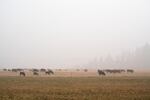
FILE - Cows graze in a field covered in dense smoke from the nearby Riverside Fire on Sept. 14, 2020 in Logan, Ore.
Jonathan Levinson / OPB
In 2020, smoke from wildfires led Jenifer Cruickshank, an assistant professor and dairy extension specialist at Oregon State University, to explore how the issue affects livestock. Cruickshank along with several other academics in Oregon and Idaho have banded together to create an online resource hub where researchers are investigating the effects of wildfire on cattle. We learn more about the effort from Cruickshank.
Note: This transcript was computer generated and edited by a volunteer.
Dave Miller: This is Think Out Loud on OPB. I’m Dave Miller. It’s raining in much of western Oregon right now, a welcome respite from heat and smoke. But as we all know, the fires and heat waves are only expected to get worse in the coming years. There are big questions about what that’s going to mean for livestock. After the devastating fires of 2020, Jenifer Cruickshank, an assistant professor and dairy extension specialist at Oregon State University, banded together with other academics in Oregon and Idaho. They created an online resource hub to gather and share information about the effects of wildfire on cattle. Jenifer Cruickshank joins us now to talk about it. Welcome to the show.
Jenifer Cruickshank: Oh, good day.
Miller: What went through your mind in September of 2020 when wildfire smoke from a huge east wind blanketed most of Western Oregon?
Cruickshank: Well, I think, like everyone else living here at the time, it was startling and disturbing, and I had dairy farmers contacting me with questions about, how is this affecting the cows? And I had to say, I didn’t know. So I went looking in the research literature and found that nobody knew, so this wasn’t an area that had been investigated and my saying, “I don’t know” was like, we generally don’t know, so that certainly triggered some interest in pursuing investigation into the effects of wildfire smoke on livestock health and productivity.
Miller: It’s actually a surprise to me, I mean, that was unprecedented in Oregon for some specific reasons, but it’s not like wildfires haven’t been a serious issue in huge swaths of the West for decades. Why do you think there has been such a gap in academic knowledge about this?
Cruickshank: I really don’t know, I was startled. Especially in California and they’ve got a large dairy industry there, and there was a little bit of research out of Australia because of course, they’ve had some really serious issues with wildfire there, but really there was nothing. And when you went look for, search terms of “smoke” and “animals,” you came up with a lot of studies about giving mice lit cigarettes, and that was kind of the extent of it. And then what we know out of the literature on human health and wildfire smoke, but there was really just this gaping hole and I think certainly something to move into and get some answers.
Miller: So, and it’s only been three years, which is not a huge amount of time - often the wheels of academia can turn slowly. But what have you been doing to try to fill in those gaps?
Cruickshank: As you mentioned, I work with colleagues at Oregon State University and also the University of Idaho. And we’ve secured some funding, which of course is a really important step in getting some grants to support any sort of research work. Our Idaho colleagues had done an earlier study where they were looking at the effects on dairy cow production with natural wildfire smoke exposure. And they identified a reduction in milk production of three to nine pounds, which just for reference, one gallon weighs 8.6 pounds. So, depending on circumstances, that could be a pretty substantial drop in production, but I’ve also had producers anecdotally tell me that they hadn’t really, with pretty severe smoke exposure, smoke events, they hadn’t seen much drop in production.
So I think we’ve got a lot to learn about which cows specifically are affected. Are there certain ages, are there certain stages in lactation that are more sensitive? We’ve got a lot to learn about, are calves more sensitive to smoke exposure than older animals? So there’s a lot we still don’t know.
Miller: Is the thinking that dairy cattle are more susceptible in general than beef cattle to exposure to smoke? Or is that one more question that’s still in the unanswered pile?
Cruickshank: That’s certainly one more question in the unanswered pile and, given kind of how our cattle industries are structured in the state geographically, where we’ve got a lot of beef cattle in Central and Eastern Oregon, they’re probably getting more smoke exposure on average then the bulk of our dairy cattle, who are concentrated a little bit more on the western side of the state. Although we’ve got some dairies down in the Grants Pass area and those cows get a lot of smoke. Again, it’s an excellent question and we really don’t know at this point.
What I can say is that cattle, given the anatomy of their lungs, have the potential to be more susceptible than some other species with particulate matter getting deep into the lungs and not being able to be cleared very well. So there is some evidence, just based on their anatomy, to suggest that cattle have the potential to suffer greater effects than maybe some other livestock species.
Miller: You mentioned some early data about drops in milk production. That seems like a very chartable piece of data. I mean, you have X many gallons but obviously we’re talking about, in some cases, much more complex systems and bits of data than just how many gallons of milk a particular cow is producing. How else do you study the effects of wildfire smoke on dairy cattle?
Cruickshank: Yeah. So in all of the studies that we’ve got going on now and that we have mapped out for the next several years, a common factor in all of those will be doing blood draws on all of these cows and from the blood looking at the profile of white blood cells and red blood cells, along with looking at markers of metabolism and then also stress and immune function markers in the blood. So that’s a really common technique that we’re applying across the board in all of our studies. In some of the studies, we’ll be taking additional tissue samples from animals and looking at cell populations in the respiratory tract and also looking at some changes in gene expression. So really kind of drilling down and getting a better understanding of what the smoke is doing at the physiological level.
Miller: I mean, obviously, there are still a lot of things you’re hoping to learn, but meanwhile, there have been very smoky days in Oregon this summer as well. What advice do you already have for dairy producers on days with a high AQI?
Cruickshank: At this point, we can kind of just offer really basic advice which includes reducing activity that the cows or other livestock are engaged in. So kind of minimizing exercise, which is really parallel to the advice offered to humans, right? Because keeping your activity level down, you breathe less, which means that you’re pulling in fewer particulates. Also, if you’ve got on your calendar doing something like weaning, which is removing milk from the diet of young mammals, that’s a stressful event for them. It’s a perfectly normal dietary transition, but it is stressful. So if there is a high AQI, maybe postpone that weaning date off until the air quality clears up. Similar stressful events like vaccinations or changing social groups, which is also a disruptor and stressful, maybe postponing that.
We want to keep fresh clean water available, which is always, always important, but it’s just extra important in times of wildfire, particularly because that often comes with high temperatures and we want the respiratory tracts to stay really well hydrated because they’ll get less irritated that way. And along with the heat, always providing shade, maybe fans and misters to mitigate that heat stress. And really this kind of comes down to, we want to minimize…so we do understand enough about the effects of wildfire smoke that it is a stressor on the animal system, so we want to minimize the other stressors that we may have a little bit more control over.
Miller: You grew up on a small dairy farm in Western Oregon, in the Willamette Valley. How much did you and your family think about these issues that we’ve been talking about so far when you were growing up?
Cruickshank: Never. Absolutely never. And I’m old enough to have grown up when field burning was still a really common practice in the Willamette Valley. So we actually did have some smoky days, right? That could happen really locally if they were burning a grass seed field somewhere near you. But no, never gave it a thought.
Miller: We’ve been talking about smoke so far, but high heat is another very serious and sort of related concern. Is there a preferred temperature range for cattle?
Cruickshank: Oh, for sure. So, dairy cattle who are milking, they start to feel heat stress over about 70 degrees. They’re generating a lot of heat, both because of their digestive system, they’re ruminants. So their microbial population in the stomach is generating a lot of heat. Plus just the whole process of producing large volumes of milk is also heat generating. When the temperature rises, they really struggle to expel that heat out of the body. Dairy farmers will provide fans and, and misters when it gets hot to try and mitigate some of that heat stress. Where we are fortunate in our climate in the Pacific Northwest is that it typically cools off at night. And so then that allows the cows to really kind of release the heat that they’ve built up over the day.
Miller: Typically, but that is changing, right? I mean, what happened to livestock during the heat dome two summers ago when temperatures were almost 50 degrees higher than the upper comfort zone of dairy cattle?
Cruickshank: They were suffering a lot and milk production, it just dropped like a rock. So this is something where producers will tell you that when it gets hot, there is a visible drop in the milk tank. So when it’s hot, cows will eat less, and when they eat less, they’re gonna produce less milk.
Miller: How much can dairy farmers do? I mean, fans and misters - I guess I’m just wondering at what point are those simply not enough?
Cruickshank: Well, certainly in our heat dome event, that it mitigates a little, but certainly not to the extent that you need it. And really it’s a challenge. It’s absolutely a challenge. And there are some different barn structures that they’ve been utilizing a little bit more in the midwest on dairy farms that operate a little bit more like a lot of modern poultry buildings where they’re enclosed, and they’ve got large fans pulling air in on one side and then large exhaust fans on the opposite side. So you get this cross ventilation system. And so in the Midwest where they don’t have quite the cooling at night, those barns can be really beneficial to the environment for the cows. But in our climate, we mostly have open-sided barns. So we’re relying a lot on natural ventilation and then the addition of fans or sometimes misters.
Miller: Speaking of the Midwest, I saw an article recently about a version of outdoor grazing that provides shade known as silvopasture, that some people are thinking more about. Can you describe how that works? And if that’s something that you think you’re going to see more of in Oregon?
Cruickshank: Yeah. So that is one of the challenges of a grazing system on a dairy, which certainly has some benefits for the cows. But typically pastures are pretty shadeless places so that can be challenging because the cows, if the whole point of them being out there is to be eating pasture, but it’s hot, they tend not to actually eat very much, particularly when in the sun and you’ll see in hot weather, where cows have the option of being in the barn and in eating feed that’s provided for them in the barn, versus grazing outside in the middle of the day in the summer, they’ll oftentimes opt for the barn because of the cooler temperature and the shade. So yeah, silvopasture is an option and given our changing climate, an increasingly attractive one, of planting tree lines at the major divisions between pastures so that we’ve got trees, which of course you like grow faster, to provide some shade for cows that are pastured during the day.
Miller: What’s the biggest question that you hope to have an answer for in the coming years?
Cruickshank: With the greater understanding in the physiological effects of wildfire smoke - and additionally heat stress because we’ve got more to learn there too as well - is mitigation activities. Is there something else that we can provide for the cows that can mitigate the effect of the stress of wildfire smoke? So a couple of the things that we’re gonna be investigating in the next couple of years are trying out a filtering system, which again, [is] a big challenge with our large, open sided barns. But just, hey, if it works, that’s something that we’ve learned that may be useful. And maybe giving something to the animals like electrolytes or possibly anti-inflammatory drugs to see if that can mitigate the effects of the wildfire smoke on their systems.
Miller: Jenifer Cruickshank, thanks very much.
Cruickshank: Oh, my pleasure.
Miller: Jenifer Cruickshank is an assistant professor and dairy extension specialist at Oregon State University.
Contact “Think Out Loud®”
If you’d like to comment on any of the topics in this show or suggest a topic of your own, please get in touch with us on Facebook, send an email to thinkoutloud@opb.org, or you can leave a voicemail for us at 503-293-1983. The call-in phone number during the noon hour is 888-665-5865.