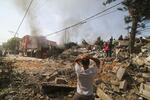
Palestinians look for survivors of the Israeli bombardment of the Gaza Strip in Rafah on Monday, Oct. 23, 2023.
Hatem Ali / AP
It’s been about two weeks since war broke out in Israel and Gaza. Though thousands of miles away, the war and subsequent humanitarian crisis in the Middle East has taken an emotional, mental and personal toll on many Oregonians. An event in Wilsonville this weekend brought together medical and mental health professionals to help community members develop coping mechanisms for the stress and find support through fellow community members.
Farah Ramchandani organized the event, and Selma Quan Anderson is a registered nurse who helped facilitate it. They join us to talk about the importance of creating space for community members to process their feelings.
Note: The following transcript was created by a computer and edited by a volunteer.
Dave Miller: From the Gert Boyle Studio at OPB, this is Think Out Loud. I’m Dave Miller. It’s been about two weeks since war broke out in Israel and Gaza. Though thousands of miles away, the war and subsequent humanitarian crisis have taken an emotional toll on many Oregonians. An event in Wilsonville this past weekend brought together medical and mental health professionals to help people develop coping mechanisms and find support through community. Farah Ramchandani organized the event, Selma Quan Anderson is a registered nurse who helped facilitate it. They join us now to talk about it. Welcome to you both.
Farah Ramchandani / Selma Quan Anderson: Thank you.
Miller: Farah first, how have you been emotionally impacted by the attack by Hamas and then the war that’s followed?
Ramchandani: Well, I’ve been watching television and witnessing it. This horror, horror of the bomb going up and smoke on the air, mothers crying, children weeping. You see dead bodies, etc. I’ve been very much impacted. It is unimaginable to witness the pain and struggle of the mothers and the children and families in the war. It reminds me of the time ‒ and so many of the people have been taken, and they probably are alive somewhere ‒ but to witness all of this, it reminds me of my own personal situation that many, many years ago my brother was one of the hostages in Iran.
Miller: In 1979.
Ramchandani: Yes. Exactly. And for six months we were trying and struggling to get him out of the prison in Iran. And it was real, real difficult ‒ really, really difficult ‒ because you work with different stages. You know, at first you try to reach out by local peoples, and the government agencies, etc. And it was during the time of election between Reagan and Carter, and everybody was out doing fundraising, etc. And it was just helplessness of reaching out to people. And at this time, it reminds me… those pain that you suffer in the past, it brings all those back and I felt the pain of the people. And so I felt that it is time for us individually to do something about what is going on in the world. We, each one of us, are responsible for what is happening. And I felt… I seem to feel so helpless. I was really quite helpless, and seeing the children crying and the mothers, and seeing blood. It’s just imaginable and it brought, it seemed like it was just next door to me. But yet, I could not reach out to help those people.
Miller: Selma, what about you? Why did you want to take part in this event?
Quan Anderson: So, Farah had called me in the midst of this emotional upheaval that she was feeling, and I was just feeling the same way. I work as a nurse and recently I was involved directly with things that affect our society but like gun violence, the fentanyl addiction, I see a lot of that as a nurse. And then now, finally the warfare, and one day I’m… You know, I pride myself as a professional that I can normally detach from these emotions and do what I need to do to care for people...
Miller: Because it seems like a requirement for your job?
Quan Anderson: Yeah. And when Farah called me that day, I had just let down and all these emotions came out of me, and I was struck by them. And Farah called me and she said, she started to tell me and I said, ‘I know, I know, I’m feeling the same way. What can we do?’ And we both came to the conclusion of what can we do because we can’t possibly be the only ones that are feeling this. And so then we thought what about the collective trauma? What about other people feeling the same way? What are they doing with their feelings? So that’s what we decided to focus on, helping others to deal with this sense of powerlessness that we all have.
Miller: Farah, correct me if I’m wrong, but the sense I’ve gotten is that the goal of the event wasn’t about talking about the political intricacies of what’s going on, or the complicated history, but about steering the conversation in a different direction. So what was the different direction?
Ramchandani: How to deal with our inner feelings and how to be able to focus on something positive that we could do for others. And because, it isn’t just the children and mothers, etc., but the environment. How is the environment being affected by all of these things, the animals, the farms? All these bombs that are going up, they affect not just only people in Israel or in that region, it is going to affect all of us. How are we going to prevent such atrocity becoming a normal way of life? It isn’t. It cannot be. So I see the rise in all the community arising against such atrocities.
Miller: Selma, what were your hopes for the event?
Quan Anderson: My hope was to really leave with something positive so that we wouldn’t be paralyzed by this anxiety that we were all feeling. And Dr. Darrel Eacret came to share with us and he talked about how that together, collectively, we can have synergy and talk about these things and come up with maybe an answer. Maybe an answer of what we can do.
Miller: What did you hear from participants who showed up?
Quan Anderson: Yeah, so we heard the same thing. People said they watch the news just enough to be informed, but they don’t want to delve anymore because it’s so emotionally affecting them. And they want to know about coping mechanisms. They wanted to know what they can do in their own world.
Miller: And so what kind of coping mechanisms did come up?
Quan Anderson: We talked about how sharing as a group helps. That none of us really have the answer, but in the synergy that we create, that we come up with the positive things. And we had another presenter, Dr. Janice Cockrell, show up and she talked about the history of war and how actually the history of war has really improved over the years. So we kind of reviewed history and we talked about that… I don’t know…
Miller: But that gave you help, the sense that, despite what it appears to be, what you heard is that things actually are getting better.
Quan Anderson: For instance, all the humanitarian organizations, the number of the humanitarian organizations are at an unprecedented high. The number of children and women groups involved, those are at a high. So those are things that we looked at.
Miller: I’m curious, Farah, what it meant to simply be able to gather together. I mean, to be among other people, even if you were all feeling anxiety and grief. What did it mean to simply be together?
Ramchandani: Well, it just shows that whether, what our beliefs are or what nations we are born, etc., that mankind as a whole has this feeling of connection. We’re all bonded by the power of love. We are bonded by the... My feelings are no different. This gathering was basically seeing people who were Christian, who were Muslims, who were Baha’is, who were Atheist, etc. We all felt this connection of bond of love. It connects us. That unity through diversity. As the Baha’i writing states, unity through diversity is essential and that we must accept people of other cultures and of other… but it doesn’t matter who they are. We feel their pain as they feel our pain, I’m sure.
Miller: And Selma, what did it mean to you to be able to gather together after the social isolation, for so many of us, of the pandemic?
Ramchandani: Good question.
Quan Anderson: That’s a very good question. You know, there’s a big pause here, right? And I don’t even know where to begin on that. But it’s that feeling of unity. It brings us back to that coming together, that we all have the power of overcoming the thoughts of war with an ever more powerful thought of peace and unity. And I think that unity is about synergy, right? And you can’t do that alone. So I think coming out of the isolation of COVID, it meant a lot to me.
Ramchandani: And it doesn’t matter what or where we come from. But I think one of these things is make us aware, from this gathering,what makes us more and more concerned about the world at large, not where we come from or how we grew up. But this has made us ‒ the war has really made us ‒ aware of others and the conditions of others. It has educated us. It has made us concerned. You know, look at this country. People come from all over the world and what do they do? They bring their tradition, they bring their food, they bring their culture, they bring their beliefs, etc. There’s that freedom. But during the time of the COVID, you asked that question about the COVID. It isolated us. It isolated, but it was really hard, and it’s because we’re not like little cats that go in the corner and meow, but as a human, we must have contact with each other.
Miller: Farah Ramchandani and Selma Quan Anderson, thanks very much.
Ramchandani / Quan Anderson: Thank you. Thank you very much.
Miller: Selma Quan Anderson is a registered nurse. Farah Ramchandani was one of the organizers of an event over the weekend to help people who are dealing with the emotional toll from the war in Israel and Gaza, and a lot of other things going on in society right now.
Contact “Think Out Loud®”
If you’d like to comment on any of the topics in this show or suggest a topic of your own, please get in touch with us on Facebook, send an email to thinkoutloud@opb.org, or you can leave a voicemail for us at 503-293-1983. The call-in phone number during the noon hour is 888-665-5865.