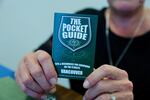
The guidebook is small enough to fit in the palm of your hand and is printed on waterproof and tear-proof material. It's filled with survival tips, resource lists, and phone numbers to homeless service providers.
Molly Solomon / OPB
In 2017, Vancouver resident Lois Smith got the idea to put out a succinct print guide to resources and services for people experiencing homelessness. She’d been volunteering with Friends of the Carpenter, a faith-based nonprofit that runs a day center for people experiencing homelessness. She says the stories from the unhoused people she talked to stayed with her, and realized she could put something tangible into their hands to help direct them to services, shelter and other resources. She knew it had to be informed by the people she wanted to help and she wanted it to be light and withstand rain, snow and heat.
Smith now puts out the guides yearly as an independent project that is funded entirely by donations. They’re printed yearly in different colors, making it easier to tell which one is current. She says she works with local officials, law enforcement, social service agencies, churches and many others to make sure the content is useful — and gets into the hands of people who need it. Portland’s Street Roots puts out a similar paper guide, though not a waterproof one. Smith joins us to tell us more about how the guides are used in Vancouver and Clark County and how she sees the idea spreading.
Note: The following transcript was created by a computer and edited by a volunteer.
Dave Miller: From the Gert Boyle Studio at OPB, this is Think Out Loud. I’m Dave Miller. In 2017, Lois Smith was volunteering at a day center for people experiencing homelessness in Vancouver and she came up with an idea, a small, foldable-proof, waterproof guide full of information and resources that would be useful for people who were living in shelters or on the street. That pocket guide is now in its ninth edition. It’s distributed by dozens of agencies and nonprofits and individuals in Clark County. Lois Smith joins us now to talk about how she puts these guides together and how they are used. It’s great to have you on the show.
Lois Smith: Thank you.
Miller: Where did this idea come from to begin with?
Smith: Yeah, Dave. So the idea actually came from years of volunteering in the community and talking with people who were experiencing homelessness, hearing their stories of how they were surviving, things that they would do to stay safe. And it dawned on me one day, I thought, well, what if I were homeless, what would I do? Who would I call? Where would I go? And so those stories inspired me, again, just to come up with something that would be relevant to someone who was newly homeless or on the brink of homelessness.
Miller: And so that was your intended audience, somebody who has sort of recently found themselves in this circumstance?
Smith: That’s correct.
Miller: How did you go about actually collecting the information, because you’re not homeless yourself and you’ve never been homeless?
Smith: No, I have never…well, I have been homeless, but not for an extended period of time. What happened when the pocket guide started, it was this idea and the information that was pulled into the pocket guide was actually done through many, many people throughout the community where we work together as advocates, as volunteers, to get information to help inform the pocket guide. So all of the information that goes into the pocket guide is informed and provided by people who’ve experienced homelessness or are currently homeless.
Miller: Can you describe the sort of categories? I have one in front of me right here - the most recent one that came out - it’s winter 2023-2024. For folks who haven’t seen one yet, haven’t held one, give us a sense for what’s in it.
Smith: Sure. So the pocket guide is a waterproof, tearproof resource. And I just want to start with that Dave, it’s small enough to fit into a cell phone case pocket or a bra if a woman’s escaping domestic violence. That’s what makes the pocket guide so special. The pocket guide is a five panel, accordion-folded little resource. And on one side, you will see general tips, safety tips and weather tips for how to survive outside. We also have a panel that is about local laws and ordinances. So for folks that might be camping or wondering where they can be, this helps inform them of how to stay safe and out of law enforcement’s way.
Miller: That has a pretty prominent place. It’s on the back of the guide. So when it’s folded up, you, it’s the only thing you can see in terms of one of the panels that you can read. Why give that such prominent billing?
Smith: Thank you for that. That was very strategically placed because when I came up with this idea, that was the first thing I thought I would want someone to see, is what those local laws and ordinances are. If anything else, they’ll know what’s legal, what’s illegal and really, just how to stay safe and work with the laws and the ordinances so that they’re not finding themselves in trouble or getting cited or arrested.
Miller: How much do these guides change from year to year?
Smith: So every year, there is outreach that occurs for a couple of weeks at a time and we have different touch points. So this past year, there were 14 different agencies and other individuals that actually helped get updates and find out what was relevant, what’s not relevant and they helped inform that information. So what changes year to year is all dependent on what folks that are living outside say is need-to-know information. That’s the secret too, about the pocket guide, is that it’s need-to-know. Not nice to know. So, anything…
Miller: What do you mean by that?
Smith: We have wonderful resources, a plethora of resources in our communities. What this little guide is, is really kind of like a…if I needed to know something, am I going to get the need-to-know information? And it really helps lead people to an agency or another organization that can take them to the next step and provide even more resources. So it’s kind of like, if I were going to survive on the streets, what are those numbers I need to know?
I forgot to mention that on the flip side of the pocket guide, we have the hotlines and important numbers. We have places that the youth can call, our local day centers, where people can get laundry and showers, meals, food and clothing, medical, dental assistance, and other free services. So the need-to-know information, most people that are experiencing homelessness, they need to know, one, how can I get into housing? Two, where can I get help? Where can I get a meal? Where can I get a shower? Where can I do my laundry?
Miller: There’s also in the general category, much more basic advice. A lot of it is really stark, like this: Don’t steal from other homeless people. Looking homeless can keep you homeless. Keep a clear head, stay clean and sober. A lot of advice about how to make it less likely that your things will be stolen. Tie things to you if you don’t want to put a blanket on top of your backpack and use that as a pillow.
There’s also this: Don’t trust anyone, but you need to trust someone. It’s like some kind of Zen paradox. Where did this line come from? And what does it mean?
Smith: Right. So the tips that you see inside the pocket guide came from folks that live outside. When we first started the project, there was amazing outreach that occurred and we had tips coming in from people from all over, that were experiencing homelessness. So this was one of over 150 tips that we had in front of us to look at and say, wow, which ones to get into the pocket guide? The ‘don’t trust anyone but you need to trust someone’ is really, really important because for someone to experience homelessness and be by themselves and on their own, they don’t have that buddy to help keep them together and safe and be able to watch out for each other. So it’s really important that someone have someone that they can trust.
Miller: Even though, also on the flip side, is don’t trust people because they could hurt you, they could steal from you, they may be out for themselves somehow. I mean, that’s the first part of the phrase.
Smith: Right. I can only say that this tip came from someone who has lived experience and felt that it was really important that it be considered to be in the guide.
Miller: Do you think that you could chart any significant shifts in the experiences of homelessness or the support system available for people experiencing homelessness in Vancouver, if you go back and look at the different guides that you’ve put out since 2017? I mean, do the guides become a kind of a set of wayposts for you to see the changes in the experience of homelessness in the region?
Smith: You know, Dave, what I’ve seen over the years is there’s a shift in resources. So every year when we do outreach and get information from folks outside, the folks that we talk to have changed, because our demographic changes as well. The goal of the pocket guide is to help people connect with services, to get them back into a safe place and back into housing. So, over the years, what I’ve seen is a shift in what available resources we have that are considered those need-to-know resources, some are very stable.
But I’ll tell you, when COVID hit, the world changed. And we actually came out with a COVID edition of the pocket guide where we saw what we used to have; churches that were able to provide meals, had to shut down. And then post-COVID, they lost their volunteers. So they were never able to open, offer those services again. I would say that was a huge milestone, a really big one. It affected the services our unhoused folks are getting. While we used to have a plethora, I would say many pre-COVID, we had fewer after COVID. Now we’re back in the place of coming up with newer resources in different different places for folks to go.
Oh, the other thing I would say, Dave, is the number of homeless, that when I first started the pocket guide, we printed 2,000 copies. We didn’t have a really good handle, I don’t think, on how many homeless people were living in the county. What I’ve seen over the years is the number of pocket guides that are printed, increased, the number of distribution sites have increased from 22 to nearly 100 statewide. The need is great statewide. Pocket guides are in every state prison in the state of Washington.
Miller: And my understanding is that they’re given out to people being released in Clark County after they leave state prison. Is that a sign of just how precarious post-incarceration housing is?
Smith: It’s indicative to me that many of our folks that come out of prison, that are released back to the county, have no place to go or no support services or network. And so they literally come back here with nothing. And so my hope and goal was that if they get the pocket guide, they’ll at least have some places to go for a meal, a place to get a shower, things like that.
Miller: Many people experiencing homelessness have intermittent or maybe regular access to the internet. Have you considered putting a version of this guide online?
Smith: Actually in the very beginning, I did have it online. And what I found out very early on is the pocket guide was actually created to be a relationship building tool. And I say that because it’s waterproof, tearproof, it is a conversation piece that we all can have with someone who’s unhoused. When I went and put it online, it replaced that moment where we make that human connection. Although people do have cell phones and access to the internet, when someone says, just go on this website, what you’re missing is that conversation, that connection, when someone says, can I talk to you, here’s a resource [that] you might find helpfu, and really hear their story and help build a sense of trust.
Miller: Do you do that when - you’re with us right now, but you’re going to, I assume, maybe drive back across the river and go back to Vancouver soon. If you see somebody on the street, do you stop your car, get out and say, here’s a guide that might be helpful?
Smith: I try not to stop in the middle of the street because that’s extremely dangerous, but I do.
Miller: That was a silly question.
Smith: But I do, I keep a pocket guide on me all the time, in my pocket, in my purse. And when I see someone in need, I make it a point to give them a pocket guide, even at bus stops.
Miller: How do you start that conversation? And we have just about a minute left.
Smith: I say, ‘Hey, I’ve got a waterproof, tearproof resource that you might find useful. Would you like to see it?’ Immediately when someone hears waterproof, tearproof and the color, it just sparks the conversation.
Miller: Lois Smith, thanks very much.
Smith: Thank you, Dave.
Miller: Lois Smith is the creator of a pocket guide for people experiencing homelessness in Vancouver or in Clark County, more broadly. She works as well for a social service nonprofit.
Contact “Think Out Loud®”
If you’d like to comment on any of the topics in this show or suggest a topic of your own, please get in touch with us on Facebook, send an email to thinkoutloud@opb.org, or you can leave a voicemail for us at 503-293-1983. The call-in phone number during the noon hour is 888-665-5865.