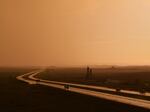
A rainstorm passes over Interstate 94 in Morton County, N.D., on May 25. Inclement weather and long travel distances to medical providers present serious access barriers for seniors here, many of whom are not able to drive or are uncomfortable driving in low-visibility conditions.
Tim Evans/NPR / NPR
Senior health care access across much of rural America is in a state of crisis.
Decades of agricultural industrialization and consolidation have eroded rural employment opportunities, leading to a steady exodus of younger residents to suburbs and cities in search of work.
As small towns have depopulated, aged, and lost their economic base, their medical infrastructure has contracted in kind.
Hospitals, clinics, dentists, nursing homes, pharmacies — they have all felt the pain of increasing financial pressures. Most facilities depend on Medicare's razor-thin reimbursement rates and alarming numbers of them have been forced to shutter operations in recent years.
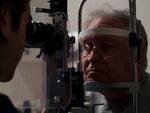
Randy Anderson has his eyes examined by Dr. Andrew Rodenburg during an optometry appointment on May 22. Anderson has to drive over an hour to Bismarck, N.D., to seek specialty care a few times a week on average, despite living two blocks from his small town’s hospital and clinic.
Tim Evans / for NPR
Providers that stay open deal with many staffing challenges, with both money and skilled workers in short supply. Residents who remain find themselves stuck in a growing number of medical deserts. While these dynamics affect all rural residents, seniors — with their more frequent and varied care needs — are hit particularly hard.
NPR reporter Juliana Kim and I traveled across the Great Plains of North and South Dakota in May to photograph and document this predicament.
Along the way, we heard from a cross-section of Americans, including residents of shrinking farming towns, medical providers, assisted living facility staff, caregivers and Indigenous citizens.
All images: Tim Evans / for NPR.
Loading...
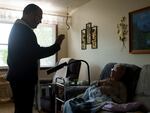
The Rev. Gary Benz offers Holy Communion to Viola Weinhardt, 94, at her home in Glen Ullin, N.D., on May 24. Benz offers Communion and the chance to connect with homebound, often socially isolated seniors who are dealing with health issues.
Tim Evans / for NPR
Loading...
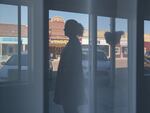
Tanya Urquieta, who was working as a project coordinator for the Older Adult Resource Network, would help connect seniors in the medically underserved areas in South Dakota's Douglas and Charles Mix counties to vital services aimed at improving their health and maintaining independence.
Tim Evans / for NPR
Loading...
All images: Tim Evans / for NPR.
From having to drive hours for emergency or specialist care to dealing with a patchwork system of health insurance, older rural people confront a range of access struggles, with many left to ration or forgo care altogether.
We also learned about various attempts by committed providers, nonprofit organizations, state employees and community members to help close some of the many coverage gaps.
Loading...
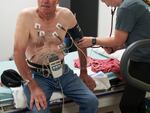
A nurse checks a patient’s pulse following a cardiac stress test during a special monthly visit by a cardiology team to Douglas County Memorial Hospital in Armour on May 30.
Tim Evans / for NPR
Loading...
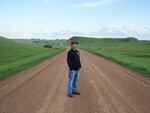
Wade Kottre, an EMT on the Glen Ullin Ambulance Service, stands for a portrait on a county road in Glen Ullin on May 25. The ambulance service is staffed entirely by volunteers and provides an essential service for Glen Ullin and the surrounding area. While many of the volunteers are seniors themselves and have worked on EMT crews for decades, some younger volunteers have joined the team in recent years.
Tim Evans / for NPR
Loading...
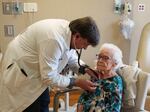
Dr. Richard Clark, a cardiologist from the Sanford Cardiovascular Institute, and a team of nurses spend a day each week traveling from their Sioux Falls offices to one of four rural hospitals that do not have cardiologists on staff. He checks a patient’s heartbeat during a monthly visit to Douglas County Memorial Hospital in Armour.
Tim Evans / for NPR
Loading...
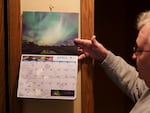
Randy Anderson flips through a calendar filled with medical appointments at his home in Turtle Lake, N.D., on May 22. Randy and his wife Marlys, who both deal with various health concerns, find their regular trips to Bismarck for care to be a considerable burden. “It’s like a full-time job almost,” Anderson said.
Tim Evans / for NPR
Tim Evans is a freelance photographer based in Minneapolis. Follow Tim on Instagram @timevansphoto.
This story was supported by the Pulitzer Center on Crisis Reporting.
Copyright 2024 NPR