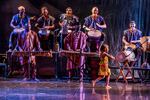
In this May 2024 performance photo provided by Sebé Kan, one of the youngest dancers in the troupe is pictured , along with troupe musicians, on stage at the Jefferson HS Performing Arts Auditorium.
Courtesy Sebé Kan
Derrell Sekou Walker teaches West African dance to elementary and middle schoolers at two Portland public schools. He loves his job, but as the founder and artistic director of Sebé Kan Youth African Dance Company, he is bringing his love of this art form — along with the feelings of joy and freedom it inspires — to the larger community. He first formed Sebé Kan more than 20 years ago, but since 2018, he’s been focused on teaching the dance traditions from Mali, Guinea, Ivory Coast and other West African nations to children and youth. On May 16, the company will present a one night only, multigenerational dance performance and concert called “Mobaya: A Coming of Age” at Portland’s Newmark Theatre.
Walker joins us, along with his wife Karida Walker, who is a dancer in the troupe; and high school senior Nylah Jae Holt, who has been dancing with Sebé Kan since she was 8 years old.
Note: The following transcript was transcribed digitally and validated for accuracy, readability and formatting by an OPB volunteer.
Dave Miller: This is Think Out Loud on OPB. I’m Dave Miller. We end today with the Sebé Kan Youth African Dance Company. It teaches the dance traditions of Mali, Guinea, Ivory Coast and other West African nations to young people in the Portland area. But the broader mission extends beyond dance – it’s to foster a source of pride in students’ West African roots and to strengthen their sense of ancestral heritage.
Sebé Kan’s next show is called “Mobaya: A Coming of Age.” The performance will be one night only, this coming Friday at 7 p.m. at the Newmark Theater in Portland.
Derrell Sekou Walker is the founder and artistic director. Karida Walker is married to Derrell. She dances in the troupe. So does Nylah Jae Holt, who is a senior at Central Catholic High School. They all join me now. It’s great to have all three of you on the show.
Derrell Sekou Walker: Thanks, thank you, thank you.
Karida Walker: Thank you.
Nylah Jae Holt: Thank you.
Miller: Derrell, first – how did you first get interested in West African dance?
D. Walker: I became interested in … 1998 is when I had a chance to see my first African dance class. I’ve seen West African dance performed on stage and things like that, just growing up, school assemblies and that type of thing. But when I had a chance to check out a class that was in a community center that I was working at at the time, that just hooked me.
Miller: So, you didn’t just watch it, but you took part in that class?
D. Walker: Yes.
Miller: What do you remember from that day?
D. Walker: Just walking in and being told to, “shut the door, it’s really loud out there.”
[Laughter]
Miller: Somebody else said that to you?
D. Walker: And I last for about, maybe like 10 to 15 minutes. Then I got up and took my shoes off. I tried to do the last couple of movements as the class was ending. And after that, I returned every Tuesday and it’s been my life ever since.
Miller: Why? What made you come back?
D. Walker: It was the music and the athleticism of the movements. I had come from playing baseball and running track and field. At the time I was still running track and field pretty seriously. I was like, “oh, this is something that looks athletic and it’s dance.” I always love to dance, not formally, but just parties, family gatherings and things like that. So it was the athleticism, and then definitely the music and the drums because I’m a fan of all types of music and I’m drawn to it.
Miller: Nylah, what about you? I mean, what kind of dance had you done before you did West African dance?
Holt: Prior to West African dance, I had mostly done hip-hop and drill team, the common ones that we had in school.
Miller: Do you remember the first time that you did West African dance yourself?
Holt: I had seen it a lot because my godsister was a dancer. I was just very intrigued by what it looked like, so I would practice on the side when I would watch, but it wasn’t anything serious. And then once I finally got to test the waters myself, I got really comfortable.
Miller: But you were little, because you’ve been doing this for 10 years. So when you were like 6 or 7, you’d watch older family members doing it and you were on the sidelines copying them?
Holt: Essentially, yes.
Miller: And then you could do it for real yourself.
Holt: Yeah.
Miller: What kept you doing it?
Holt: This company has just been a sense of family and taught me a lot of tradition that I wouldn’t have learned in school by itself. I’ve learned a lot about West African culture that I don’t think that I would have received anywhere else. We were just so focused on learning the traditions of what we were learning. It wasn’t just about the dancing, you have to understand where it comes from and why you’re doing it. I think that it was just a sense of family and learning tradition that I hadn’t got.
Miller: Karida, what about you?
K. Walker: My start with the company or with West African dance?
Miller: Your start with West African dance preceded the company, is that right?
K. Walker: Yes. I studied some as a child, performed as a teenager and things like that. But my start in dance was with tap, jazz and ballet at Sally Mack’s School of Dance on 37th and Sandy.
Miller: Can you describe what it feels like now for you to do this dance?
K. Walker: Now, it’s pretty deep because my knowledge of … learning from my husband about the roots of the music and the dance. He’s kind of a rare bird that plays the music and does the dancing, and that’s not very common. There’s a lot of people who are masters at dance or drum, and he’s one of both. But because I learned these things from him, it connects to the roots of other Black dance styles, and I see and I feel kinesthetically the connection to other Black dance styles that I’ve studied. I’m a tap dancer ...
Miller: So you can see and feel the direct line between these dances…
K. Walker: A hundred percent.
Miller: … that probably, I imagine, go back hundreds or thousands of years in Western Africa. And then classic Black or African-American dance styles of the 20th and 21st centuries, you see those?
K. Walker: Yeah. A hundred percent. And you feel them …
Miller: Can you describe it, in words? I mean, I suppose if this were a YouTube video, we could watch it. It’d be a lot easier. But can you describe it so we have a sense for that line?
K. Walker: Part of it is even the way you approach some of the styles. So if you were going to get on the floor and dance hip-hop compared to if you were going to get on the floor to dance ballet, or Irish dance or something. Even the starting position – when I’m taking a ballet class, like pulled up, first position, turned out, all these different things, the alignment that’s required for ballet is very different.
And for the dance styles that have more of that influence, compared to when it’s time to tap dance … and when I teach tap dance, it’s like, ground yourself. Ground yourself in the floor, in the music. That’s job one. If you’re doing hip-hop, ground yourself. If you’re dancing it up high, you look goofy. If you dance it pulled up, it’s like you’re dancing it like a goober, but if you sit it down … Do you know what I mean? Like, you ground down into the floor, and that’s exactly what it is in West African dance and music.
So, much of that part of West African culture is what was able to remain through the transatlantic slave trade. Because the written language was eliminated. The spoken language was eliminated. But the language of music and dance remained. So that is at the heart and the roots of American music and American dance entirely.
Miller: You know, Nylah, I read in my intro, a version of what is literally the mission statement of this dance troupe, to help students feel their West African roots as a source of pride and to strengthen a sense of ancestral heritage. You were saying this earlier, but that’s happened for you?
Holt: Absolutely. I think that just having a space where it’s focused on those traditions and those cultures, and having to understand what they’re used for, it teaches you so much. You’re not gonna get any of this type of information in school. You’re not gonna understand the use of music. Like, you get broad explanations, but when it comes to actually being there to dance and feel it, you have to understand where it’s coming from and why you’re doing it.
So having that extra piece, having those people who can tell you, “This is where it came from, this is why we do it, this is how it’s supposed to be done. You are representing this when you do it.” You have to understand those things and therefore you can’t do the dance without it.
Miller: Derrell, has it given you … well, please, go on.
D. Walker: I would just add to that, a lot of times we’re able to show them movements that happen in everyday West African village life, like if you’re working or if you’re hunting and things of that nature. So sometimes we’re able to explain specific movements.
Miller: And the origins of very specific movements.
D. Walker: Yeah.
K. Walker: There’s a quote, I think it’s Randall Robinson. He says, “One of the worst things you can do to a people is to rob them of the memory of themselves.” And for us, we all grew up in Portland schools, [but] schools anywhere in this country, so much of the history that’s taught of Black people begins on a plantation. But that’s not where our story begins. So much of this, and the roots of our culture, begin with the stuff that you’ll see on Friday night.
Miller: Derrell, can you tell us about the music that you play and that folks can hear at these performances?
D. Walker: Yes, West African music, I’ll start with the specialty instruments like the balafon. We’ll have an ngoni there, which is like a West African guitar style but not as many strings as your traditional guitar. Then we also have the djembe hand drums, which is probably one of the most popular hand drums on the planet, next to the congas and things like that. Then we also have our bass drums, the dununs, which are actually the rhythm. So when you hear those dununs play, that is the source of all of the rhythms that are played.
Miller: Which one do you play?
D. Walker: I will be on djembe most of the night, but I do play and teach all of it.
K. Walker: The djembe communicates live with the dancers.
Miler: What do you mean by that?
K. Walker: On stage. When you have live music on stage … which isn’t necessarily common for so many of us. We dance to recorded music, even in professional companies. But this company, you get the live musicians on stage. So you have the rhythm section, if you will, the bass and the drum, like in a jazz band, but here, the dununs are the rhythm section …
D. Walker: And my role, and a couple of other guest artists that we’re bringing in from across the nation, our role will be to lead the dancers. We call it lead djembe. Lead djembe plays the signal to start the rhythm, plays the signal to bring the dancers out …
Miller: You’re the conductor.
D. Walker: Exactly. We change their movements.
K. Walker: Yes. It’s happening live, yeah.
Miller: Nylah, I’ve seen videos and I understand that the company sometimes does halftime shows during Blazers’ games. Have you done one of those?
Holt: Yes, I believe I’ve done two.
Miller: What’s it like to be in the middle of the Moda Center with 17,000, 18,000, 19,000 people watching you?
Holt: Personally, for me, I get a rush. I just enjoy the idea of performance itself, so it’s not just about, “oh, I’m going out here to dance.” No, I’m going out here to look my best. I’m going to smile. I want to give everything that I have for everybody to enjoy what we work on, so that all the work that I’m putting in on the off time is not like, “oh, I’m just here to show you.” No, I’m here to give it to you. I want you to come feel like you want to come be welcomed and join this troupe.
K. Walker: Our youngest daughter. [Laughs]
D. Walker: She’s definitely one of the ones that does that because when she walks off of that court, it’s like, “oh my God, just let me breathe before we head up in this elevator.” [Laughs] Oh man, I remember those.
K. Walker: Our youngest daughter is 7 and she’s performing. And she did our last Moda Center performance. She had a small role. And luckily it was that because she was doing the dancing, but she’s trying to see herself on the jumbotron.
[Laughter]
Miller: I think everybody looks at themselves in the jumbotron, unless they’re a professional like Nylah.
K. Walker: Right. Not Nylah, they’re pros, but there’s a little pumpkin in the back that is like watching herself. She’s doing the steps on time and everything, but she’s also looking up at the jumbotron.
Miller: It’s a huge screen. I get that.
D. Walker: And to add to that, that’s an amazing part about our company is that we do have such a wide range of dancers. We have a 7- to 10-year-old range, and a huge group of them this year that we’re so proud of, and they’re our next generation that are gonna come through the ranks and hopefully finish the way that Nylah has finished.
Miller: But then, Karida, I mentioned that you’re a dancer, too. Are you also dancing with 10-year-olds or are you in a separate performance category?
K. Walker: We’re the mamas, if you will. We’re in a separate performance. There are these very important village parts of the show, where you do see these multigenerational components to how young people come of age. That’s the theme of the show.
So there are some intergenerational moments in the show. There are mother-daughter moments in the show, big sister, little brother moments in the show. So there are some multigenerational aspects that you’ll see.
Miller: What does it mean to you to be doing this in a multigenerational way?
K. Walker: It means to be a part of something just bigger than ourselves and even for what our own generation is about. For the teenagers themselves, even in rehearsal we feel it, the way that they mentor the 8-year-olds. Now that Nyah’s not 8 years old, now she’s one that’s mentoring the middle schoolers and the younger ones.
And then the grown-ups, when we show up, how we come in and we support the teenagers … There’s this very “village” feeling in the creative process and in the rehearsal process, and that translates on stage.
D. Walker: Very family, like she said earlier.
Miller: That’s relatively rare in terms of a lot of activities now. I mean, there are some community things or religious events where three generations are together. But in terms of actively doing something, if you go to a youth soccer game, a track meet or whatever, it’s the kids and then parents are watching. Sometimes older people can do their own thing in some kind of rec league. It’s rare when people of different generations are working together on some project.
D. Walker: I agree.
K. Walker: It really is. Like, in rehearsal, we had a big rehearsal on Saturday … It was more of a full company rehearsal because the adults, a lot of times we practice separately when we can practice. But when …
D. Walker: Even our younger groups, too …
K. Walker: Yeah. They separate out, but when we come together, the energy that the kids feel watching the adults … some of them are watching their mothers. Two of my daughters, they’re watching their mom. Nylah’s watching her mama because her mama’s dancing and she’s going to dance with her mother in some parts of the show. So the energy that they get and the inspiration that they get from watching adults, and for them to know that dance doesn’t have to stop at graduation, the way that it can feel. There’s so much life to dancing and that it’s a part of life.
Miller: Although, Nylah, am I right, you’re about to graduate? You’re going to go to Jackson State University in Mississippi?
Holt: Yes.
Miller: Congratulations. [cheering] So, can you keep doing this dance? You’re not going to be in Portland.
Holt: Well, I have the courtesy of having the best dance instructor ever. And I know that, even while being gone, I’m still gonna receive videos on what I’m gonna be doing when I do get back home for the next show. [Laughter] I might not be fully in it, but I’m going to be still there as much as I can. And I’m gonna bring what I have here to Mississippi. I wanna expand all my knowledge, all the dance knowledge that I’ve learned in whatever ways that I can, whether I’m dancing or not.
D. Walker: I think that you can maybe seek out some drummers and teach yourself. Like, she been in it that long.
Miller: And do it and keep going there.
D. Walker: Yeah, she’s got the tools to teach.
K. Walker: Our niece is at Tuskegee University and she was maybe 10 years in the company. She actually used African dance as her talent at the Miss Black & Gold Pageant down at HBCU – and won. And he went down to drum live for her talent, because they’ve never had a drum and African dance talent at a pageant. So they didn’t know what to do.
So she won, but she also comes back to perform little bits and pieces. There are some alumni that come back from there, from Howard in DC, where some people can also train with … Some of the guest artists that are actually coming are from D.C. And some of our dancers that have gone to Howard can also train with some of the people that have been guest artists for us.
Miller: It was a pleasure talking with all of you. Karida Walker, Nylah Jae Holt and Derrell Sekou Walker, thanks so much.
All: Thank you.
Miller: Again, the performance is this Friday at 7 p.m. at the Newmark Theatre in Portland.
“Think Out Loud®” broadcasts live at noon every day and rebroadcasts at 8 p.m.
Contact “Think Out Loud®”
If you’d like to comment on any of the topics in this show or suggest a topic of your own, please get in touch with us on Facebook, send an email to thinkoutloud@opb.org, or you can leave a voicemail for us at 503-293-1983. The call-in phone number during the noon hour is 888-665-5865.