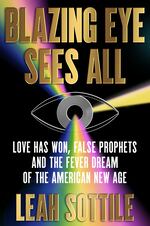
Leah Sottile's latest book explores American New Age. The book puts a spotlight on the history of U.S. spiritualism and highlights the innerworkings of groups such as Love Has Won, I AM and Church Universal and Triumphant.
Courtesy of Grand Central Publishing
Oregon journalist and OPB’s “Hush” Podcast Host Leah Sottile has made a name for herself investigating extremism and fringe movements in the West. Her latest book, “Blazing Eye Sees All,” explores New Age religion, including the Love Has Won movement. Beyond that, the book is a history of spirituality in the U.S. and looks at the ways fascism and metaphysical circles are intertwined. Sottile joins us in front of a live audience at the Literary Art Bookstore in Portland to share more.
Note: The following transcript was transcribed digitally and validated for accuracy, readability and formatting by an OPB volunteer.
Dave Miller: This is Think Out Loud on OPB. I’m Dave Miller, coming to you today from the Literary Arts Bookstore in Southeast Portland. It is an hour with the writer Leah Sottile.
[Audience applause]
Three years ago, when she started to think about her new book, the freelance journalist Leah Sottile decided that she wanted to do something new. She’d written articles and a book and hosted podcasts, including for OPB, that often focused on extremism in the West. She had a different idea for her new project, a deep dive into the world of New Age spirituality. But the connections to her previous work became inescapable and the book turned out, as she said, into an unintentional story of extremism, but also feminism, climate change, endangered species, along with deception, power, myth and the nature of belief.
The new book is called “Blazing Eye Sees All: Love Has Won, False Prophets and the Fever Dream of the American New Age.” Leah, it’s great to have you back on the show.
Leah Sottile: Thanks for having me.
Miller: Before we get into the details of the main cult that you write about in this book and its historical lineage, I thought we could just start with what’s at stake in this. What can we learn about overall society by looking at these New Age groups?
Sottile: That was something that, as I wrote it, sort of became more apparent to me. This book is a collection of pieces that really dive into the history of the New Age movement in America, and a lot of these groups are led by women. But I think one thing that is a theme is that all of them were really disregarded by society … “these are weirdos, these are freaks, these are the fringe.” It’s evidenced through the book by the ways that they’re highlighted by daytime TV shows, talk shows, things like that.
So what I thought was, if I take a serious look at these, it might present something about why these groups were so attractive and are consistently attractive to people. So I’m not sure that I know what the exact takeaway is. But I do think that this book talks a lot about why people are attracted to these fringe, spiritual sects.
Miller: Why were you attracted to writing about them?
Sottile: Well, I wanted to not write a book about extremism. So I found halfway through that I was backing into a book about extremism, which was great and also a little disappointing. I was just like, “I really wanted a break from this.”
Miller: Was that a surprise to you? You really didn’t know where the tendrils would lead?
Sottile: I didn’t. I think it’s because there were a few origin points for this book for me. One was during COVID, I actually was taking classes from Literary Arts, the organization where we are today. A few of those classes were about tarot cards, and how you can use tarot cards in inspiring new creative writing prompts, writing ideas and things like that. And I really enjoyed these classes. I thought they were awesome and super productive for me.
But I started to notice the more classes that I took, there were people in my classes that were really kind of seeing the cards in a different way than I was. They were kind of seeing the future told, or they were really hanging up their emotions and almost well-being on those cards. And I thought, “well, that’s fine, but is there a point where that could be exploited?”
Miller: What were those cards for you?
Sottile: For me, it was a few things. For one, I think they were great in producing new essays or like thinking deeply about how I was feeling about the moment that we were living in.
Miller: So like a kind of secular prompt that happened to come from this beloved, complicated, spiritual, historical artifact? But you didn’t latch on to the spiritual side of it?
Sottile: Not really, no. And I think that that just says a lot about me. I’m just not one to sign up for things. But I was really intrigued by the history of them. I mean, just plainly, Tarot is just a very old card game. And it’s got a lot of historical origins. There’s a deep art history to the cards, the meanings of the cards and things like that, how they’ve been interpreted and used. So I was just really interested in that. For me, I didn’t feel myself getting pulled into a more spiritual practice with those things. But I did see that happen. And I thought, “how great that the teachers that I have are not people who would take advantage of that.”
But I could see that there were, especially on Instagram during COVID, a lot of people saying, “I can read your cards for you, sign up for a coaching session, let’s get out these crystals and you need to buy these things from me that are these New Age healing techniques.” And I saw that there were a lot of people [that appealed to.]
That’s when I thought as a journalist, this is interesting for me creatively, but also, is there a line where this could be exploited? And yes, is the answer. It can and has been. But also, where it led to a story of extremism for me was a little surprising when I dug into the historical origins of a lot of people in the New Age space, and how quickly those ideas connect to antisemitism, hypernationalism and things like that.
Miller: Let’s talk about the Love Has Won group itself, which is threaded more than any other group throughout the book and it’s in the subtitle. This is not going to be a surprise to people who’ve seen the HBO documentary that came out a couple of years ago or a ton of reporting about it.
The end of the group happened actually partly in Oregon. The founder of it, she died of, the coroner’s report said, “alcohol abuse, anorexia and self-administered colloidal silver,” this toxic metal at the end of her life. And she weighed 75 pounds. She seems like all she was taking in were opioids, maybe some cannabis tinctures, alcohol and this toxic silver.
That was the end of the group. What was the beginning?
Sottile: Really, that was a big genesis point for the book, too, for me. I saw a lot of this reporting. I did not know that she had died in Oregon originally. But I was intrigued by this idea of the end of this group. And what I found through reporting was that this was a person who started her life with a ton of promise. [Amy Carlson] was from the Midwest. She grew up in Texas and wanted to be a singer, had big aspirations to be famous.
Life happened for her, a lot of unfortunate circumstances. She raised several children as a single mother. She did not get famous and she sought spirituality from a bunch of different places. Eventually, that led her to online forums about aliens, about astrology, some of these things that kind of intersect with the New Age space.
And at a certain point, literally she was sitting at dinner with her family and she said, “I have to go.” And they said, OK. But she literally left, she just left her life. And that led her on the path to become what she called “Mother God.”
Miller: The God of the world, a reincarnated version too, of Jesus, Marilyn Monroe, Joan of Arc and many other people over the millennia.
Sottile: Yeah, she became the center of her own self-constructed belief system where, as Mother God, she was God, but she was also the planet. So any offense to the planet, it was an offense to her. She was just at the center of this ideology. Some people have said she couldn’t become famous, so she made herself famous in that way.
Miller: I want to play a few seconds from maybe hundreds or thousands of hours of online videos that she put out over the course of her life as a leader of this group. This is from Valentine’s Day of 2015.
Amy Carlson [recording]: So we’ll read this part about … we’ve been continually expanding … We’re exploring more into diabetes, disease, viruses, sickness. So we’re introducing some new surgeries to repair holes in the brain due to taking pharmaceutical drugs, man-made drugs, ADHD medications, antidepressants, GMO foods and soda. During these procedures, we repair this along with the feeling centers and in some cases, the entire neurological system. We are using breakthrough 4D and 5D technology to accomplish this. We are also exploring AIDS patients, diabetes, disease, viruses, sickness, cancer, heart and beings who have had strokes.
Man [recording]: All the above.
Carlson [recording]: Yeah. So miracles are unfolding daily, everybody. The magic has begun.
And we also want to share, Robin was talking to me about this this morning, that in order for these surgeries to work and activate, you have to pay it forward. And we have three ways to pay it forward. And the second one is to trust the process. If you don’t trust the process, the energies will not activate. It’s just the way it works.
Miller: At times, Love Has Won seems like QVC or the Home Shopping Network. What were they selling in terms of products or services?
Sottile: It was a few things over time. So this all started with Amy really livestreaming all the time and doing kind of astrological predictions. I think in the book, I talk about her as being like a newscaster of astrology, like the forecast for the day. She would sell consultations on the phone that later would become something called etheric surgeries. This is a practice that has existed long before Amy Carlson with New Age spaces, but it’s the idea that you can be healed by someone over the phone. They can do a kind of psychic surgery on you, and heal your physical and mental ailments. So she would sell those.
Eventually, as Love Has Won became a group, they were selling products like candles, lotions and things like that. But specifically, their big product was colloidal silver, which is a substance that is made in a variety of ways, but most crudely made by connecting wires to batteries, and extracting a substance out of batteries and water, and then selling it to people as a cure-all.
Miller: She mentioned Robin a few times. Which Robin is she talking about?
Sottile: This is the actor Robin Williams.
Miller: Who had already died.
Sottile: Who had died. So within New Age groups, especially the ones that I discussed in the book, there’s a system of ascended masters that people tend to pray to. I can kind of equate it to Catholic saints, these are stories that hold some sort of spiritual value. So within Love Has Won, those masters tended to be dead celebrities: Whitney Houston, the comedian Bill Hicks, Tupac Shakur, all kinds of people like that. But Robin Williams held the highest position in Amy’s mind. And I think that this is something that’s been a big joke about Love Has Won. It is funny to say, “we pray to Robin Williams,” right? Like that seems crazy.
Miller: And the list, it makes me think of a Pinterest board now, or even more, the image comes to mind is a teen’s bedroom wall in like 1985 with all these fan posters. A lot of them are 1980s people who are popular. She was born in 1975. It’s easy to make fun of. Does that absurdity serve a purpose?
Sottile: It does. That was one thing for a long time, I was like “how am I going to handle this?” I really wanted to treat these topics journalistically and seriously. But also, there are times when, if something is funny, you just need to say it’s funny.
But I had someone who is a part of Love Has Won explain [it] to me. She, like most people, was recruited online. The group would hold these day-long livestreams where they were talking about all kinds of things. But when they talked about Robin Williams, this was something that a lot of people could relate to. They could say, “oh, I loved Robin Williams!” And they would get people talking in the chat. “What was your favorite Robin Williams movie? Which Robin Williams movie spoke to you the deepest?” And she said, for her, that was a point where she said, “Oh man, I loved his movies. These people loved his movies as much as I did. They spoke to them.”
It was just a point of connection. And I think that’s one thing that I’ve learned over all the years I’ve been writing about extremism is, often, it’s just a little touch point that gets a conversation going and establishes a small amount of trust. And for this person in the book, that was what started it for her.
Miller: The vast majority of people who became a part of this group gave money or paid for services, it was an online experience. They stayed at home. A small number of them got so enmeshed that they left their homes, sometimes their families, and they moved to Colorado or wherever the group was at that time. What was life like in that cabin?
Sottile: It was strange. I think one of the best descriptions I got was from someone who would eventually become a “Father God” for the group. Amy had a series of men that she dated over the years and she would deem them Father Gods, so they held a higher position within the group. But this particular Father God explained to me that he’d been talking to Amy online, he’d purchased some of her etheric surgeries over the phone. And when he arrived in Colorado, it was an absolute mess. Amy was extremely intoxicated. She had a pretty severe addiction to alcohol at that point, the house was a mess, they were living by her strange timeline. If she wanted to stay up all night drinking, they were to stay up all night drinking.
So at first he said, “Oh my God, what have I done? I’ve gotten myself involved in something that is not what I thought it was online.” But because he had traveled so far and invested money, he just said, “you know what, I’m going to give this time. I’ll stick it out a little bit.” [He] found that that’s kind of what everybody else that was there was also doing and kind of sunk into their rhythm of what Amy wanted them to do.
What she told them that they were doing was that they were healing the world with love. They were raising the vibrations of the planet so we could all be better for it. And the way that they did that was by running chat rooms and talking to people online, booking these surgeries. They started to feel like they were actually doing really good work.
Miller: Can you tell us the story of a Coast Guard veteran from Mississippi with two children, a man named Ben?
Sottile: He was recruited into the group right at the beginning of COVID. He was married and had children, and his wife and children were traveling when “the lockdown” started, just those really early days in 2020. And it deeply scared him. He had been watching Love Has Won livestreams and people were saying, “You gotta come to mom, you got to come on mission.” And he just thought, OK, this is the time, this is when I need to do this.
He was really scared. Got in a plane, went to Colorado, called his family and said “I’m in Colorado.” And all of them are like, “What are you doing there?” And he said, “I’m going to check out this group. I’ll be OK.” He was with the group for less than 48 hours. And what he and his family allege is that while he was there, someone in the group gave him a drink. They say that there was something in it … this is obviously not proven. But he was told to go wander around in the forest around the cabin and to explore, I think it was to fight darkness in the woods, some kind of vision quest or something like that.
He got very lost. He was extremely intoxicated. He lost all of his clothes at one point. And basically, a huge search was done by his family to try and find him. He had been booked into a hospital. They finally got him home again. He had lost his phone somewhere in the process of fighting darkness, as they say, in the woods. And his family told me that that was the best thing that could have happened for him, to lose connection to Love Has Won, because they thought he would have just gone immediately back to it.
So his family was able to get him home. It took him almost a year to kind of deprogram from what he had learned from them online and those 48 hours that he was with the group. It was so potent that he thought Amy was God, that she was in Colorado and that he needed to be near her. It took him a very long time to realize that what she was selling was just absolute garbage.
Miller: One of the deep themes of the book and one of the aspects of these groups that undergirds all of them is that they’re run by women. Why? How did that come to be?
Sottile: The New Age movement is huge. It’s almost hard to call it a movement because there’s so many things that fit under that. And within that there are certainly tons of non-female leaders. I focused on these female leaders because of what I was discussing before, that they felt disregarded in my mind by the media, but were very popular with people. And they each had a certain set of beliefs that seemed to have been kind of passed forward in time from the 1850s.
What I started to conclude from studying these women was each of them had sought some kind of more mainstream or traditional spiritual path, but felt pushed away for some reason, excluded or told what to do by male leaders and they wanted to break away in some way. The further back in time you go, I think it was a little bit more of an appeal towards spiritualism and things that were really appealing to women, like being media spiritual mediums, talking to the dead, seances and things like that. Those are really popular with women.
So I think the theme is that each of these women wanted to be a spiritual leader but could not within mainstream spiritual belief systems.
Miller: How much was that a draw for their adherence, women and men?
Sottile: I think it was really popular. And when we look at Love Has Won, I think the group kind of tried to couch their ideas in some sort of progressivism – like, “Oh, obviously God is a woman, look what women can do.” The rest of their belief system completely negates that, but that was really appealing. There was kind of this feminist angle to it.
When I talk in the book about a woman named J.Z. Knight, who is commonly called Ramtha and operates the Ramtha School of Enlightenment in Washington state, that is a person who really wanted to instill in women that they had power. And I think that’s a big theme that a lot of these leaders had, is that you have the power inside of you. You don’t need some male priest, parish leader or bishop to tell you about God. You already understand God inside you. I think that that’s really appealing.
Miller: Although the J.Z. Knight story is complicated and interesting. Because maybe that’s one of the messages, but the way that Knight has been putting out this message is that she says she is the voice for a 35,000-year-old warrior man, Ramtha, who’s inextricably tied to her. How do you think about gender when it comes to J.Z. Knight and Ramtha?
Sottile: I mean, I’m fascinated. I’ve said this before and I’ll say it again. J.Z. Knight is a dream interview for me, an interview I couldn’t get. She doesn’t talk to people, for a variety of reasons that I can only guess. But I wanted to interrogate that specifically.
To kind of back up a little bit, J.Z. Knight is someone who started this group in the late ‘70s, early ‘80s, in Washington state. And she is a channeler. Channeling has been very popular with women throughout history. She channels this 35,000-year-old male Lemurian warrior, as you say, and assumes a different stature as she does it. Her body, she holds herself different. Her voice deepens.
Miller: As you’re saying this, I’m doing all these things. I should be more like that.
[Laughter]
Sottile: She kind of sits differently. You could look at it and say it’s acting. But for thousands of people, they really believe that she transforms into a different person and she is channeling this ancient wisdom.
I spoke to a lot of ex-followers of hers who said that the way that she justifies this is that he is speaking for women and that people will only take that seriously if he speaks as a man advocating for women. I’m sure there’s many other ways that she justifies this, I don’t know specifically because I haven’t spoken to her. But I thought that that was so interesting. It was such a point of evolution in this lineage I was looking at. Instead of just being a woman saying, “I have power,” she’s saying, “I have power because this ancient man has chosen my body to deliver his message through.”
Miller: Let’s turn to some of the historical undercurrents that you explore in the book. How did antisemitism get so layered into so many of these groups?
Sottile: That was the thing that surprised me in my research. The historical research of the book begins in the 1850s with the spiritualism movement, with the influence of a person named Helena Blavatsky. What I wanted to understand was who picked up Blavatsky’s ideas after her life, because she authored a system of what she called “root races.” Those root races, she argued, proved in her mind that Aryan people were of the most advanced races. That was a very appealing idea to the Nazis. There were other people who had these ideas, I don’t think they were completely original to her.
At a certain point, a person named William Dudley Pelley picked up these ideas. Pelley was notable because he was a massive antisemite, perhaps one of the most potent antisemites I’ve ever researched in my work. And he was writing a ton about Blavatsky’s ideas about masters and about ascended masters, some of these things that we’ve discussed already. And he really kind of poured a lot of gas on that fire and infused the New Age movement to come with this antisemitism.
I say “infused it” because what I started to learn as I researched the New Age movement is that with each generation, it’s really a lineage of theft and plagiarism. People take ideas, they kind of twist them just a little bit with their new ideas and then carry them forward as their own. With Pelley, that’s when we really started to see that he infused this antisemitism. This is in the 1930s. And from there forward, that antisemitism was there – and remains, in some circles.
Miller: There’s an amazing passage in the book where you talk about a guy who was just hearing about this group, Love Has Won, and he seems like he’s amenable to it, he’s sort of interested. He’s like, “Yeah, I like this love stuff.” But then he finds out that there’s a real thread of antisemitism among the leader and her followers. And for him, that’s a hugely good thing. He’s like, OK, the fact that they don’t like Jews … it’s a selling point for him. It’s striking to read that.
Sottile: It was a striking conversation to have, let me tell you. I was very surprised when he said that, because he had sounded like he had so much doubt about the group. But he was very excited about it. And I think that that speaks to how common antisemitism can be within New Agey circles. One thing that I would say is a common shared value is doubt in professionalism, doubt in establishments and things like that. So within New Age circles, it’s very common for people to believe in conspiracy theories that Jews are controlling banks, they’re controlling the world, they’re controlling governments and things like that. In a way, it’s one of the most obvious things … it’s very common.
Miller: One of the things that struck me … maybe it’s a mistake to look for a lot of internal sense in the worldviews of these groups because they’re internally inconsistent, so almost haphazardly constructed. But what role do conspiracies play in the world-building for these groups?
Sottile: Oh, a ton. The groups that I was really interested in all nurture a huge conspiracy theory, which is this idea in the lost civilization of Lemuria. So if anyone’s familiar with the lost civilization of Atlantis, Lemuria is this supposed continent that sunk into the ocean at one point after having a spiritual battle with some other foe. But Lemuria was a place where everyone was extremely spiritually enlightened. And by some sin of their own, the civilization was destroyed.
All of these groups really believe that. They really believe in the idea that continents can sink into the ocean. So I think that that’s just a great example because it’s so easily disproven with science, plate tectonics and the way the earth moves, continental drift. And that’s all uninteresting to the New Age movement and has been for the last 200 years. Scientists are just kind of trying to make the world less spiritual, less interesting. They’re more apt to nurture these alternative histories, these alternative archaeologies of the world.
Miller: It’s called Lemuria. I’d heard of Atlantis, never Lemuria, but it’s called that because of lemurs, these small animals that way back we’re related to. You actually went to the Oregon Zoo to look at lemurs because of this, which I found to be a surprisingly moving thing to imagine you doing, grounding yourself in the reality of the world, when these animals were the basis for a much more fantastical, sometimes violent, pernicious or scary offshoot.
So what did you learn when you actually saw lemurs and talked to actual lemur experts?
Sottile: Yeah, I learned a lot. I went to the Oregon Zoo because I don’t have the money to go to Madagascar, which is where lemurs live.
What I learned was that this idea of Lemuria started because in the 1800s, an academic wrote a paper floating the idea that lemurs were living in Madagascar and in India. And [it] was so strange that they lived an ocean apart, that there must have been this lost civilization that connected the two places that sunk into the ocean. By the time he died, he was like, “yeah, that was bad science.” But the idea was really picked up on by the spiritual movement.
When I went to the Oregon Zoo and I told the people there who work in primate research, they had never heard of Lemuria. I was enlightening them to it and they all got very excited about it. I was like, “No no no, please don’t get excited about it!”
Miller: “I’ve seen where this ends.”
Sottile: But what I learned a ton about lemurs was that actual, real lemur society is matriarchal. It’s run by females, it benefits women. And I thought that that was just so ironic because that’s so much of what the new age movement aspires to, to create this world where women are in charge, where they’re spiritual leaders, where they’re enlightened. It just was very funny to me that that actually exists.
Miller: You write about a video that showed up on the internet a few years ago, which is a mash up of two different speeches. One was given by the cult leader Elizabeth Clare Prophet, who ran something called the Church Universal and Triumphant. The speech that was chopped up in the video that we’re gonna hear is from the early 1980s – I think 1984.
The other part, the male voice we’ll hear is from retired Army Lieutenant General Michael Flynn, who briefly served in President Trump’s first term as his first national security adviser and then went on to become a kind of Christian nationalist speaker and hero.
Let’s listen to this video that showed up online a couple of years ago.
Elizabeth Clare Prophet [recording]: Mighty, I am present. I am here, o God, and I am the instrument of those sevenfold rays and archangels.
Michael Flynn [recording]: We are your instrument of those sevenfold rays and all your archangels, all of them.
Prophet [recording]: And I will not retreat. I will take my stand. I will not fear to speak and I will be the instrument of God’s will, whatever it is.
Flynn [recording] We will not retreat. We will stand our ground. We will not fear to speak. We will be the instrument of your will, whatever it is.
Prophet [recording]: Here I am, so help me God, in the name of Archangel Michael and his legions. I am freeborn, and I remain freeborn, and I shall not be enslaved by any foe within or without.
Flynn [recording]: In your name and the name of your legions, we are freeborn and we shall remain freeborn. And we shall not be enslaved by any foe within or without, so help me God. God bless you, God bless America. Thank you very much.
Miller: What do you see as the significance of this video?
Sottile: I thought it was fascinating in many aspects. For one, like I said before, there’s so much plagiarism within the New Age movement. It was interesting to see a world leader essentially stealing the ideas of this woman and the speech of this woman. That was in some ways not surprising to me.
But I think in Elizabeth Clare Prophet’s time, she was cast as a real crazy person. She, at one point, told her followers that the apocalypse was coming and they had prepared fallout shelters. She ordered everyone underground for 24 hours. They came up and the world had not ended, and she lost a lot of followers at that time.
She became this punch line of someone who just had these crazy ideas. I thought it was very notable that someone who was seen as so fringe was being talked about, whose words were being stolen and used by this political leader in a church, and very popular and becoming mainstream. And I think that that’s something I’ve seen just throughout the years as I’ve done my work, that things that were seen as unimportant, weird, fringe, have just slowly become extremely mainstream.
Miller: So what does that mean for the word “extremism?” I used it in my intro, you’ve used it before too. How helpful is that word right now? What does it mean? What doesn’t it mean?
Sottile: Yeah, I’ve asked this question to experts and I don’t feel like I’ve gotten a satisfying answer either. What does it mean when extremism is in the White House? I think what I’ve come down on is it doesn’t mean the ideas are any less extreme. It just shows that they’re more acceptable by society.
Miller: Let’s take a question from our audience. What’s your name and what’s your question?
Audience Member: Hi, my name is Sam. And thanks Leah, for your time today. Do you see or is there some sort of delineation in terms between a cult and the New Age movement that you speak of? Can you talk about that a little?
Sottile: Yeah, I think that’s a really good question. I had some arguments with my editor about when and where we use the word “cult” in this book. The word “cult” actually doesn’t appear until over 200 pages into the book for this reason. In academic circles, the word “cult” is really seen as kind of a dirty word. Some religious studies experts would say that it’s a way to say that these new ideas, we don’t want to accept those. I think also, you could make an argument that many religions are culty, it’s just how long they’ve been around.
So I think in regards to my work, cults start to feel nefarious when they’re led by a charismatic leader who is personally benefiting from preying on other people, making promises to people. And specifically financially benefiting, saying, “you’ve got to pay me, I can heal you, I can make your life better.” Obviously, I talked to a lot of ex-followers of some of these groups, so I didn’t talk to anybody who said, “yeah, my life did get better.” But I did talk to people who were members of groups in this book that you would call a cult, who said, “I still wouldn’t change that I was in this group. I did come away with some understanding of myself.”
So I know that might be kind of a squishy answer to your question, but I think that where I, as a journalist, apply my skeptical mind is when there seems to be a leader benefiting from it.
Miller: Some of the most painful parts of the book for me to read were when you spent a lot of time with families of people who had been sucked into these groups and they tried to bring them out in various ways. One of them, which was really fascinating, is a man named John and his wife Kim. Can you explain what was happening to her and what he came up with to try to prevent her from moving to Colorado?
Sottile: So Kim was recruited into Love Has Won online, through Facebook. She had been kind of doing research around conspiracy theories and looking for groups of people that she could talk to online. She was experiencing varying personal crises at the time. COVID had happened, she had struggled with substance abuse disorder and she had also uprooted her family from Western to Eastern Canada. So she kind of didn’t have much of a support network.
She was appealed to the group because she felt like everyone in her life was tired of dealing with her and her problems. And here were people that really understood her and welcomed her in. So she got really into Love Has Won. She was on the livestream for six hours a day, she was listening to their radio all day long, she was buying colloidal silver, she was buying the surgeries and everything. And she was also getting in the comments of these livestreams and doing recruiting, trying to get people into the group.
Her husband noticed this, John, and he was like, “What are you doing? Why are you spending all your time, spending money on these people? It’s a cult.” What happened was that when she started to realize he was judging her, she stopped telling him what she was doing. And he noticed. He started to pick up that she was thinking of leaving. This is, again, during COVID. The border was shut down, but she had sort of said enough things that, “Hey, when the border opens, I want to go on mission with mom in Colorado.” That really freaked him out. They have two kids.
So what he did was he started to pretend that he was also in the group. He said, “You know what, I’ve woken up, you’re right, mom is God and God is a woman.” So what he did was he wanted to make sure she didn’t get away and that she didn’t give up on them. So he figured if he could speak her language, he might be able to slowly pull her out of it.
Miller: It seems like he had some ambivalence about it. He was lying to her to prevent her from losing her life or family to what he saw as a bigger lie.
Sottile: Yeah. And he felt a ton of guilt around that. I’m lying to her, and because she feels so lied to, she has joined this group. She felt lies around the ways that she had been treated as an addict and things like that. I think he took a gamble and it did ultimately pay off for him.
Miller: Although the detail that she says made something switch inside her was flabbergasting to me. The way you write about it, he told you that that he had seen on a screen she had been googling things like, “how to get out of a cult.” So she had some misgivings.
Then, as she reported, she saw on one of the many livestreams that Love Has Won had done, there was a bottle of Febreze, the stuff you spray to cover up pet smells or something. That was in the background of one of these videos. And she said, “wait, if this is really Mother God, why do they have Febreze?” And that was the detail that took her out of it. It was maybe the most surprising thing of the entire book.
Sottile: I also found it to be surprising.
Miller: But what’s the deeper point here? What do you think this says about belief, how it’s created, how it’s evaporated?
Sottile: I think that one thing that John thought was … When this happened, he had opened a bunch of tabs on her computer while she was sleeping: “Do I know I’m in a cult?” She had had some drinks the night before and he had thought maybe she won’t remember. She’ll wake up, open her computer and think, “Oh, well maybe I’m starting to doubt this little bit.” He had a bunch of books that were going to be delivered about cult information and things like that. What he thought was that if he gave her information and logic, that would be the thing that would pull her out.
But it wasn’t that at all. It was her seeing this bottle of Febreze sitting on Mother God’s altar behind her and thinking, “You’re the planet. You’re the embodiment of the world and you’re using this chemical to cover smells.” To her, it was just so discordant with the image, with the vision of God that she had in her head. So I think that was a complete shock to her husband.
Miller: Antisemitism is fine, but why do you have Febreze?
Sottile: There were so many conversations that I had with people where it was like, how did you overlook the way that Love Has Won spoke about Jews or the ways that they spoke about the queer community, specifically? And they all had ways that they justified it: “Well, lots of spiritual belief systems don’t think that marriage should be between anyone but a man and a woman. So I just thought, that’s not my opinion, but I’ll let them believe it.” So there were just all these kind of mental pathways.
I think for me, a lot of times when I talk about this book and other projects I’ve worked on, people will say, “What’s the answer? How do you fix this?” And I still think it’s just such an individual thing that pulls people out of some of these radicalized belief systems.
Miller: Let’s take another question from the audience. What’s your name and what’s your question?
Audience Member: I’m Kevin. I was wondering what you learned, kind of along the same lines, about deprogramming, what the process has been for some people, and what’s worked and what hasn’t worked?
Sottile: I think that it is extremely individual. I’ve spoken to some people who have read this book who were a part of some of the groups in this book, but also other groups. And they contacted me afterwards sort of stunned, like, “I have a lot of work that I need to do to understand what I believe in and why I believe in it.” So I think in some ways, I’ve seen some people that have deprogrammed by immersing themselves in literature about high-control religions, cults and things like that.
But I think by and large, the thing that seems to work the most is for people not to feel like their only community are those groups. Because I think that there’s such an inclination with our political situation, with things like this to kind of push people away and say, like, “Oh, my uncle thinks these crazy things now, I don’t even wanna talk to him anymore.” I completely understand that. But that really means then the people that they talk to are really just those people within those communities. I think that that’s kind of the wrong approach.
So it’s not clean. But I do think that it’s more of a, “We’re not giving up on you, we’re trying to give you information” approach. And I’ve also seen other people, specifically within the New Age movement, who have stopped believing in maybe the charismatic leader, but have kept some of the ideas. So, “OK, I don’t believe in this cult leader anymore. But those clouds up there? Those are probably aliens.” I think it’s kind of, “OK, that’s fine, go ahead and believe the clouds are aliens, as long as we get you out of the antisemitic part of it.”
Miller: I want to turn to the online aspect of this, because it’s really important. And obviously it’s one of maybe a small number of real differences between Love Has Won and groups 80 years ago. Because so much of the ideology and tactics are the same, but the internet has upended everything about how we communicate and it’s enabled obviously the spread of any idea globally, instantly.
Do you think it’s also changed the kinds of ideas that spread? Or anything about what people in these groups believe, as opposed to how the ideas are shared?
Sottile: Potentially, yeah. I think that for a long time, if you were somebody who wanted to believe in Elizabeth Clare Prophet or Ramtha, you probably wanted to see that spiritual belief system playing out in front of your eyes ...
Miller: Go to the tent yourself.
Sottile: You would travel to Montana to the Church Universal and Triumphant headquarters. You would go to Yelm, Washington to see Ramtha during her wine ceremonies. Love Has Won is a good example of the modern cult, I guess, because they largely operated online. You could see that spiritual center playing out online in videos. And in fact, a lot of the Love Has Won livestreams, they would just have a tapestry up behind the livestreamers of Amy, sort of in prayer looking perfect. People did not know that she was not on camera because she was literally wasting away in another bedroom.
I guess that’s one really negative point of evolution is that you used to have to come and see the person perform and if they weren’t there you might not believe in it. Now you just have videos and if it seems like that person’s there on the internet … that’s not their current state of being. Does that make sense?
Miller: It’s more like the “Wizard of Oz,” the way you’re describing it. She could be behind the curtain, passed out, perhaps.
Sottile: It’s really scary. Right.
Miller: What was it like for you to watch, to immerse yourself in that? Was it hundreds of hours of videos that you watched?
Sottile: Oh yeah, easy. I guess something I do as a reporter is I just like to go deep, and go to the absolute bottom of the hole to try and figure out what a thing is.
Miller: But there’s no bottom to this.
Sottile: That was kind of the thing with Love Has Won was the more videos I watched, the more confused I was, the more I didn’t quite understand. I was just looking for something to hang on to and say, “Ah, that’s what they believe in.” In a way, it really seemed at the end of the day like a QAnon cult. That was the most coherent ideology that I could grasp onto.
On many of the livestreams, they would do a Q update where they would say, “Here are the things happening in this world, and Q says this.” The antisemitism component comes up a lot. This idea of loving Donald Trump, Love Has Won absolutely loved Donald Trump. So I could kind of hang on to those things. But I just felt like I had to keep watching so I could see, is this changing? The more people who joined, does it evolve in any way? And what place does Amy hold in all of it?
I mean, I could have watched hundreds more hours. I’m not sure I would have come to any different conclusion.
Miller: What are her most fervent followers doing now? It’s been, what, four years since she died.
Sottile: Yeah, she died in April of 2021. So after she died, the group split in many different pieces. Let’s just say this, there weren’t a lot of people who said, “I don’t believe in this anymore.” What they saw was an opportunity for them to become the carriers of Amy’s flame, I think. Several started their own groups, which really replicated all of Love Has Won’s strategies. Online streaming, a radio program that goes all the time, selling products including colloidal silver, colloidal gold. When the FDA sends you a letter saying stop selling those things, you just change the name of the company and do it under another name. So that’s really what people started doing.
I haven’t seen any of these followers start to purport themselves as a god. It’s still about “Mother God.” So it’s really kind of preserving Amy. A group popped up that was on the East Coast. There was one in Mexico at one point. I’m not really sure of the status of all of them, but I do check in often to see, “Oh, yep, they’re still talking about Amy online.”
Miller: Leah, thanks very much.
Sottile: Thank you.
Miller: That’s Leah Sottile. Her new book is called “Blazing Eye Sees All.”
Thanks so much to our audience here and to the folks at Literary Arts who let us do our first show from their still pretty new space.
“Think Out Loud®” broadcasts live at noon every day and rebroadcasts at 8 p.m.
If you’d like to comment on any of the topics in this show or suggest a topic of your own, please get in touch with us on Facebook, send an email to thinkoutloud@opb.org, or you can leave a voicemail for us at 503-293-1983.