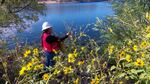
Alauna Grant gathers native sunflower seeds alongside the Iron Gate Dam reservoir, Sept. 6, 2023. Workers with local tribes are cutting down weeds and collecting native seeds to replant the land exposed following the removal of the dam.
Todd Sonflieth / OPB
Long before the four dams along the Klamath River were removed, the habitat restoration process began. RES, a company that specializes in ecological restoration, has been involved in the process since 2019.
It’s charged with working on habitat restoration and will continue to maintain the project for about five years. We check in on the effort with Dave Coffman, the director of Northern California and Southern Oregon for RES.
Note: The following transcript was transcribed digitally and validated for accuracy, readability and formatting by an OPB volunteer.
Dave Miller: This is Think Out Loud on OPB. I’m Dave Miller. The removal of four hydroelectric dams along the Klamath River was completed last year. As we’ve talked about before, it was the largest dam removal in our country’s history. But that massive undertaking was not the start of the habitat restoration process for the watershed. In fact, it was more like a midpoint. Restoration began back in 2019. It’s been led by a company called RES, or Resource Environmental Solutions, and they’ll continue this work in the years to come.
Dave Coffman is the director of operations for RES in Northern California and Southern Oregon. He joins us now. It’s great to have you on Think Out Loud.
Dave Coffman: Thank you, Dave.
Miller: Can you give us a sense for the scale, the landscape-wide scale of this project?
Coffman: I can. The dam removal project itself, and the subsequent restoration of former reservoir footprints and associated lands, tallies in around 2,500 acres – but the impact is much broader than that. The Klamath River watershed is over 15,000 square miles in size. For reference, that’s a little bit larger than the state of Maryland.
Miller: I thought you’d say Rhode Island, which is a tiny state that’s always picked on, but Maryland is bigger than Rhode Island.
Coffman: It is. This project that removed these four dams and is restoring this land and this river, opened up access to another 450 miles of habitat for salmon and other anadromous fish upstream of the lowermost dam. It provides a continuity of water quality benefits down all the way to the coast, over 200 miles downstream of that lowermost dam.
Miller: What is your firm’s role in all of this?
Coffman: RES is the nation’s largest ecosystem services provider. We provide nature-based solutions for a range of reasons and purposes, either to offset impacts, from say, development, or in this case, the Lower Klamath Project to minimize the impact that a potential project, or a certain project, may have on the environment. And our role here is to not just provide restoration services, as far as native re-vegetation and in-stream habitat, but also to provide a guaranteed outcome for successful restoration of this project.
Miller: How do you guarantee something, when we’re talking about the intersection of human interventions and the natural world’s response? It seems like, because of that second part, a guarantee seems really challenging.
Coffman: Well, it is challenging. Me, my team, others that work at RES spent our careers trying to figure out how nature responds to stressors and how different restoration practices may or may not be successful at any given place, at any given time. And we can honestly say that we figured it out sometimes. So we take that experience that we gathered over our careers. Some of the folks that work at RES have been in this industry trying to figure out restoration for three or four decades. So we tap their knowledge.
The other benefit that we have out here in the West is we have Indigenous knowledge, traditional ecological knowledge that we can tap on how to best steward landscapes. So we look and gather all the information we possibly can as far as what desired outcomes are for restoration and expected paths to get us there.
Then we work to develop a series of what we call success criteria, against which we monitor the outcome of restoration or our restoration practices. And if for some reason things aren’t on a projection that we desire – we call it a positive ecological trajectory – if things aren’t consistently improving, we have stopgap measures in place to then go out and monitor, survey, figure out why things aren’t recovering as anticipated. And then backup plans, and honestly backup plans for backup plans, to make sure that whatever the environmental stressor is, may it be drought or poor soil quality, whatever may be affecting the recovery of the ecosystem, we then can address it through a series of measures.
Miller: Let’s turn to some of the specifics in this restoration project. After the dams came out, there were about 2,200 acres of former reservoir footprint, and way more land past that. But what was that specific over 2,000 acres like in the immediate aftermath of the drawdown and the dam removal?
Coffman: Well, a lot of adjectives have been used in the past and the best one that I’ve heard is like a soggy moonscape, where we can all think of what the moon looks like, pretty barren and devoid, but then you add a bunch of water and it’s just wet and muddy. And that was generally it. It was a lake bottom. And anyone who’s seen a lake low during drought conditions, I think can understand what a muddy lake bottom looks like. It was soggy, the mud was deep, there wasn’t any vegetation growing. So we really did have the opportunity on this project to start ecological recovery from the ground up and, in this case, a very wet ground up.
Miller: Can you tell us about the seed collection process that preceded that?
Coffman: Yes, that’s the effort that started back in 2019, spearheaded by our predecessors on the project. We took over in 2019, supported by our friends and colleagues at the Yurok Tribe, to go into the watershed around the former reservoirs and to collect native seeds from a variety of plants that grow under a variety of conditions. Collected somewhere around 3 million seeds. Then over the course of a few years, through multiple iterations, taking wild-collected seeds to nurseries and to farms up and down the West Coast, were able to grow those seeds into something closer to 20 billion native seeds that we are in the process of planting over the course of a number of years in the former reservoir sediments.
So that was a massive undertaking, a huge effort, a lot of field effort, a lot of long hours, lots of effort in these nurseries to nurture and foster these plants to success, to where we could have enough native seed available to us to restore these footprints.
Miller: If it was a soggy moonscape in the immediate aftermath – and we’re not that far away from that time – what does that land look like today?
Coffman: I will try my best to paint a picture with words. The landscape has since dried out, it’s walkable. In some cases, it’s drivable with our implements and machines. I’ll say it’s not everywhere – every now and then we find a soggy spot. But we’ve now laid down two full rounds of native revegetation, grasses, forbs. We’ve planted trees, quite a few acorns. And that vegetation has taken hold.
Last spring and this spring, we were treated to what we would consider a super bloom of native pollinator plants, California poppy, Menzies’ fiddleneck and different species of Lupine that really put on a show as far as visuals go. And the green that these native plants are able to maintain as we move into the summer months surpasses that of the non-native invasive vegetation in the surrounding watershed.
So we’ve got a lot of green. We’ll have a couple more poppy blooms over the course of the summer, if last year is any indication. And the river and the streams are returning nicely. The river has returned to a nice clean color, not muddy as it was during and immediately following the drawdown. The tributary streams that have reoccupied their former flow paths are running clear and cold. I hear reports … I even heard one this morning from some folks who were rafting the river over the weekend and were really having trouble figuring out where the former reservoir footprint started and ended, because of all the native vegetation that’s taken hold out there.
Miller: Wow, already.
Some of the work that your team has been doing recently involved helicopters and large juniper trees. Can you describe that operation?
Coffman: Yes, sir. Large-scale restoration requires large tools and one of the most successful tools that we found out there for this project is aircraft. When we do restoration of large streams and rivers, we use whole trees to provide a couple of benefits. One is in-stream habitat for fish, and for bugs that feed the fish. The large wood provides a level of stability from erosion or different geomorphic processes. But we’re also recognizing that we’re working in a pretty dry part of the country in that portion of the Klamath Basin. So trees aren’t immediately available.
They’re around in the watershed, so what we’ve done is found harvest sites for large wood material in the immediate vicinity of the former reservoir footprints. And in a lot of cases, we’re using juniper trees and we’re thinning them in areas to provide a threefold benefit. The thinning provides a wildfire benefit, as you thin dense stands of juniper, you provide some wildfire resiliency. Juniper does have an oversized impact on groundwater supplies, so by removing this non-desirable species, we may be having a positive effect on local groundwater.
Then we fly those trees using large helicopters. Picture, for instance, Marine One, the helicopter that transports the president in Washington D.C. That’s the exact same make and model of helicopter that’s used to transport trees out here. They’ll lift whole juniper trees – trunks, branches and root wads – and fly them over long distances very rapidly to get them from the harvest site to the installation site. And it is a sight to behold, that’s for sure. It’s also a surefire way to see progress happen very quickly on these restoration projects.
Miller: And to mimic the natural process of, I don’t know, a 150-year-old tree falling into a stream and then creating a natural habitat that might last for 100 years. You don’t have that time, so you have to mimic it instantly.
Coffman: That’s exactly right. These trees are providing that, mimicking that natural condition, they provide a footprint for native vegetation to take hold. So as the native trees grow in the riparian areas around these, we’ll call them imported trees, as the trees that we bring in and incorporate into the restoration decay over the years, they’re being replaced by natural growing trees that will then kickstart or renew this process of wood loading into the streams and rivers, which science tells us is good for fish populations.
Miller: How are salmon doing now that they have access to hundreds of miles of river that had been closed off for 100 years?
Coffman: Well, the short answer to that is, we’re working to figure it out. The shorter answer, yet very optimistic one, is we, the project team and other folks working on the project, always kick around questions and answers in interviews such as this or at conferences. We get asked questions of how soon do you think fish will return to the Klamath? How soon will salmon come back to the Klamath? And we could always say, with good feelings, that we think salmon will be back in the Klamath and these former reservoir footprints within a few years following drawdown.
Well, I’m very happy to say we were very wrong with that conclusion. There were over 6,000 adult Chinook salmon counted, having passed the former Iron Gate Dam footprint last year, and dispersing upstream, reaching rivers in the state of Oregon up in the former JC Boyle footprint, where they hadn’t been able to access in over 100 years. And those fish were seen in those river reaches up in Oregon within two weeks of the removal of the final dam material at Iron Gate Dam. So, you want to talk about positive affirmation of the hard work that’s gone into this project, seeing those fish return as quickly as they have was pretty mind blowing, very emotional for a lot of us.
As for how they’re doing, the resource agencies, ODFW and CDFW down in California – who are monitoring fish recovery – we’re hearing reports back of healthy outmigration of juveniles this year into the mainstem Klamath and down towards the ocean. So, signs so far are all pointing to very good recovery potential for these fish.
Miller: What other animals are you finding in the areas that are no longer underwater?
Coffman: A lot of really neat stuff. Some [are] a little more challenging than others to work with. We found out that the cracked reservoir sediments make great habitat for rattlesnakes.
Miller: Do they have food?
Coffman: They must have food if they’re there. One thing about snakes is, if there’s snakes there, that means there’s rodents. And if rodents are there, that means that the hawks and the other raptors have a prey base.
Miller: So, in other words, rattlesnakes are a sign of a much fuller ecosystem that you’d like to see.
Coffman: That’s a great way to put it. They’re an indicator of recovery. Some of the other things we’ve seen out there, we installed some camera traps – those are game cameras. We install game cameras out and around the former reservoir footprints to get a view of what’s coming in and out. The deer are coming in and out for water and grass. They really do like the native vegetation that’s been planted out there. We’ve seen elk pretty far down in California. We know that they were up and around the portions of the project in Oregon, but down in the lower reaches of the project, we’ve seen elk, we’ve seen mountain lions, bears, you name it. If there’s a critter in Northern California or Southern Oregon, they seem to be, if not using, at least passing through these project areas.
Miller: Has any of the funding chaos at the federal level affected this project?
Coffman: No, sir, it has not. The funding for this project was provided years ago via the states of Oregon and California, and has not been affected by any of the federal shakeups recently.
Miller: You know, I’ve had a lot of conversations in the last couple of years with members of Indigenous tribes from the area – Karuk, Yurok, Klamath tribes – and they’ve talked very profoundly about their familial connections that go back countless generations. They’ve talked about the work they’re doing in the context of people to come, of future generations. You have a different background, you’re not from this land. But I’m curious how you, yourself, think about either the near future or the deep future, when it comes to the work that you’re doing right now?
Coffman: Well, a project like this gives lots of opportunities for thoughts about that exact thing. You know, I grew up on the land too – not this land – but did grow up on the land, being nourished by the land, just like our Native American friends who have lived on the Klamath River and been sustained by the Klamath River since time immemorial. And it’s profound to think about the impact that these dams had on the river.
But now the restoration project … So often we think about restoration as planting grass and putting habitat in streams. When you think about it a little more broadly, we’re restoring people through this project. We’re restoring people to the land. We’re restoring the ability for the river to sustain generations of folks whose entire livelihoods were based around this river. I’ve worked on a lot of restoration projects around the country and I can say that this one has had the most profound impact on me, just through the recognition of that, the benefit of a restored river restoring people.
Miller: It was a real pleasure having you on. Dave Coffman, thanks very much.
Coffman: Thank you.
Miller: Dave Coffman is the director of operations for the company that is behind the ongoing restoration efforts in the Lower Klamath Basin.
“Think Out Loud®” broadcasts live at noon every day and rebroadcasts at 8 p.m.
If you’d like to comment on any of the topics in this show or suggest a topic of your own, please get in touch with us on Facebook, send an email to thinkoutloud@opb.org, or you can leave a voicemail for us at 503-293-1983.