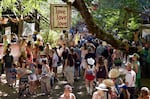
A banner proclaiming the “love” ethos of the Oregon Country Fair hangs from a tree limb. Though the large limb protrudes into the pathway, the fair works around it. “In anything we're doing, what we have to do is ask, ‘Am I expressing reverence for the land?’” said VegManEC volunteer Glenn Gregorio.
Dan Evans / OPB
“Fair,” as those who attend regularly call it, began in 1969 as a simple fundraiser for an alternative school.
But over the last 56 years, it has turned into a veritable Oregon institution. Its mission is to create “experiences that nourish the spirit, explore living artfully and authentically on earth, and transform culture in magical, joyous and healthy ways.”
In 2013, “Think Out Loud” went to the Oregon Country Fair and broadcast a show live from just outside the entrance gates to see how that mission was playing out.
“Oregon Art Beat” has a new profile of the fair, which airs on OPB TV Thursday, July 10, and is now up on OPB’s YouTube channel.
Our guests included fairgoers Lucy Kingsley, Geoff Silver, John Lyle and Suzi Prozanski, author of the book “Fruit of the Sixties: The Founding of the Oregon Country Fair,” as well as acoustic troubadour Brian Cutean.
We also talked with Tripp Sommer, KLCC news director; Sheri Lundell, who helped plan the first fair in 1969, co-founder of the Portland Saturday Market and owner of Cafe 26; and Peter Yarrow (1938 - 2025), formerly of Peter, Paul and Mary, who performed at the 2013 fair.
Production note: The 2013 live broadcast was hosted by Dave Miller, produced by Allison Frost, and engineered by Steven Kray and Jonathan Newsome. We had production help from interns Alex Eidman, Kathryn Boyd-Batstone and Jessica Kittams.
Note: The following transcript was transcribed digitally and validated for accuracy, readability and formatting by an OPB volunteer.
Dave Miller: This is Think Out Loud on OPB. I’m Dave Miller. The 56th Oregon Country Fair is kicking off tomorrow in Veneta. The annual event takes place every year in July. We have a special episode today in honor of the fair. It’s an hour that we did live from the fairgrounds in 2013.
[2013 “Think Out Loud” show recording playing]
Miller: Hello, I’m Dave Miller. It’s Think Out Loud, coming to you live from the 44th annual Oregon Country Fair. [Applause] We are on the stations of OPB as always and we’re thrilled to also be coming to you on KLCC.
It is a warm, nearly cloudless day here. We are just off the main entrance. There’s some patchouli in the air, people head to toe in tie dye, some of them we’ve seen in a drum circle practicing in the distance, with some dancers headed to the stage right now. Around the corner from us, you’ll find vaudeville, free juggling lessons and the Mighty Tiny Puppet Theater.
If you’re hungry, there is an international smorgasbord of portable food with knishes, crepes and burritos. Everything here, food and otherwise, seems to be suffused with the message that greets you when you walk in: Yes, yes, yes.
This hour we’re going to be talking to artists and musicians from fairgoers young and old. You can share your stories of the Oregon Country Fair. We want to know what your memories of “fair” are – that’s the way people say it here. What brings you back, if this is, say, your 30th or 40th time here? What are you most looking forward to if this is your first time?
We start right now with a little bit of history. Lucy Kingsley joins us. She’s gone to every fair since the very first one in the late fall of 1969. It was not in summery, sunny July, the very first time. She’s had too many different jobs here to list them all, but they’ve included medical coordination, food and crafts booths, registration, lost and found, and more. Lucy Kingsley, it’s great to have you here.
Lucy Kingsley: Oh thank you, David.
Miller: I should say it’s actually great to be in your home. It feels a lot more like that.
Kingsley: [Laughs] It feels like home to me for sure.
Miller: So you just came from the opening ceremonies. Can you briefly describe what happens at the opening ceremony?
Kingsley: Well, this year we were celebrating the element of air. There were people from a silent mime troupe called Risk of Change that came dressed as clouds. There were people with bubbles and feathers. There were a few of us on stage, celebrating in various spiritual traditions. And people dressed in white. There are altars that would have been made for the previous, I think three fairs, celebrating earth and water, and this year, air, fire, and then we’ll celebrate psycho-spiritual rejuvenation.
Miller: Psycho-spiritual rejuvenation. Let’s jump right into that. It’s a mouthful and I want to get to what that means. [Laughter] What do you mean when you say … And folks in the audience, if you have your own ideas, think about it because I’d like to turn to you next, what that term means to you, if that’s what you’re here for. But Lucy, what is psycho-spiritual rejuvenation?
Kingsley: What is it? It’s a place where I can come to be at home, to allow the better part of myself to be and to share with myself, the other folks that I work with. There are over 3,000 volunteers that put on this event. There are significant others that support them. And then of course there are the guests for whom we throw this fabulous festival party.
Miller: The guests … 3,000 volunteers, though.
Kingsley: Yes, over 3,000 volunteers.
Miller: So before we get to that, because there’s a lot there – does anybody in the audience have your own version of psycho-spiritual rejuvenation that you come here for?
What’s your name?
Darcy: Darcy.
Miller: OK, so what does that phrase mean to you?
Darcy: Recharging my battery and being around like-minded people.
Miller: How many times have you been here?
Darcy: I came, my first time, in 1996.
Miller: How many have you missed since then?
Darcy: Oh, a few, but I’ve come back.
Miller: So when you say recharging your battery, what do you mean and how do you know your battery has been recharged?
Darcy: When you have enough energy to give your love to other people.
Miller: Lucy, I mentioned that you’ve been here since the very first time: November of 1969. What was that very first fair like? How much do you remember from that first fair?
Kingsley: [Laughs] Well, there’s a saying that says that if you can remember the ‘60s, you didn’t live through them.
Miller: Is that true for you?
Kingsley: Not entirely, but …
Miller: There’s some gray spots there.
Kingsley: There’s some gray spots. There’s some holes in the Swiss cheese, yes. [Laughs]
Miller: What do you remember though from that first year? I understand it was very different. First of all, it wasn’t called the Oregon Country Fair.
Kingsley: No, it was called the Renaissance Faire. It was started as a fundraiser for what became a charter school, an alternative school for the children of folks. And there were some kids that just couldn’t manage to be in school in the normal way that school was operating, and this was a charter school and it was a fundraiser for them. We raised some money for the school, had a great time.
The form was essentially the same. It was craft booths and food booths, and people paid a small entrance fee, and there were some stages for entertainment. It was mostly acoustic back then. It was not on this site, land; we didn’t move to this site until several years later. It was up on a hillside, south and west of town. And it was just people coming together with common energy, common spirit, returning to the land, valuing things, valuing making things by hand, and making music from your hand and heart.
Miller: Did it seem that first year that this was something that was going to continue?
Kingsley: It didn’t seem like that at the time. And it’s been curious to me, being a part of the fair, to see how it’s changed and grown, and yet how in some ways it’s still the same. Sort of the same, same, but different.
Miller: So what’s different about it?
Kingsley: Oh, it’s certainly much larger. It certainly takes a whole lot more time, effort and material resources to put together. More of us are involved in putting it together. I think that first year … Well, the first year I came, I came as a tourist and I’ve worked every fair since then, so we’re not really sure. But it was just mostly a handful of people from the school who put the fair on.
Miller: So what’s kept it going? What turned this from something that was a benefit for a school into, in some ways, a local/international event?
Kingsley: I just think that it’s just become so clear to us that we need to come together, we need to celebrate together. We need to bring the best of ourselves, and show the best of ourselves to the rest of the world and to our guests that come, and to one another.
Miller: Suzi Prozanski is here with us, author of the book “Fruit of the Sixties: The Founding of the Oregon Country Fair.” It’s great to have you here.
Suzi Prozanski: Thank you, glad to be here.
Miller: What does that phrase mean to you, the “fruit of the sixties,” and how is this fair “the fruit of the sixties?”
Prozanski: Well, I thought of “Fruit of the Sixties” because of course the fair’s emblem is a peach, so I wanted to do something with the fruit. It’s a sweet, juicy thing that happens for a short time every year. As far as what it means to me …
Miller: How is this the fruit, in particular, of the sixties?
Prozanski: Well, that I traced pretty well, but it’s the values of the sixties, groups that … For example, Lucy was involved with the White Bird Clinic. When they first started, and they still exist in the community to serve people who can’t afford health care. And they were the first people to provide medical care at the fair. It brought together a lot of people like that, who would give of themselves sort of for their job and wanted to be that way in the world, try to live differently in the world.
Miller: We’re maybe a generation-and-a-half past that right now. Are the original leaders still holding sway here? Are they still in charge and are their values the ones that still feel like they’re the ones that inform the festival, the fair?
Prozanski: Well, there’s a lot of people who have been coming since the fair began – actually a few – and they’re not necessarily as involved. People at the very early years, sort of got burnt out and mostly are not involved from the first 10 years. But people who’ve been coming since the mid-‘70s, almost all of them that I’ve talked to are still coming. It just fed something in their soul that made them want to come here.
Miller: Lucy, you didn’t get burned out.
Kingsley: No.
Miller: Why not?
Kingsley: I think because there was a way that I continued to find a way to be fed by being here. It’s important for me to literally, physically stand on this land and feel embraced by it. And it’s absolutely a place that is my home and I have to come home. It’s sort of like the salmon having that sense of the waters where they were born. I sort of feel like that when I come back and actually step on the land that’s here, and be embraced by it and the trees, the birds and the moles that live under the office where I work. There’s just a thin carpet on the floor and the floor is different every morning. [Laughter]
Miller: Suzi, you wrote the history of this … On that note of the land here that Lucy has such a deep connection to, like a returning salmon here, how did this land that we’re on actually end up becoming the site for the fair? I understand that this wasn’t the original site.
Prozanski: It wasn’t the original site. The second fair was held off of Crow Road and the third fair was held here in fall of 1970. For many years, the fair would give its proceeds to nonprofits. That’s how it saw itself, as a fundraiser as well as a gathering place.
But in 1980, the fair became incorporated as a 501(c)(3). Jill Heiman, the fair’s attorney, helped that happen. And Sandra Bauer became the first fair president. That year, they filed a suit against the Lane County commissioners who were trying to shut down the fair. The commissioners and the sheriffs, they required the fair to pay a bond that they didn’t require from any other group. And the sheriffs, who were hired to help direct traffic, instead would stop cars on insignificant infractions and use it as a reason to search.
Miller: What was the reason for the animosity on the county’s part towards the fair? Why did they want to shut down the fair?
Prozanski: Well, the fair was always, especially back then, kind of a wild and free-spirited place. The county commissioners actually said on the record that they did not approve the fair values or the things that went on out there.
Miller: What did they mean by … Well, there are two different categories, there are values and things that went on. But what did they have in mind?
Prozanski: Probably the drug use that was happening. There was some then, yes, for sure. And that was part of the reason that they tried to shut it down, but they also objected to things like people being naked in the showers. I just have to point out it wasn’t just one thing. They really didn’t like the fair very much. So, Jill Heiman filed the lawsuit on the grounds of constitutional right to assembly.
[In the] meantime, the fair land came open for sale. The Western Aerial Corporation wanted to sell the 240 acres for $250,000. The fair didn’t have anywhere near that kind of money, but they started a charter membership drive. April 1982, the lawsuit came to a conclusion and the fair got the $19,000 in a settlement from the county that justified the lawsuit.
They used that money plus the charter membership to purchase the land, the first down payment. And the second down payment came in December after they held a concert where the Grateful Dead came and helped raise money and the Springfield Creamery helped create that opportunity. They used that money and the rest of the fair proceeds for the rest of the down payment. Then they bought it all off within 10 years.
Miller: We’re getting some of the deep history here, but we met some first time fairgoers as well. You mind telling us your name and where you’re from?
Amity: My name’s Amity. My sister’s called Holly. We’ve come all the way from England to visit the fair this year.
Miller: So what brought you here?
Amity: Well, our grandfather lives here. He’s been coming to the fair for over 20 years. Usually, we come in August to visit him every year, but this year he wanted to bring us over specifically for the fair.
Miller: What had he told you about the fair before you got here?
Amity: He told us it would be like nothing we’d seen before, and that it was quite wild and we’d enjoy it.
Miller: Was he right so far, like nothing you’ve ever seen before, wild and that you’d enjoy it?
Amity: I think so, yeah. [Laughs] Yeah, we’ve really enjoyed it so far. And we got here yesterday. We’ve only been here at night, so we haven’t really seen that much yet, but it seems …
Miller: Now are you camping here as well?
Amity: Yeah, yeah, we’re staying over.
Miller: So is there some image that sticks in your mind so far? As you said, under a day only, but anything that sticks in your mind so far that sort of is the picture of Oregon Country Fair for you right now?
Amity: It seems just very creative, friendly, and we’re just really enjoying all the music and food. And there’s a lot of food, a lot of very good food. [Laughter]
Miller: What have you eaten so far?
Amity: We had some tamales last night for dinner. And then some eggs and potatoes for breakfast. But we’re looking forward to eating some more.
Miller: Well, thanks very much for joining us. That’s Amity here from the UK.
Geoffrey Silver is with us as well. He’s a fairgoer. He lives in Portland. He does volunteer security and photography. In his non-fair life, he is a criminal defense attorney. Geoffrey Silver, good to have you here.
Geoffrey Silver: Thank you, Dave.
Miller: How long have you been coming to fair?
Silver: I started in 1977 and I’ve missed two fairs since then.
Miller: You’ve missed two fairs since 1977?
Silver: Correct.
Miller: That’s a pretty good batting average.
Silver: It’s my favorite place to be in July.
Miller: Just July?
Silver: It’s unlike anything else in the world. It’s a very special place.
Miller: What keeps you coming back? We heard earlier some great metaphors of recharging batteries, psycho-spiritual rejuvenation, returning like a salmon – although hopefully, unlike salmon, you’re not going to die when you get back here. But what brings you here?
Silver: Several things, the sense of community is pretty amazing here. The sense of being a part of something larger than myself where the creative energy is unlike any other place that I’ve been to, where people work together to create something larger than themselves. A majority of the people really volunteer here. There’s a very small cadre of paid staff, but most people give. It’s a way of giving service and giving back to this place that many of us call home. And I can say in one day here, I’ll get more hugs in one day than I do the entire rest of the year in the community.
Miller: Are these people you know who are giving you hugs or just people who see you walking and realize that here’s a guy who could use a hug right now?
Silver: Mostly they’re people I know. You keep coming back, you continue to make connections. So I haven’t been hugged by that many strangers, but there are a cadre of young people who go out giving free hugs to different people. So I wouldn’t say a victim, but I’ve had the pleasure of engaging those kids on occasion.
Miller: A beneficiary. I mentioned that in your non-fair life, you’re a criminal defense attorney in Portland.
Silver: That’s correct.
Miller: Does coming here every year inform your work as a criminal defense attorney at all?
Silver: There’s a crisis intervention or humanistic intervention training that is given here that really helps you accept all different walks of life and perceptions of reality. So it’s really helped me identify with a wide group of individuals. Very much those skills that I learned there helped me deal with everything from angry judges to people who have mental challenges who happen to be court-appointed clients, let’s say.
Miller: Geoffrey Silver, thanks very much.
Silver: You’re welcome.
Miller: Geoffrey Silver is a longtime fairgoer, Portlander, does volunteer security and photography.
Molly has called in from Lincoln City. Molly, welcome to the show.
Molly: Thanks.
Miller: Yeah, go ahead. What’s your experience here?
Molly: I’ve been coming to the fair. I’ve been coming to the site, actually, since 1972. I went there accidentally. Well, I went there to attend a concert for the Grateful Dead, but it turned out to be free. Anyway, during that concert, I saw the people and the beauty of the land. I saw the fact that we all helped carry the kids back to the original spot. We walked a long ways into the woods to get there.
The next year, I found out that there was a fair there every year. So I joined a co-op group that ran food booths and I was with that group for 14 years. It was Phoenix Rising, which was one of the first food booths.
My feeling is that, again, I have to come back there to that site and to the fair every year. I’ve been coming for 35 years. I’ve only missed three, during which my daughter was at a stage where she would say no to drugs, so I thought maybe she shouldn’t go for three years. But she’s coming with me this year and she’s 33 now. She was here with me before I gave birth to her in the summer of 1980. I kind of went down there. I was overdue for her birth and yet I figured [that] someone will help me, the White Bird will do it. And luckily she wasn’t born at the fair, but she was born two days later.
Miller: Molly, thanks very much for sharing that story.
So Lucy and Suzi, I’m wondering … because [that’s] the second time that drugs have come up. She said she didn’t want to take her daughter there when she was getting the message, say no to drugs. To what extent are drugs or drug culture a part of the fair from the past and to this day? Lucy?
Kingsley: Well, we’re a drug and alcohol free event, and have been specifically a drug and alcohol free event since the middle ‘90s. We are a family event, a place for children. And that, for some folks, has been a very difficult and challenging transition.
Miller: What do you mean when you say that?
Kingsley: Well, that the fair would say, obey the law, change the law, particularly with regard to the use of marijuana. And there are people who feel that it’s wrong that marijuana is illegal.
Miller: They disagree with marijuana prohibition and they disagree with your choice to actually enforce that here.
Kingsley: Yes, that’s right.
Miller: Yet, you have.
Kingsley: Yes, we are a drug and alcohol free event, and we say that on our publicity. We say that with our words and with our actions.
Miller: And how much do people follow those rules both during the day and at night on the campgrounds that are not officially a part of fair?
Kingsley: Who knows? [Laughter]
Miller: Who knows?
Prozanski: Who knows? It’s private.
Kingsley: It’s like what someone does in their own home is private, it’s like what someone does in their own campsite is private.
Miller: I want to run a comment by you. This was in a letter to the editor. It was written by a young woman at the time named Rose Lifschutz. She wrote in the Fair Family News, the newsletter – and she loves the fair, and there’s only an excerpt from it.
She said, “Each year it seems bigger, louder, messier, less like a community. The fair is a sacred place, but it seems it’s becoming an all-night party/concert/gift shop. I feel it’s rapidly changing around me. I wish there was something I could do about it. I understand I may be pining for the good old days, but I can’t help it. I’m sad when I think about the fair and where it’s headed.”
She wrote this six years ago. At the time she was in her early 20s and she’d been going her whole life. Does that ring true to you at all, that it’s gotten bigger and bigger and messier, and she says it feels less, as a result, like a community?
Kingsley: Well, the size of the folks that it takes to put this event on has radically increased. I currently work on the inventory crew and when I first started, the number of people that it took to put this event on was not quite 2,000 people. It’s now over 3,000 people that it takes. I think part of what happens is that people come here, they see what this event is and they want to find a way to become a part of it.
So, as from within the fair family, as the fair family grows and the needs for services grow, then we need more people to help provide more services. We need more people doing traffic. We need more people doing security. We need more people doing recycling. We need more people providing water.
The problems that the fair faces are the problems that the world faces. How do we work with growth? How do we sustain ourselves? How do we be sensitive and good stewards of the land? And when we just sort of draw more and more people who wanna be involved, who wanna participate, it’s a challenge.
Miller: Lucy Kingsley and Suzi Prozanski, thanks very much for starting us off.
Kingsley: Thank you.
Prozanski: Thank you.
Miller: Lucy Kingsley has gone to every fair since the very first one in 1969. Suzi Prozanski is the author of the book “Fruit of the Sixties: The Founding of the Oregon Country Fair.” That’s part one of a series of histories of the Oregon Country Fair.
[2013 “Think Out Loud” show recording pauses]
Miller: Our colleagues at Oregon Art Beat have a new video documentary on the fair that’s available on demand on YouTube right now.
I should note before we get back to this show that one of our guests from the original broadcast, Peter Yarrow of Peter, Paul and Mary, died this year.
[2013 “Think Out Loud” show recording playing]
Miller: We’re coming to you on OPB and on KLCC, live from the Oregon Country Fair. This year’s festival officially started a little more than an hour ago. Here’s how one longtime fairgoer has described the scene:
“Out on this land that disappears beneath the Long Tom River each year, our edges get frayed, our wires get crossed and we allow something other to come through: raggedy and hilarious, groovealicious and spontanaceous. Nothing like it ever was and never will be again, and it’s already changed again by now.”
That is the musician Brian Cutean. He is celebrating his 25th year at the Oregon Country Fair. [Applause] He joins us. I should just always have long quotes from our guests who write eloquent things. It makes my script a lot easier.
Brian Cutean, it’s great to have you here.
Brian Cutean: I think I have pink eloquence on parade. [Laughs]
Miller: What do you remember from your first concert here? This is your 25th year of coming here, but the very first time, what was it like?
Cutean: Well, it was a lot smaller, but the spirit has continued to spiral outward. It has grown, it has gotten bigger, but it is more together, I think in some ways than it ever has been before.
Miller: How do you see that as a musician and as a fairgoer, that kind of sense of togetherness?
Cutean: I’ve always come as a musician and they’ve always been real nice to musicians, because music is a big part of what happens here – the vaudeville and the performers, the stilt walkers, the dancers. I mean, everyone who contributes is a part of it and it’s been all inclusive. It’s been a wonderful, wonderful quarter of a century.
Miller: What has kept you coming back? Because as I understand it, you go to plenty of other festivals, but you keep coming back here.
Cutean: Well, I still tour. But actually, when a festival hires you back 25 years in a row, that’s a pretty good reason to come back.
Miller: Being liked is a good reason.
Cutean: Well, yeah, a lot of support. And I’ve went through a lot of my early stuff here where I had to learn how to stand in front of people and scream a little bit to make … If you’re going to stand by the side of the road, you have to be a bit of a force of nature.
Miller: So you actually learned a little bit about performing by being here as well?
Cutean: Yeah, a lot actually, especially for busking and street performing.
Miller: Yeah. Can you give us a song here?
Cutean: Sure.
Miller: What are you gonna play?
Cutean: I was going to play this song, because there’s a lot of people who come to the Country Fair, who find themselves at a jumping off point in their life where they’re either just about ready to move into a new part or leave an old part behind. And musicians and creative people live in their trucks and travel around, so that’s kind of a jumping off point too.
[Brian Cutean playing “Everywhere I Need to Be” – acoustic guitar and harmonica]
Well, I slept next to the highway
with diesels in my dreams,
I was taking it out of Texas once again
and I woke up to the dawn light
with the mountains in my blood –
finally getting back where I belong again
Then I crossed over Raton
while the morning was still young,
I was thinking about the cities and ol’ Townes
and the green of Colorado
took the breath from my lungs
while the wheels turned round and round and sang the song:
You know I don’t live in a house
but I always am at home
You can’t find me where you think I’m s’posed to be
And I don’t answer my phone
but you can leave a word at the beep
Don’t you lose no sleep worrying about me:
Where I am is everywhere I need to be
(That’s the truth, folks)
You know the desert is an open place
with a high lonesome sound
that’s where people go when they don’t want to be found
and the mountains keep deep secrets
shared only with the sky,
way out beyond the wandering why
I saw an owl in the desert
and she had a lizard in her beak
she was standing by the highway not needing to speak
while the cactuses were blooming
and the sunset painted the land –
well, these are things we all can understand
Even though I don’t live in a house
you know I always am at home.
You can’t find me where you think I’m s’posed to be.
and I don’t answer my phone
but you can leave a word at the beep
But don’t you lose no sleep worrying about me:
Where I am is everywhere I need to be
(At a little country fair … harmonica!)
I might be in your town tomorrow,
it could be a couple of years
You know, the road winds on forever far and near
Still I see you in the land and sky,
you’re in everything I do
you know I couldn’t go the distance without you
Sure is good to tell a story
and to hear one in return
You know that’s always been my favorite way to learn
So to all you rambling gypsies
with your stories up your sleeve:
I give thanks for your encouragement to leave
Even though I don’t live in a house
you know I always am at home
You know you can’t find me where you think I’m supposed to be
and I don’t answer my phone, but leave a word at the beep
Don’t you lose no sleep worrying about me:
Where I am is everywhere I need to be
Where I am is everywhere I need to be
Where I need, where I need to be
[Song ends]
[Applause and cheering]
Cutean: All right, thank you.
Miller: That is Brian Cutean and where he is right now is at the 44th annual Oregon Country Fair. His new CD of live Country Fair performances from 25 years of performing here is called … It’s nine letters, get ready for it: “QTNTFYOCF.” It stands for “Cutean Twenty Five Years Oregon Country Fair.”
Cutean: Hey, you got that!
Miller: I got that, only because you explained it to me. Then it makes perfect sense. So we’re going to hear a little bit more from you later if you don’t mind sticking around.
Cutean: I don’t mind stickin’ around.
Miller: John Lyle is here, a fairgoer from Hawaii. John, good to have you here.
John Lyle: Thank you. It’s great to be here.
Miller: When did you first come to the fair?
Lyle: I came here four years ago, which at that time was the 40-year anniversary, which was a milestone in itself. And I’ve been here every year since.
Miller: What was going on in your life four years ago, the first time you came here?
Lyle: It was around another high school reunion anniversary, which I didn’t go to, and I was extremely, I guess, unhappy and angry at our generation particularly, the generation of the ‘60s. I was very cynical about what we have done to each other in the world. And I kind of realized that we had the world on a silver platter and what have we done to take care of it?
So this couldn’t have come at a better time for me because I was feeling very disillusioned. And when I came here, I realized that not only were there a lot of people like this, but they were all here together and they had been here together for 40 years. What I saw created here was, like many people have said, something different than anything I’ve ever seen or experienced before and I didn’t know it even existed really in the world.
Miller: As you’re talking, it just occurred to me that on the TV show “Portlandia,” they had that famous video early on, “The dream of the ‘90s is alive in Portland.” As you’re talking, it occurred to me that it’s almost like what you’re saying – the dream of the ‘60s is alive, or the hope of the ‘60s is alive, at Oregon Country Fair. Is that a fair way to put it?
Lyle: Well, that’s a perfect way to put it. [Background applause] And you look at the people here, you make eye contact, and people acknowledge each other and they smile at each other because it’s safe. How often in our daily lives do we encounter this many people that are so open, kind, loving, helpful and happy to be here together, to be alive? And that blew me away.
Miller: So that’s a beautiful version of it. The more cynical one is that you only get that three days a year. So how do you keep that sense of hope alive? If you were angry, disillusioned, felt like your generation hadn’t lived up to its ideals, then you found this place, which does live up to it in a lot of ways, but it’s only for a long weekend in July once a year, how much hope can you get from that?
Lyle: Well, that’s a great question. I think if you ask that question to everybody at this fair, you would be amazed how many responses you would get, that people take a part of this in their own individual way back to their homes, their families, their coworkers, their communities. And the people here keep it alive.
Miller: Other people … [Talking to the crowd] I see some nods here. Yeah, what’s your name?
Ben: My name is Ben.
Miller: So that rings true to you [that] the energy, whatever that you get here, you can take it outside, you can feel it on a drizzly April day?
Ben: Absolutely. Once people are kind to you, and you realize you’re in a place where all you need is a smile, and that’s your passport to get through things, then you can take that anywhere you want to go.
Miller: Joining us on the phone right now is Peter Yarrow, a legendary musician. He is the Peter of Peter, Paul and Mary, and he’s going to be performing here this weekend. Peter Yarrow, welcome to the show.
Peter Yarrow: It’s a pleasure to be with you, my friend.
Miller: I understand that you’re at the fair somewhere here, although it’s a very big place, so I’m thrilled to get you on the line. What brought you here this year? I understand it’s also your first time ever at the Oregon Country Fair.
Yarrow: Yes, well, my son lives in Portland and has been singing the praises of this fair for many years. My son is a graduate of the Kerrville Folk Festival, which has a very similar kind of feeling, but it’s much smaller and it’s really focused on new singer-songwriters. But it’s also a place where you rejuvenate. You also participate in a moment.
Miller: In case people aren’t familiar with it – although there are some folks in the audience here who are – I think that’s a yearly festival in Texas. As I understand it, you’re coming here, among other things, as a spoken word artist. What are you going to be doing here this year?
Yarrow: Well, a great deal of my singing and my speaking are focused on pretty much the same thing, and affirming and committing to a sense of community, oneness and respect. It all harks back to the Civil Rights Movement. And of course we’re only a few days away, August 28, from celebrating the March on Washington in 1963 for the quarter of a million people at which Peter, Paul and Mary sang. And in many ways, although this is a non-political festival, just the way we treat each other ultimately becomes a political issue.
If we don’t have empathy and compassion for each other, then we allow laws to be made and policies to be developed that exclude, that creates greater inequity, that don’t advance the needs of the planet … in fact, slide now to catastrophic environment. So when I will speak, most important is my Operation Respect effort, which is a nonprofit that has a program called Don’t Laugh at Me in 22,000 schools in America and many other countries that have called upon us, like Israel and Croatia, and now Ukraine, Hong Kong.
That’s what I’ve been doing for 15 years. And the characteristic of this Operation Respect effort is that it has a program called Don’t Laugh at Me, which, when it’s implemented in schools, creates a caring environment – the kind of environment that’s reflective of what’s being shared here right now. There is mean spiritedness or superficiality that plagues our culture, so I’ll be talking about that.
I created most recently, at the request of the Newtown residents and people who were involved in it, a concert of caring, and grieving, and loving, and to fulfillment of what they call the Sandy Hook Promise, which means that they don’t want you remembered for the tragedies that occurred there being the place where only …
Miller: Peter, I’m going to … it’s a little bit hard to hear you right now unfortunately, because I think a lot of people are using cell phones around here and the towers are full up. But that’s Peter Yarrow. Thanks very much for joining us. Legendary musician, the Peter of Peter, Paul and Mary.
We got a comment from Alexis who says, “It may be iconic and all that, but to me, who formerly lived nearby, it’s iconic of an unwelcome throwback to the ‘60s. I lived the ‘60s and frankly, while I appreciate some of the artistic endeavors that arose from that era, I could do without the attitudes and especially could do without the drug culture. I finally sold my farm that was near the fair location. I had people squatting in my horse hay pastures without permission and leaving vast amounts of drug paraphernalia behind. I’d run them out and then back they would come.” That’s Alexis on our site.
Some stickers at that. Does that comment not ring true to folks here, folks in the audience? [Speaking to the audience] Anyone want to jump in?
Well, Sheri Lundell is here. [She] helped plan the very first fair in 1969, co-founder since then of the Portland Saturday Market, owner of Cafe 26, one of the fair’s original food stands. It’s great to have you here.
Sheri Lundell: Thank you. It’s great to be here. I’m sitting in the sun. It’s wonderful. I’m nearly asleep. I’ve had my food booth open all night. I’ve been up since 3 a.m.
Miller: Well, you seem bright-eyed and bushy tailed still.
Lundell: Well, it’s exciting to be here.
Miller: What was that very first year like? We heard a little bit earlier, but what are your memories of that first year? You were serving food then, right?
Lundell: No, the very first year I didn’t serve food. I went to it. I was one of the people who were at the free school at the time. It was kind of before charter schools and it was a rundown farmhouse on a peach orchard. And the first fair was absolutely beautiful. I had thought it was going to be a glorified bake sale. I wasn’t too much in favor of it, but it wasn’t. It was rolling hills …
Miller: Meaning that you didn’t think that it wouldn’t be like a fun event? What would a glorified bake sale be?
Lundell: Oh, I don’t know, where you put in more effort than you get back, that you might as well have just donated the money you spent on the cake.
Miller: And end up trading cookies to each other.
Lundell: Right, trading cookies to each other. But it wasn’t. It was beautiful. It was rolling hills. The property belonged to one of the people at the free school, one of the teachers, as we were called. It had oak trees. I remember bonfires and good food.
Somebody was making sourdough pancakes and it was just lovely. It was really nice. And I started serving food, well, the next year that we moved to this location – the June fair.
Miller: What did you serve that first year?
Lundell: I served shish kebabs. I had a card table and a Hibachi that both cost … total was like $2 that I had invested. And I had some food stamps, or commodity food or whatever, that I made some shish kebabs out of. They sold out right away. So I sent people into town to buy more and I made a lot of money for the time. I came home with like $500. I’ve been trying to make a profit ever since. [Laughter]
Miller: Chasing that first profit.
Lundell: Chasing that first profit, exactly.
Miller: So what did you get up at 3 a.m. this morning to make?
Lundell: Well, I have a wonderful crew. They’re all volunteers. A lot of them are second generation in our booth. We have our own fair family that we mostly only see down here. The night crew was kind of wearing out a little bit. They’d been awake all night and it was time to get up to prep for breakfast, so we started boiling potatoes, cracking eggs, doing some dishes.
Miller: How did your work here and running a stall here turn into or sort of propel you towards Portland’s Saturday Market?
Lundell: Portland was boring. I had been in Eugene, loved Eugene and did not move to Portland willingly. It was for a husband with a job and it was just so boring. There was no street activity. There was no counterculture. There was no excitement. My friend Andrea and I decided we should start a Saturday market, by golly. And I didn’t have any place to serve food. I really like to make food and serve it outdoors.
Miller: Is Thurman here right now? [Thurman] Scheumack, great. I understand you’re a broom maker originally from the Ozarks in Arkansas. Did I get the thumbnail of your story right?
Thurman Scheumack: Yeah, I used to work at a historical center in Northern Arkansas.
Miller: So what brought you here and what kind of brooms do you make here?
Scheumack: Well, that’s progressed over the years. It started out as just a traditional folk art from the Ozark Mountains and it’s turned into a little more of a witchy kind of thing since I started coming here.
Miller: That did better, the witchy stuff sold better at fair?
Scheumack: Well, I just make the brooms. I don’t ask what all they do with them. [Laughter]
Miller: So what does this all look like to somebody from the Ozarks? And why did you make the switch to actually move to the Willamette Valley?
Scheumack: Well, for me, it was life changing. It must have been great growing up in a place like the West Coast when you’re a liberal, you’re just hardwired that way from birth. But it’s tough when you come to live in a very conservative, fundamentalist kind of community like the South. So I was doing a series of kind of art demonstrations and working at art festivals up and down the West Coast.
I had this open weekend and I heard about this Oregon Country Fair thing and I didn’t know anything about it, what it was. There’s, believe it or not, nothing like this in Arkansas. [Laughter] So I kind of wound up here by accident. I won’t bore you with all the details. It was kind of a serendipitous thing and I wound up here not knowing what to expect. And let’s just say Arkansas never looked quite the same after that.
Miller: It’s hard to go back to the farm.
Scheumack: Yeah. [Laughs]
Miller: You talked to our producer right before the show. We met you and we found out that you just got married last night behind your stall, behind your booth?
Scheumack: Yes. Yes.
Miller: Why’d you want to get married here? First of all, I should say congratulations, then I’ll ask a question. Congratulations! [Applause] So why get married at the Oregon Country Fair?
Scheumack: Well, mostly because she’s my booth mate and it was very convenient.
Miller: That’s so romantic.
Scheumack: But it came complete with a chuppah we made in the back out of the local harvested cherry woods.
Miller: In the finest Arkansas transition, a chuppah. [Laughter]
Scheumack: Yes.
Miller: Your wife, though, is Jewish, right?
Scheumack: Yes. And yeah, that’s quite a thing, that’s a combination. That speaks a lot about the Oregon Country Fair in and of itself: a Jewish princess and the Ozark hillbilly. [Laughter]
Miller: Well, congratulations again.
Tripp Sommer is here. Before we say goodbye, as I’ve said a couple of times, we’re broadcasting on OPB and on KLCC. Tripp Sommer is a news director for KLCC, which has been broadcasting a lot from the main stage since 1992.
Tripp, first of all, thanks very much for letting us on your station.
Tripp Sommer: Welcome. Welcome to the fair. Welcome to the KLCC airwaves.
Miller: So why break away from regular programming, from either your local programming or NPR news, to bring stuff from the fair?
Sommer: KLCC, as other radio stations, feel a mission to have community outreach and we have had a booth at the fair since the late ‘70s in the community village. And once we got a remote broadcast equipment, I talked to the folks at the main stage and said we would love to bring this event to our listeners who either can’t make it, don’t know about it, or just something that’s a huge cultural event. This is news. This is community, this is culture.
Miller: And what do you hear from listeners? Is it all positive or do some of them say, “hey, where’s ‘All Things Considered?’”
Sommer: “Where’s ‘All Things Considered?’” Exactly. And we try to honor that. Each of the next three days, we’ll be broadcasting the top of the hour news from “All Things Considered” and then come back to the main stage for the headliner of the day. So we incorporate it into our programming as well.
Miller: Well, Tripp, thanks very much.
Sommer: Pleasure.
Miller: That’s Tripp Sommer. He’s the news director of KLCC. Thanks to everybody here and in particular the great folks at KLCC who helped make this a simulcast.
I wonder, Brian Cutean, if you could take us out with a little bit of music, a little bit of instrumental music while we say goodbye. I wanna thank our audience here and all of our guests. From the Oregon Country Fair, I’m Dave Miller. Have a great weekend.
[Brian Cutean playing acoustic guitar]
“Think Out Loud®” broadcasts live at noon every day and rebroadcasts at 8 p.m.
If you’d like to comment on any of the topics in this show or suggest a topic of your own, please get in touch with us on Facebook, send an email to thinkoutloud@opb.org, or you can leave a voicemail for us at 503-293-1983.