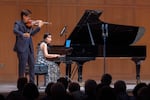
Pianist Gloria Chien and her husband Soovin Kim are pictured in performance in this July 2024 photo provided by Chamber Music Northwest. They became artistic directors of the nonprofit in 2020, taking over for the renowned clarinetist David Shifrin. The theme of the this year's summer festival is “Echoes of Bach."
Courtesy Tom Emerson/Chamber Music Northwest
The 55th annual summer music festival by Chamber Music Northwest is now underway. This year’s theme is Echoes of Bach, featuring the composer’s work and dozens of other masterpieces from other eras that resonate with it. For decades, the nonprofit was led by the renowned clarinetist David Shifrin. In 2020, pianist Gloria Chien and her husband, violinist Soovin Kim, were named as artistic directors. We first talked with them in 2021, the year they received the Chamber Music Society of Lincoln Center’s Award for Extraordinary Service for their work during the pandemic. We talk with the duo about their time at the helm and how the organization has grown since then - and what makes Chamber Music Northwest’s summer festival an annual draw for some of the most talented musicians from around the world.
Note: The following transcript was transcribed digitally and validated for accuracy, readability and formatting by an OPB volunteer.
Dave Miller: From the Gert Boyle Studio at OPB, this is Think Out Loud. I’m Dave Miller. The 55th annual summer music festival by Chamber Music Northwest is now underway. This year’s theme is “Echoes of Bach.” It features some of Bach’s work, along with dozens of pieces from the centuries that have followed from composers who have celebrated and been inspired by the Baroque master. In 2020, the pianist Gloria Chien and her husband, violinist Soovin Kim, were named co-artistic directors. They took over from the beloved clarinetist David Shifrin.
Gloria and Soovin join us. It’s great to have you both on the show.
Gloria Chien: Thank you.
Soovin Kim: Hi, Dave.
Miller: This year’s theme is “Echoes of Bach.” Where did that theme come from?
Kim: Well, we love thinking about music throughout history referring to other pieces, other composers, as if there’s a conversation going on across the centuries. Last summer, we had a focus on Beethoven – “The Beethoven Effect.” Beethoven revolutionized music history in so many ways ...
Miller: … Including, though, writing a ton of string quartets and piano trios. Classics of the chamber music canon, which you can’t say the same thing of Bach, exactly.
Kim: That’s right. But what we were talking about last summer, and talking specifically a little bit less but in the general spirit of celebrating, is Bach and Beethoven have an effect on virtually every composer since then. I remember a number of years ago, I was talking to a panel of living composers, both younger and older today, and the one name that came out of every one of their mouths was Bach.
They played Bach every morning on whatever instrument they’re playing. They listened to it, they studied it. And it’s just incredibly stimulating, mysterious to us still. Probably even for the greatest musicians in the world, still the most elusive composer, even though we all love it and study it our whole lives, the complexity of the language.
Miller: Gloria, what does Bach mean to you as a violinist?
Chien: I’m a pianist, actually.
Miller: As a pianist, sorry.
Chien: That’s OK. Well, I think the whole history of Western music would be very different without Bach. I don’t know that it would exist the same way. But one really striking thing is when the pandemic hit and everything stopped, everybody started playing Bach. And it’s partly because he also just wrote incredible monumental works for solo instruments, but also I think it speaks to his music and how it connects and heals in a very, very personal way. I mean, Goldberg Variations is one that I go back to every time, so I spent the pandemic just every morning playing some of the variations and it was very healing.
Miller: Soovin, did you play solo Bach partitas on violin in those same times, alone?
Kim: Yes, I did. Although the pandemic was very strange, especially to be a violinist. Yes, the solo Bachs, those are some of the few pieces that we can play on our own without other instruments. But playing solo Bach has been a part of my whole life.
And something Gloria said about how essential it seemed to become at a moment like when we were in COVID lockdown … I noticed at some point, that at some of the most special moments of life, like a wedding or a funeral, we often turn to Bach. I was living in New York on 9/11 and afterwards, Bach everywhere. It’s something we turn to for celebration, for reflection, for mourning, all at once.
But one additional, very specific element about Bach’s music that we are exploring all summer is the idea of counterpoint. Multiple voices at the same time conversing with one another, sometimes enhancing each other, agreeing with each other, sometimes fighting with one another. Bach was the master of counterpoint and he still is the master of counterpoint. Everybody’s been chasing him since. And I think that relationship between the voices, that conversation has so many analogies in life. I think, ultimately, that is a huge part of why we keep on referring back to him. It’s like us having this conversation, but examining it in many different ways.
Miller: You started this festival with a whole set of six Brandenburg Concertos. Let’s listen to an excerpt from the first – this is the third movement of his first Brandenburg Concerto. This was from the beginning of this year’s festival. We’re going to hear, among other musicians, the violinist Shunske Sato, Oregon Symphony principal horn Jeff Garza and Seattle Symphony’s hornist Jenna Breen. Again, this is part of the third movement of Bach’s First Brandenburg Concerto.
[Bach’s orchestral Brandenburg Concerto No. 1 playing, performed at the 55th Summer Festival, “Echoes of Bach”]
Miller: Soovin, what stands out to you listening to this performance now?
Kim: The incredible joy, the rejoicing. Admittedly, the first Concerto has been my least favorite throughout my life.
Miller: I’m so glad you said that because it’s mine too.
Chien: Really?
Miller: Yeah.
Chien: Oh … Did you hear the concert?
Miller: No, I didn’t. This has nothing to do with this performance. It’s just the others are extraordinary in different ways and this one has resonated with me less. You were saying that, but then you heard this performance and it was different for you?
Kim: After this performance, it’s my favorite. And this is a tribute to the leader Shunske Sato and the entire band. But the whole spirit of this performance of the complete Brandenburg was really defined by Shunske Sato, who these days is almost undisputedly the biggest name and the biggest excitement in the historical performance practice world, as a violinist. Just one of the most dynamic string players in the world and he inspired everybody so much.
Miller: Gloria, we last talked in 2021, less than a year into your joint tenure as artistic directors, and at a time when life and performing was still super heavily impacted by the pandemic. What do you most remember about your early days as an artistic director of this nonprofit, this festival?
Chien: It’s surreal to think back to that time. But I actually also have a very fond memory of our first live festival that was reduced, and after being away from everyone and for all the musicians that were playing through the channels, to come together in a way where … So, that summer, when we first came back together, it was socially distanced, we reduced the number of audience, but we also decided to start every concert with a prelude of some sort. And it could be a Bach, it could be something meditative or a movement of the Messiaen. And I remember the Echo Chamber Orchestra, they started with a Bach Chorale. They just hummed it.
Miller: These were string players who held their instruments and they all hummed or sang.
Chien: Yeah, and it was just one of the most moving moments that I could remember. But it was also the very first time that we felt like we all came back together and how appreciative we were to have an audience, to be able to play with each other and to have a community. Yeah, it feels like frozen in time.
Miller: Soovin, do you think anything good came from that dark time, artistically?
Kim: That is a very interesting question. Yes, I’m sure there is a lot, but if you press me right now to say exactly what are the the biggest things, I’m not sure. I think the first thing that hits me is an appreciation for what we do.
Miller: Is that something that can last? It’s something I’ve wondered, not as a musician, but just as a human. There are so many things that I remember saying, or hearing people say, “Oh, now that we’ve seen this, things will never be the same. When we go back to some version of regular life, we won’t forget this feeling, we won’t forget this specialness, we won’t forget ‘X, Y or Z.’” And I don’t know. I feel like personally, I have forgotten a lot of those things. It’s so easy to go back to old ways, even when you say you won’t.
Chien: Well, it’s certainly …
Miller: We’ll get back to music in a second, but I’m curious about artists’ view of that time.
Chien: Well, we found different ways to reach people from around the world. I think that’s a positive. In that time, also, we were able to invite artists from around the world to make these absolutely beautiful video concerts for us that I still treasure very much and I’m so glad we have those. So certainly the exposure and ways to connect with different audiences, and to also just to see what’s out there, that is all very positive. Yeah, you’re right, I mean, life goes on, but we do remind ourselves from time to time that it is a gift.
Kim: The technology – and that’s basically what Gloria is saying – the upgrade in technology that classical musicians, the classical music world, was forced to confront, learn and utilize, that was really great. I think we were far behind the rest of the world. It also does happen to be probably one of the most difficult things in the world that human beings do, to translate with technology.
But what that has enabled now, every young student now is so much more aware of microphones, of speakers, of how to record on your own, taking video. And I know that our contact with musicians around the world is just so much closer. It’s become a closer community, shrank the world. I teach a lot and now, without a thought, we have lessons with students who are in China. And it makes sense.
Miller: Something that was weird – if not impossible – in 2019, for most people.
Kim: It was possible, but we weren’t utilizing it.
Miller: Yeah, and probably many people would have said, “No, I’m not going to do that.”
Kim: That’s right.
Miller: Many teachers at least.
Let’s get to some more music. Next weekend, Sunday the 20th, and then a week from today, Monday the 21st, folks can hear a Mendelssohn Viola Quintet, meaning one more violist added to a standard string quartet.
Let’s play a recording of this piece from the 2017 summer festival. This featured the Brentano Quartet with guest violist Hsin-Yun Huang. Here is part of the first movement:
[Felix Mendelssohn’s Viola Quintet playing, performed at the 2017 Summer Festival by the Brentano Quartet]
Miller: Apologies, Felix. I’m gonna cut in for a second here. What was Mendelssohn’s relationship with Bach and Bach’s music?
Kim: Bach, believe it or not, was very close to being lost to the world and he was not nearly as appreciated in his time. Not just as much as today – I mean, nowhere near – but even as much as many other composers of the day. He was a bit of a renegade. He was, by all accounts, a virtuoso organist, but people sometimes stopped going to his church because they couldn’t stand the cacophony of his playing, the dissonance. It’s very …
Miller: He was avant-garde.
Kim: Yes.
Miller: He was a contemporary musician and people didn’t get it?
Kim: Well, you listen to the Brandenburgs and there’s a lot of noise, there’s a lot of harmonic dissonance that ends up coming together, a lot of it because of this idea of counterpoint that we’re talking about.
Miller: I’ve heard some people say that some Baroque music, it’s like heavy metal today.
Kim: That is true. It went in a very much more elegant direction in the classical era. I love the Baroque sound, especially when you’re using a harpsichord – that has that very metallic sound. But Mendelssohn was credited in the 19th century [for] really saving Bach, and not just rediscovering, but really championing and putting forward to the world his music. And that was reflected in his composition as well, the counterpoint, the spirituality of it. I’m sure that’s one way in which he really connected to Bach.
So this is why Mendelssohn is a major part of our summer festival. We have three of the greatest, most beloved works in the chamber repertoire: These two Viola Quintets, the B-flat – we already did the A-major – and then the Octet, the famous Octet that will be performed this week.
Miller: Gloria, can you tell us about the Protégé Project, which is now, at this point, one one of the longstanding parts of this festival?
Chien: We’re actually celebrating our 15th season for the Protégé Project. This was started by David Shifrin, our beloved artistic director emeritus. It’s his legacy. He had an eye of identifying who is going to be the next big star in classical music. And all of them are by invitation only and they’re all at the cusp of their big major international career. Before the Dover Quartet won the Banff [International String Quartet] Competition, they were here. This coming week, we have the current and the alums. We have about 12 of them on stage together.
I was very lucky to be one of the protégés back in the days as well. We invite them here to not only give recitals, but also to be on the main stage with our senior artists. And to give them these opportunities to build their community here, but also just launch them into the world.
Miller: What did it mean to you to be one of the protégés 13 years ago?
Chien: Well, David Shifrin has been a major figure in my musical life and he has been, always, a great mentor for me. So for him to invite me here was a great honor, but also to collaborate with the artists that summer opened a lot of doors for me and also opened my eyes about this community.
I remember so much about going to the concert, to see the picnic before the concerts and what that was like, and how the concert is not just about what’s on stage, but it’s also about the relationships that you build with people and the community that you build. So I remember it very fondly, that summer, and surreal to be here in a different capacity.
Miller: Yeah, to be in charge of it.
Soovin, you also have a newer program called the Young Artist Institute. What’s that?
Kim: Gloria and I began the Young Artist Institute in 2022 – we just finished our fourth summer. It is a group of 16 high school-aged students from around the world, primarily from the United States, but each year we have several international students. Also, by invitation only. They all come to the program on full scholarship. And we have, each summer, four of whom I consider the greatest teaching-artist-performer faculty in the world. We spend three weeks with them working very intensively on solo and chamber repertoire, and that has also been an incredible human experience.
I’m sure many of these students are someday going to become protégés. And as Gloria was talking about all the protégés, both current and former, that are in town this week, I was just thinking, “Wow, David Shifrin was identifying leaders of the next musical generation.” The ones that are coming back now are now the leaders, some of the greatest players in the world. So, mission accomplished by David Shifrin and we just are trying to continue that tradition.
Miller: That’s about the pipeline of musicians. How do you think about a pipeline, if that’s the right word, for audience members? I ask because I’m a huge fan of chamber music and often when I go to a concert – I’m about 50 now – there are sometimes people who are younger than I am. But I’ve been to plenty of concerts where I am the youngest person in the audience. And it makes me, I guess the word is despair, sometimes for the future.
Kim: Well, there are many people who have presented concerts for a long time, who say the audience, the youngest have always been about 50.
Miller: So, even 50 years ago …
Chien: The empty nesters start to go back …
Miller: OK. But I do wonder … I mean, the only reason I like this music now is because my grandparents and parents played it for me, and they dragged me to concerts and then I ended up caring about it. So I do feel like kids have to be dragged, if they’re going to go when they turn 50.
Kim: They do, exposure certainly helps. But first of all, when I said the youngest member is always 50, it does depend on each community and each organization. One thing that we have come to understand that was very special about Chamber Music Northwest when it was started almost 55 years ago was that it was a very young audience.
We have many audience members we meet every week who have been coming for 40-plus years and some of them every summer from year one. So that definitely was a strength of Chamber Music Northwest. We do need to always have this pipeline, so when we do community outreach as an organization, we are really focusing our efforts on reaching younger children. We want to provide for people of all ages, but certainly that early exposure is very important.
But it is a time of life thing, also. It’s hard, if you have families, if you have kids, you’re busy, there’s disposable income. And also it is one of these things, classical music, that is like wine, like art, certain kinds of food for a certain kind of palate. There’s an appreciation that does come with life experience. And I have found, actually, quite a number of very serious audience members who were not exposed to it when they were younger, but their friend or somebody like that may have exposed them …
Miller: Created that connection.
Kim: I think it’s very important for people. And it’s also a very social thing to go to together. That’s something we see at Chamber Music Northwest – friendships that have lasted decades coming to the concerts together.
Miller: I want to hear a little bit more music. And this is the piece that Gloria, you’re playing tonight. It is called “Quartet for the End of Time,” written by Olivier Messiaen, one of the most famous chamber works from the 20th century. Just briefly, what should folks know about where and when this was written?
Chien: It was written during World War II when Messiaen was in the prison camps. The circumstances was, these were the only instruments that were available and that the inmates knew how to play. So it was a combination of piano, clarinet, violin and cello. It was also premiered there for the camp and you can imagine under such circumstances this work was written.
Miller: This is a recording we’re gonna hear from 1986. It’s a Chamber Music Northwest recording and it features, among other musicians, the clarinetist and longtime artistic director of the festival, David Shifrin.
[Olivier Messiaen’s “Quartet for the End of Time” playing, performed at the 1986 Summer Festival]
Miller: Gloria, you mentioned that David Shifrin has been a really big part of your musical life, professional life. What does it mean to play with him? I should say he’ll be playing again tonight with you. What does it mean to you to play with him?
Chien: This is actually the iconic recording that many of us grew up with. So it is kind of a dream to be able to play this particular piece with David. And actually, my first time playing this with David was maybe 10 years ago. I remember that was the first time, at the end of the piece, I was emotional on stage. And I think that speaks to just how impactful this piece is, even for musicians. The other day, when we were running through the piece on stage, Clancy Newman, who’s our cellist, was in tears at the end.
So we talk about Bach’s spirituality and there’s certainly that element here where Messiaen writes. It’s in these different movements, some are solo movements, but there are these two movements for cello and piano, ends with only violin and piano. He goes to the abyss, literally, but he also goes to the most transcendent and the most … He has this way of putting these chords that are absolutely timeless. So after all of the chaos and all of the struggles, there is a certain sense of surrendering and peace, and you go away just feeling absolutely transcendent. So it’s very special.
Miller: Gloria and Soovin, thanks so much for coming in. I really appreciate it.
Chien: Thank you so much for having us.
Kim: Thank you.
Miller: Gloria Chien is a pianist, a co-artistic director of Chamber Music Northwest. Soovin Kim is a violinist and the other artistic director of the festival. It goes for another two weeks or so.
We’re going to go out on a recording of Brahms’ G-Major Sextet. This is from 2007. This is going to be one of the final pieces for this year’s festival. It was also played about 20 years ago. This is the Orion String Quartet with guest violist Paul Neubauer and guest cellist Peter Wiley.
[Johannes Brahm’s String Sextet No. 2 in G Major playing, performed at the 2007 Summer Festival by the Orion String Quartet]
“Think Out Loud®” broadcasts live at noon every day and rebroadcasts at 8 p.m.
If you’d like to comment on any of the topics in this show or suggest a topic of your own, please get in touch with us on Facebook, send an email to thinkoutloud@opb.org, or you can leave a voicemail for us at 503-293-1983.