If you’ve ever enjoyed a Spanish coffee made tableside while seated in a mahogany booth beneath art deco stained glass skylights, you may have done so in the bar at Huber’s — the oldest restaurant in Portland.
And for that indelibly Portland experience, you can thank James Kai Louie, Huber’s co-owner and grandnephew of the restaurant’s original chef.
Louie died at the age of 79 on Monday, leaving his son to manage operations alongside Louie’s siblings.
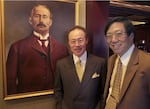
FILE - Brothers James and David Louie, co-owners of Portland's oldest restaurant, standing with a portrait of its namesake, Frank Huber, in 2014. James Louie, left, died this week, but the restaurant continues to be operated by the family.
Heather Arndt Anderson / OPB
Huber’s storied history stretches nearly 150 years. It first opened in 1879 as the Bureau Saloon, which moved from its first home on Southwest 1st Avenue at Morrison Street to Southwest 3rd and Washington Street in 1884.
Frank Huber, then the Bureau’s bartender, took over a few years later and, in 1891, Huber poached the Peerless Saloon’s 21-year-old cook Louie Wei Fung (known as Jim Louie), who’d arrived in Portland as an 11-year-old stowaway on a ship from Guangzhou of southern China.
They were a dream team: Huber poured the drinks, and Louie knew his way around a roast turkey, which soon became a staple of the joint.
In an interview with Oregonian writer — and yarn-spinner of yore — Stewart Holbrook, Jim Louie once recalled the time in 1894 when he had to work during a major flood. A party entered the Bureau Saloon in an oil-powered watercraft called a naphtha launch. Working from a rowboat behind the lunch counter, Louie served steamed clams and turkey sandwiches.
Undeterred by a little wet weather, Louie proved himself a true Portlander. It was the height of anti-Chinese sentiment, but even so his status as local legend was clinched.
Those turkey sandwiches would soon become the main attraction, keeping the restaurant afloat when Oregon banned the sale of alcohol five years ahead of national prohibition. With booze off the menu, the saloon pivoted and focused on the food — though if one asked the right way, a Manhattan might arrive at the table concealed in a coffee mug.
It turns out that cocktails served in coffee cups would make another appearance as a buffer to flagging sales decades later. In the 1970s, Spanish coffees became the restaurant’s second trademark. The cocktail was introduced to the menu by one successor to the family business, James Kai Louie.

FILE - The Spanish coffee at Huber's is labor-intensive but a major draw for bar patrons.
Heather Arndt Anderson / OPB
The cocktail is performance art, theatrically prepared tableside by a bartender smartly clad in a waistcoat and tie.
Long trails of bracing liquors into swirling glasses: high-proof 151 rum and triple sec. With the click of a brass lighter, the vapors are ignited into blue wraiths, which warm the sugar-rimmed glasses as they temper the ardent spirits.
With twirling wrist movements, the bartender keeps the wraiths dancing until the sugar on the rims begins to caramelize.
Next, a swan dive of Kahlúa coffee liqueur. The blue wraiths continue hooping until they are drowned by a pour of coffee and a cap of nutmeg-kissed whipped cream.
In its complexity and labor, the cocktail could almost be a tribute to the Mayan fire god Tohil.
James Kai Louie was first served a Spanish coffee at the now-defunct Fernwood Inn in Milwaukie, then modified the recipe for Huber’s, adding his own panache to the preparation. The labor-intensive beverage reignited the thrill of dinner theater and drew crowds to the bar.
Today, the bar purports to sell more Kahlúa than any other bar in the United States.
The drink isn’t just a Huber’s mainstay, though — according to award-winning bartender and author Jeffrey Morgenthaler, the Spanish coffee may be the closest thing Portland has to its own quintessential cocktail.
Like Huber’s turkey dinner — now in the hands of the fourth generation of Louies — it is not to be missed.