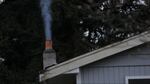
FILE - Smoke coming from fireplaces and wood stoves has been linked to a host of health effects including heart attacks, strokes, high blood pressure and asthma attacks.
Katie Campbell
The Environmental Protection Agency estimates there are more than 10 million wood-burning stoves in homes across the U.S., or roughly one for every 35 people. The smoke from those stoves can emit harmful particle pollution, which has been linked to respiratory illnesses, cardiovascular disease and a host of other health issues. Researchers at Oregon State University recently tested residential wood stove emissions in rural Oregon in an effort to understand how the stoves perform in homes.
Nordica MacCarty is an associate professor of mechanical engineering at OSU. She joins us to talk about her work to make wood stoves burn more cleanly and efficiently.
Note: The following transcript was transcribed digitally and validated for accuracy, readability and formatting by an OPB volunteer.
Dave Miller: From the Gert Boyle Studio at OPB, this is Think Out Loud. I’m Dave Miller. The Environmental Protection Agency estimates there are more than 10 million wood burning stoves in homes across the U.S., or roughly one for every 35 people. The smoke from these stoves can emit harmful particle pollution, which has been linked to a wide variety of health problems. Researchers at Oregon State University recently published a study showing just how much pollution wood stoves emit in a variety of homes in rural Oregon. They’re also working to make wood stoves burn more cleanly and more efficiently.
Nordica MacCarty is an associate professor of mechanical engineering at OSU. She joins us now. It’s great to have you on Think Out Loud.
Nordica MacCarty: Hi, Dave. Thanks for having me.
Miller: We were just talking before the show about wildfires. Smoke is obviously a really worrisome aspect of wildfires. But you’re talking about smoke from intentional fires, small fires in wood burning stoves. How do you think about the smoke and pollution that comes from these sources in comparison to the scale of wildfire smoke?
MacCarty: Yeah, that’s a great question. I was really interested to learn that smoke from wood fires for heating is actually the third largest source of particulate matter pollution. So behind that wildfire smoke and agricultural dusts, which are these big massive events that we can’t necessarily impact, wood stoves are really a significant source of pollution. Typically, we think of air pollution coming from things like vehicles and industry. But it turns out that household wood stoves are a quite a bit larger source and that just a few smoky stoves can create a significant negative effect on air quality in communities where people are using them.
Miller: What kinds of negative effects can the smoke from these stoves have on people’s health?
MacCarty: The smoke contains small particles. The particles are so small that they actually are able to get past our nasal passages, penetrate deep into the lungs and actually reach the bloodstream. So it contributes significantly to cardiovascular disease and the worsening of respiratory illnesses. And there’s lots of pretty nasty crud in there, like polycyclic aromatic hydrocarbons, carbon monoxide, benzene, formaldehyde, sometimes even lead. So lots of toxic components as well as the problems associated with the small particles themselves.
Miller: How much of all of that ends up inside people’s homes as opposed to going out their chimneys and into their communities?
MacCarty: In the U.S., there is a small concern with what we call fugitive emissions, which are the emissions that leak out of the stove when we’re reloading or things like that. But generally it’s the ambient air pollution that’s a more significant concern, at least in the U.S.
I do a lot of work in the developing world as well, where people are actually cooking on campfires inside their homes. About 2.7 billion people are still relying on wood for cooking and heating in the Global South. And so that’s where the indoor air pollution is really a significant concern, such that it’s the second leading cause of death for women globally. It’s just simply from breathing the smoke that they’re creating when they’re trying to prepare meals for their families.
So there are some concerns in the U.S. about indoor air pollution, but the ambient outdoor air pollution is a bit more significant.
Miller: What does the EPA require these days in terms of wood stove emissions?
MacCarty: Every five or 10 years or so, the EPA comes out with new guidance on the certification level at which stoves are able to emit particulate matter pollution. So about five or 10 years ago, that was 4 g/hr of particulate matter. And in 2020, they reduced that to 2.5 g/hr. So the current certification standard is that any stove sold or installed in the U.S. needs to emit 2.5 g/hr or less, based on lab tests in certification laboratories that are approved by the EPA.
Miller: My understanding is that part of your new research has really dug into the important words you just mentioned there, that that’s “based on lab tests.” Why was it important for you to look at real world use of these stoves? I guess I’m just wondering how different that might be than what people would put together in a lab?
MacCarty: Sure, great question. In the lab, what we’re trying to do is compare stove performance under very controlled conditions. So we can compare stove A versus stove B versus stove C and make sure that we’re comparing them all on the same basis. And so in the lab, we run very consistent load sizes, we use very consistent types of fuel, and that sort of thing; whereas when we get out into people’s homes, there’s a lot more variability.
Sometimes people are burning wood that’s been out in the rain or may be unseasoned, so it’s really wet wood. That makes it really smoky. Or maybe they’re overloading the stove and creating a lot of pollution that way, or maybe just operating it differently or not running the controls the way that the manufacturer had intended. So when we get out into the real world, we often see much higher levels of emissions than we would see in the lab.
Miller: You, as I noted, recently tested emissions of several wood stoves in different households in rural Oregon. What stood out to you in your findings?
MacCarty: We did emissions measurements in seven different homes, in rural areas around Cottage Grove. Those were stoves ranging from being 25 years old and uncertified, before EPA even had certification, all the way to the most current 2020 standards. And one thing we found was that the newest certified stoves do perform significantly better than those really old uncertified stoves that don’t have any sort of emission controls like catalysts, secondary air tubes or things that we know work well to help reduce emissions and improve efficiency. So it’s great to see that those certifications and that regulation is driving innovation such that we are seeing improved performance.
However, we did see that the emission rates were considerably higher than what stoves were when tested in the lab. Granted, we don’t expect lab tests to predict field performance. But we were seeing emission rates quite a bit higher than that 2.5 g/hr. So that’s putting a lot of smoke into the airshed. And one thing that we identified was that about 70% of the particulate matter emissions that we measured were occurring during startup and reload. So that gives us an indication of where we can work toward engineering better ways to reduce smoke. So if most of that smoke is produced when people are lighting the fire or putting fresh wood on, if we can figure out how to reduce smoke during those phases of the burn, then we can start making an impact on air quality.
Miller: Do you have ideas for how to do that?
MacCarty: Absolutely, yeah. We’ve been working on injecting jets of air under the fire and just above the fire at exactly the right place and time, and in the right amount that is needed to support clean combustion and really good turbulent mixing. So some of the innovations in our preliminary data are showing that we can reduce overall PM [Particulate Matter] emissions across the burn by 95%, if we inject this air at the right place at the right time.
Miller: Wood stoves though, they’re not like cell phones or, I don’t know, TVs that people seem to replace every couple of years. Wood stoves can last for decades. Meaning, replacing one that lacks function could be seen, by many households, as a luxury that they can’t afford. So what options do you see for the millions of existing stoves that are out there that don’t have either the current EPA required technology or even newer stuff that you’re hoping could, at some point in the future, become standard?
MacCarty: One of the pervasive problems of wood heat in general is that there are these legacy stoves in place. So for folks who have an old stove and aren’t able to do a change out, some of the advice is an EPA program called Burn Wise where they teach people how to check the moisture content of their wood, and make sure to provide plenty of air, and not load the stove full of wood, and then turn down the draft and let it go overnight, smoldering and producing a lot of smoke. So there are practices that people can follow to reduce their emissions.
Ideally, we would move toward changing out. Stoves don’t necessarily have to be really expensive. We see some models for $1,000 or less. And in the past, there have been change out programs, especially in communities where a lot of people are burning wood. So potentially there could be some subsidies and support for that.
Miller: You say that there have been, but in the past. Have those change out programs been eliminated by the Trump administration?
MacCarty: I don’t know for sure, but I know that there is currently talk of eliminating some of those subsidy programs. Yes.
Miller: Nordica MacCarty, thanks very much.
MacCarty: Thank you.
Miller: Nordica MacCarty is an associate professor of mechanical engineering at Oregon State University.
“Think Out Loud®” broadcasts live at noon every day and rebroadcasts at 8 p.m.
If you’d like to comment on any of the topics in this show or suggest a topic of your own, please get in touch with us on Facebook, send an email to thinkoutloud@opb.org, or you can leave a voicemail for us at 503-293-1983.