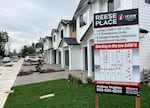
New construction in unincorporated Clackamas County pictured in early 2025. The mix of townhomes and single family housing is on Southeast Courtney Avenue.
Andrew Theen / OPB
Gov. Tina Kotek has aimed for a goal of 36,000 homes being built a year. As part of her housing development plans, Kotek’s office announced the launch of the Housing Accountability and Production Office, a joint office between the Department of Land Conservation and Development and the Building Codes Division. The agency will provide technical assistance and enforce state housing production laws. Joel Madsen and Tony Rocco, the office’s joint managers, join us with more about the goals of the agency and what it means for Oregon’s housing crisis.
Note: The following transcript was transcribed digitally and validated for accuracy, readability and formatting by an OPB volunteer.
Dave Miller: From the Gert Boyle Studio at OPB, this is Think Out Loud. I’m Dave Miller. Oregon’s latest government office has officially launched, it’s called the Housing Accountability and Production Office. It’s part of Governor Tina Kotek’s ambitious plan to greatly increase the number of homes being built. But since the governor made that pledge, Oregon has actually built fewer homes each year, not more. Kotek is hoping that this new office will, as she says, “break down barriers at every stage of housing production and ultimately get more people into homes they can afford.”
Joel Madsen and Tony Rocco are the office’s joint managers. Madsen comes from the affordable housing sector. Rocco spent a lot of his career in construction. They both join me now. Joel Madsen and Tony Rocco, welcome.
Joel Madsen: Thanks, Dave. Great to be here.
Miller: Tony, to start with you, I want to just say again that line from the governor – this was in the press release, this was your collective charge – that you need to “break down barriers at every stage of housing production and ultimately to get more people into homes they can afford.” What do you see as the biggest barriers right now?
Tony Rocco: Thanks for having us, Dave. I think the first thing we have to take a look at is the development process as a whole. That’s something that we are going to do here in the near future. That’s going to identify not only those barriers, but things that are working well, and then set the framework for maybe next steps and things to address initially.
Miller: Do you not already have a sense for that? Those are questions that an entire advisory council was set up to answer and give recommendations about. Lawmakers have been responding to those recommendations for a while. What more is there to learn?
Rocco: I think what we have to do is look at it statewide. I think we do already know a number of things that can be improved. I think there’s always room for improvement in different layers of regulation, so we do have those certain things already identified. But I think we have to look at the development process as a whole from the statewide lens.
Miller: What do you mean by that, the development process as a whole?
Rocco: So all the portions of the development process, whether it be local public works or infrastructure, or land use requirements, or application of the building code process and the permitting process.
Miller: Joel Madsen, what do you see as the biggest barriers right now?
Madsen: Thanks, Dave. I’d like to look at it as really like more of the opportunities that are before us. And one of the things I’m excited about for our office is the coordination across some of the key agencies at the state level that are focused on housing production. One of the charges of our office is to assist housing producers and local governments in navigating some of the complexities of the programs and policies at the state level. I’m excited to be leaning into that as an office, to get to the end result of producing more housing.
And in that vein, we’re charged with prioritizing the resources at the state and the coordination of state agencies to produce more housing. We’re working closely with, in coordination with the governor, to bring together, again, those agencies that have direct responsibility and engagement in the housing production process, with that charge to reduce barriers, set priorities across the state agencies, to maximize housing production.
And some of the things that I think our focus will be on: increase the supply, affordability and diversity of housing; remove those state-level barriers to housing production, which could be reducing duplicative requirements across state agencies, streamlining the process of review, approval and the warm handoffs among different agencies that housing producers are navigating through, reduce those unnecessary regulatory and procedural standards that may be in place. And then again, the third focus is around maximizing the existing state resources that can support increased housing production through leveraging or reprioritizing. We want to lean into that coordination and get to the end result of maximizing housing production.
Miller: The governor set a goal of building 36,000 homes every year when she ran for governor in 2022. There were, at the time, I think about 22,000 homes that were being built on average over a number of years, each year. But we’re nowhere close to that goal, as I mentioned briefly in my intro. Local governments in Oregon issued fewer than half of that number of permits in 2023 and last year it seems to have been even worse. We’re going in the opposite direction that the governor is calling for. Tony, why is that?
Rocco: I think we have an opportunity to get engagement from the developers and the housing producers, bring them to the table here, get their input, hear from them, and have them engaged in identifying things that they’re seeing day to day that is preventing them from developing housing in our state. And I think having them at the table and having them engaged is only going to just better inform the process, highlighting those areas where we can come together, the joint office, and help streamline the development process and create efficiencies where we have the opportunity.
Miller: That’s forward looking. I’m wondering if right now already, you have a sense for why it is that we’re going in the wrong direction? Or if you’re saying we just need to talk more and we’ll learn that in the coming years?
Rocco: I don’t have a great answer for why we are not producing them currently, Dave. I think what we’re focused on, as Joel mentioned, is looking forward at the opportunity, and how we are going to create solutions, come together and streamline processes to assist.
Miller: Joel Madsen, how much urgency do you feel right now?
Madsen: Certainly feel a sense of urgency. We have a housing crisis in front of us. Also, let’s just be clear, this is a new initiative and an essential component of our governor’s mission, to really treat housing unaffordability as a crisis.
Miller: Well, it’s a new piece of one of the key priorities of candidate Tina Kotek and Governor Tina Kotek that’s now been going on for a couple of years. So even if your office has just officially opened, it’s part of a process that she has been intimately focused on for a number of years now. And that’s why I’m a little bit confused about describing this as the beginning of an effort. It’s the continuation of a couple years of effort.
Madsen: Certainly, and thank you for acknowledging that. What our office is doing is really leaning into everything we can to make it easier, faster and cheaper to build the homes Oregonians need.
Miller: I’m longing for more specifics right now because I feel like Oregonians are as well. What do you hope to actually accomplish in terms of specific streamlining of permitting, codes or the process this year? What can you do in the next 12 months?
Madsen: We are that of a liaison between developers, local governments and state agencies to find and streamline funding opportunities. That’s what we’re focused on in the near term. We’re focused on creating a more predictable regulatory environment, ensuring that the state laws that have been passed over the last few years are being implemented effectively. And where our office needs to, we’ll step in with enforcing building laws and building codes or investigating complaints of noncompliance in housing production.
And then the third I would highlight is, by September of 2026, through research and evaluation, we’re gonna be providing to the legislature that research and policy options that are aimed at boosting housing production, affordability and choice statewide. Those are three concrete activities that we’re looking forward to in the near future to lean into as a joint office, with our colleagues at the building code division.
Miller: Joel, there is something that’s now been live for something like six months, it’s a $75 million revolving loan fund. Can you explain the idea behind that and how it’ll work?
Madsen: Actually, that’s not the best question for me. But I want to acknowledge that this middle income revolving loan fund was similarly established through the housing production package of 2024, known as the Senate Bill 1537, which also created our office. It created this opportunity for local governments to work in partnership with our colleagues at Oregon Housing and Community Services and housing producers to access a different type of funding that could address middle income housing needs across the communities.
I mentioned Oregon Housing Community Services, they’re our colleagues that are administering this program and would have certainly have more information about that.
Miller: Do you know if developers have taken advantage yet of this interest-free money?
Madsen: Again, I’m not the best person to answer that one, but I know there were also some adjustments that were occurring to that program over this last legislative session, working in close partnership with League of Oregon Cities and others, to hopefully make that product more friendly and excite the development community to lean in and utilize that resource.
Miller: Tony, I mentioned in my intro that you came from the construction industry as a laborer, contractor, a home inspector, and then over time have switched into state government. Before you started working at the state level, did you have a bunch of opinions about what was wrong with state or local laws or codes?
Rocco: Thanks for the question, Dave. I definitely had some challenges on the permitting side. A lot of it was on the customer service level. That’s something that we definitely have stressed, my past 14 years here at the building codes division, is focusing on providing that great level of customer service, being facilitators, providing dispute resolution, getting customers to safe building construction in an efficient way. We’ve made some changes that also reflect that in the Oregon Residential Specialty Code over the past few iterations. And I think we’re gonna continue to do that wherever we can.
Miller: I guess I’m wondering if before you worked for the state, if you said, “hey, I see these obvious places where government could function in a more efficient, more effective way, just make these changes.” And if now that you’re working for the state, you see the challenge of “just making those changes.”
Rocco: I guess one of the things I could point to is that, from the private side, I saw the development process just as a single one process. There’s actually very unique, kind of siloed regulatory systems within that development process. And I think that’s something that Joel and I are looking to streamline, and maybe remove those silos and create this seamless, more streamlined development process for Oregonians.
Miller: Would that potentially be tied to exerting more statewide control over things that have traditionally been handled at the city or county level? More control over building codes or permitting? I guess I’m wondering about state mandates as opposed to state suggestions for best practices.
Rocco: Yeah, great question, Dave. Here at the state, we have 131 local jurisdictions that work as an extension of us. We have great building officials here in the state of Oregon and we do promulgate the statewide building codes, so they should be consistent in all of the 131 jurisdictions here. And we provide, like I said, technical assistance to not only our local government partners and those great building officials around the state, but also to customers as well, on a daily basis, and try to move things along as quickly as possible.
So I don’t think you’re going to see any additional state mandates as far as the application of the state building code. I think what you’ll see is continued support and guidance for our local government partners.
Miller: Joel, are you aware of any examples of real success stories? I mentioned the statewide numbers that have gone down in recent years. But are there any cities or counties that are doing this right, that have greatly ramped up housing production in recent years in ways that you think could be models for the rest of the state?
Madsen: Certainly. I think one of the areas that we’re seeing success in is related to local jurisdictions’ awareness of how they can be more flexible in their development and design standards for housing development applications. So for example, this was a piece of legislation – this was part of the Senate Bill 1537 also – that set a benchmark for jurisdictions to allow flexibilities for housing developments. An example being like no parking requirements or allow for a development to have flexibilities in their lot set-asides. Again, just allowing the developer to choose from a variety of options for design and development standard flexibilities that could make the housing that they’re trying to produce happen.
And that’s been successful. We’re seeing it in communities, Astoria in particular, seeing it around the metro area where those flexibilities are unlocking developments that may not have previously been able to happen.
Miller: Tony, before we go, there is a certain irony here that part of the governor’s solution to streamlining a governmental bureaucracy and removing red tape is to create a whole new government office, the office the two of you are leading. How do you prevent your office from just becoming, in some way, a part of the problem that you’ve been tasked with solving?
Rocco: I think what we do is we stay focused on what we’ve come together to do, in streamlining the development process and increasing housing production in alignment with the governor’s housing initiatives. Our housing and building safety team here at the building codes division, we also have a number of other responsibilities here at the division that we do as well. We engage with Joel and his team. And I think that we stay quite busy with providing service to Oregonians, trying to resolve disputes and provide technical assistance.
Miller: Tony Rocco and Joel Madsen, thanks very much.
Rocco: Thank you, Dave.
Madsen: Thank you.
Miller: Tony Rocco and Joel Madsen are the co-managers of the new housing accountability and production office.
“Think Out Loud®” broadcasts live at noon every day and rebroadcasts at 8 p.m.
If you’d like to comment on any of the topics in this show or suggest a topic of your own, please get in touch with us on Facebook, send an email to thinkoutloud@opb.org, or you can leave a voicemail for us at 503-293-1983.