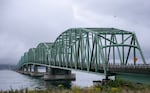
FILE - The Astoria-Megler Bridge as seen from the Washington side, Aug 11, 2024.
Anna Lueck / OPB
Clatsop County is exploring a pilot program that would convert vacation homes that are often left vacant into long-term rentals for people who work in the county.
As reported in the Daily Astorian, the program would offer cash incentives for property owners to lease out their homes for a year or more. The county has applied for a grant to fund the two-year pilot, but has yet to receive those dollars.
Clatsop County Housing Manager Elissa Gertler joins us to talk about the potential program and other possible solutions to the coast’s housing crisis.
Note: The following transcript was transcribed digitally and validated for accuracy, readability and formatting by an OPB volunteer.
Dave Miller: This is Think Out Loud on OPB. I’m Dave Miller. Clatsop County is exploring a pilot program that would convert often vacant second homes and vacation homes into long-term rentals. As reported in The Daily Astorian, the program would offer cash incentives for property owners who lease out their homes for a year or more. The county’s applied for a grant to fund the two-year pilot but has yet to receive those dollars. Clatsop County housing manager Elissa Gertler joins us to talk about this. Good to have you on the show.
Elissa Gertler: Thanks for having me, Dave.
Miller: Your county conducted a housing inventory recently. What did you learn?
Gertler: Well, we learned that in a place like Clatsop County that is surrounded by beautiful natural resources such as the Pacific Ocean, the Columbia River, the forests, that land is very hard to build on and very scarce, and that we have a scarcity of infrastructure needed to expand housing production in the five cities and in the unincorporated rural areas of the county. So as we think about how we are going to meet our housing crisis needs, we have even additional challenges just brought about by the natural configuration of the beautiful place that we live.
Miller: That’s a really good point because it seems like you’re referring a little bit to the conversation we just had, which was all about producing new homes. You’re saying that based on the geography and logistics of Clatsop County, you’re limited in how much you can build. What did you learn when you looked at what’s already there and who’s living or not living in existing homes?
Gertler: Well, we did learn that Clatsop County is very much a tourism economy. And to that end, a lot of the housing supply that does exist and is already built in our cities and in our unincorporated areas is a second home or a vacation rental. So there is a significant portion of housing stock that is not available to folks who live here year-round.
Miller: What is the scale of second homes or vacation homes that are not being used as short-term rentals? Over the years, we’ve heard a lot about debates over Airbnb, VRBO or short-term rentals and the effect they can have on communities like Astoria, Cannon Beach or others. But that’s a different conversation than what we’re talking about here, which is second homes that are not being rented out. How many are there that are largely unused for most of the year?
Gertler: Well, we collected the data and there’s a really good graphic available on the Clatsop County website, if folks want to go look at it in detail. But it really varies between the different cities. So in a place like Cannon Beach, which has a long history of being a place that people go for vacation, about two-thirds of the homes in Cannon Beach, of about 2,000 total homes, are considered “vacant for seasonal use,” meaning that somebody doesn’t live there year round. In a place like Astoria, there’s a little bit more of a mix. Probably only about 25% of the homes are considered vacant for seasonal use, which is still a significant portion.
But across all of the five cities – Astoria, Warrenton, Gearhart, Seaside and Cannon Beach – there’s a far larger percentage of homes that are vacant for seasonal use and a much smaller percentage of homes that are used as short-term rentals.
Miller: This led you, as I understand, to look into the Lease to Locals program. How does it work?
Gertler: This is a program that is being implemented in other tourism communities around the country and that’s what brought it to my attention. It basically pays property owners of second homes and short-term rentals a cash incentive to convert the use of their home to a long-term lease to a local worker. Many of the tourism communities face the same issue that we do in Clatsip County, which is the housing problem is also an economy problem. Our tourist industries depend on workers supporting the businesses that people come to visit and have a great experience at. But most of those workers, with the wages they receive, struggle to be able to pay for the housing prices that match the level of those who are using them as vacation homes. So the idea is to be able to house local workers year-round by incentivizing behavior change in some portion of those property owners.
Miller: I’m curious about that incentive and that behavior change. Because I guess my assumption when I first heard about this program is that if people had the money to buy a second home that they barely stayed in, chose not to have this be a short-term rental where they could actually pay some of that mortgage back or get some money, then they are not in a financial position where they need to to rent it out for a year. And if they wanted to rent out their second home, they would be. Do you think that that basic assumption is wrong?
Gertler: Well, I think there’s a proportion percentage equation here. Absolutely, some people want to use their vacation homes as vacation homes, and just by nature of being able to afford more than one house, you might have the financial capacity to do that without needing additional income. But what we’ve learned from other markets and from the company Placemate who administers this program, is that there are often family, market and real estate circumstances. Perhaps the kids just inherited the house from the parents who passed and they’re not quite sure among themselves what they’re going to do with it or who’s going to do it. Or perhaps the vacation rental business has been really a lot of work and they would like to just have one tenant and do less. There are circumstances where I think this is going to work, and there are certain houses, circumstances and property owners where the incentive is not going to bring about the behavior change.
We’ve talked about this quite a bit among the cities and among the various jurisdictions in the county to determine whether this is even worth trying. And what we’ve learned is absolutely, there are circumstances and property owners where just the nature of how they’re using their house currently might make them open to a proposition like this one.
Miller: Do you have a sense yet for the level of cash incentives that you’d need to offer homeowners to make them consider giving up their vacation pad for a year?
Gertler: Well, this is a great question for the company Placemate who does market research and sort of comes up with a model scenario that essentially tries to close the gap between what you might make in a short-term rental model and a long-term model, and finding the difference. But matching that with wanting to have rents at a level that are affordable to the local workforce at a certain median income, so trying to find that balance. Additionally, the scale is often, “We’ll pay you by tenant. If you have one tenant, we’ll pay you this much incentive, if you rent to two, to three, to four, etc.” Our program is looking at potentially $3,000 a tenant to try to close that gap.
Miller: Have you heard any pushback from locals who say, “Wait a minute, you’re going to be giving the richest members or at least owners in our community even more money as part of the solution here? Even if I like that I might be able to then have a home here, I don’t like that these second homeowners are getting even more money simply because they’re rich.”
Gertler: Yes, I have heard exactly that pushback and I think that’s a valid concern. I think that’s the idea of a pilot program, trying to find the intersection between the private market and the public’s interest here. And what we’re trying to do is say that the public interest of housing local workers and essentially providing rent assistance through subsidizing the landlords – which is certainly no different than what in an affordable housing voucher, for example – is a tool to lower rents and bring housing supply online for those who are struggling to accomplish it. So yes, it’s a public-private value proposition trade off. And our hypothesis is that there is enough public value to make a public-private partnership here.
Miller: What have you heard from other cities about how their versions of this have gone?
Gertler: Well, we wouldn’t even be having this conversation if I hadn’t heard good things from other cities. I learned of this from my counterpart essentially in the Ketchum, Idaho area, who, again, is struggling with similar issues in their market and had told us about the program that they were implementing. And they were very proud of the efforts that they made to actually get people to consider changing what they were doing. Also, they did say this wasn’t for everybody. There were plenty of people who didn’t feel the need to take advantage of it or didn’t want to sign a year-long lease because they actually wanted to use their home at some point in the season. But that there were enough of the folks that were reached out to that it made it worth its while, that there was enough housing supply brought on the market to feel a difference in a small community.
I think that’s what we think too. We’re not talking about the thousands of houses that are being used as vacation homes countywide. We’re talking about starting with 40 homes and seeing if we can get 80 workers housed in our community that otherwise are driving in from Tillamook County, Columbia County or wherever they might be able to afford a place to live.
Miller: We’ve been focusing on the question of housing supply and housing affordability, housing availability so far. But I’m wondering just more broadly, more civically maybe, what the effect is on a community if there are tons of homes that are vacant almost all the year?
Gertler: Well, I think it’s an interesting question. And as a Clatsop County resident, I certainly can tell you what it feels like in the offseason, right? We’re a population countywide of about 40,000 people in Clatsop County, that turns into about 120,000 people in the peak season. And so if you live here year round, you walk around in a place like Cannon Beach and you see whole neighborhoods with windows closed, boarded up, just quiet. Nobody lives there and it’s a bit uncanny. And certainly there’s a community vitality issue, there’s a community engagement issue. You think about these small town city councils and the folks who volunteer their time to serve their community, there is a bit of a community development drain that occurs when people are not in their community full time.
Miller: What are the next steps for you, if you do get funding that comes through in the fall?
Gertler: Well yes, hopefully with the good support we’ve had from local government, the business community and large employers, we’ll find the funding for the program and we’ll be able to launch it in the fall, hopefully after the summer season ends. We’ll begin getting the word out in all the cities and in the local jurisdictions to property owners who might be eligible. We’ll begin marketing to potential tenants in the fall. And then the County Board of Commissioners will enter into a contract with the company Placemate to do the program administration work in conjunction with the county. And hopefully we’ll be able to launch it by the end of this calendar year.
Miller: Elissa Gertler, thanks very much.
Gertler: Thank you so much.
Miller: Elissa Gertler is the housing manager for Clatsop County. She joined us to talk about the Lease to Locals program that the county would like to try. It would give cash incentives to vacation property owners who offer long-term leases to community members.
“Think Out Loud®” broadcasts live at noon every day and rebroadcasts at 8 p.m.
If you’d like to comment on any of the topics in this show or suggest a topic of your own, please get in touch with us on Facebook, send an email to thinkoutloud@opb.org, or you can leave a voicemail for us at 503-293-1983.