TriMet, Oregon’s largest public transportation system, announced Wednesday it plans to cut 10% of its services over a period of two years as the agency grapples with a $300 million budget deficit.
The plan includes eliminating and reducing services to multiple bus and MAX train lines and potential layoffs to its workforce beginning in November. It’s one of the largest packages of cuts the agency has seen in decades.
Exactly what ends up on the chopping block, and how much, depends on what state legislators decide at a special legislative session that starts Aug. 29.

The MAX Light Rail leaves its northbound stop in downtown Portland, Ore., June 26, 2025. TriMet announced it will reduce its services by 10% over the next two years to fill a massive gap in its funding.
Morgan Barnaby / OPB
TriMet General Manager Sam Desue Jr. said at a press conference Wednesday that the cuts are needed to avoid even more drastic reductions in the coming years.
“I am taking swift and deliberate actions to balance the budget, both for today and for the long term,” Desue said. “In order to avoid the approaching fiscal cliff and an insurmountable budget deficit, we need to balance our budget in three years.”
The first round of cuts will start in November, reducing the evening and morning services of certain bus lines, including the FX2-Division line. Eight other lines could see their frequencies reduced throughout the day.
By March 2026, the agency could also eliminate bus lines with low ridership, change more routes and significantly reduce the MAX Green Line.
Under the plan, the Green Line would only run from the Clackamas Town Center to the Gateway Transit Center, where riders would have to switch to the Red or Blue lines, or to buses, to continue their journeys. The Green Line presently continues from Gateway downtown to Portland State University.
Related: On tap for Oregon special session: 6-cent gas tax hike, transit funding and more
In the summer of 2027, MAX trains could become less frequent on all lines and more bus lines could be eliminated.
All of those cuts are anticipated to save TriMet around $159 million. If revenues from state funding and rider fares don’t increase enough by 2027, TriMet will need to cut another $48 million.
The cuts were announced a day after Gov. Tina Kotek called for a special legislative session in August, after lawmakers failed to pass a massive transportation bill during the last session. The announcement comes on the heels of the Oregon Department of Transportation announcing it would lay off 10% of its workforce.
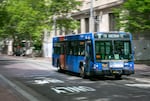
FILE - A TriMet No. 9 bus to Gresham drives past a bus-only lane in downtown Portland, Ore., June 29, 2024.
Anna Lueck / OPB
Although the most immediate cuts will proceed in November regardless of the upcoming session, TriMet officials hope state legislators will increase a payroll tax to avert steeper cuts.
The Oregon Transit Authority warned in March that transit agencies would make significant cuts without a tax increase.
Currently, the state taxes workers 0.1% out of each paycheck to fund public transportation.
On Tuesday, Kotek proposed doubling the payroll transportation tax to 0.2%. Desue said that is not enough to fill TriMet’s gap in funding. The agency is advocating for an increase to 0.36%.
Related: Gov. Tina Kotek delays ODOT layoffs and announces August special session
TriMet has also struggled with ridership since the COVID-19 pandemic.
Since 2020, TriMet has seen passenger fare revenue drop by $55 million to $60 million a year, according to agency figures. Part of that decrease has been fewer people commuting to downtown Portland, but fewer people are also riding because of concerns about security on TriMet’s buses and trains.
Desue said the agency has tripled its spending on security over the past two years.
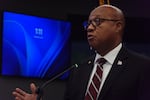
TriMet General Manager Sam Desue, Jr. addresses reporters at a press conference on proposed cuts to services on July 23, 2025, in Portland, Ore.
Joni Land / OPB
While the number of rides has steadily risen in the past couple years, it still hasn’t reached pre-pandemic levels. From 2019 and 2024, the total number of rides across TriMet’s system is down 32%.
As a result of service cuts, the agency’s workforce will also shrink. Over the next two years, 140 operator positions will need to be eliminated, with additional cuts to maintenance and support positions, according to TriMet.
To make those cuts, the agency says it will not fill certain positions as they become open, but officials acknowledged some layoffs could be necessary. It’s not clear when layoffs would exactly happen.
“We’re going to look holistically across the agency to make sure that, again, we’re setting ourselves up for the future,” Desue said.
Amalgamated Transit Union Local 757 President Bruce Hansen, whose union represents TriMet operators, said that news of the budget cuts and potential layoffs came as a surprise.
“They’re both harmful for our members and harmful for our community,” Hansen said. “Anytime we cut services, it also impacts the community members we serve.”
Related: Oregon transit agencies warn lawmakers of service cuts without a funding hike
Hansen said his organization supports TriMet’s request for a payroll tax increase to 0.36%.
TriMet is also planning a fare increase starting in August 2028: 20 cents more for adult riders, and 10 cents for children, veterans, people with disabilities and senior citizens. A one-way ride would climb to $3 for most adults. The agency previously increased fares from $2.50 to $2.80 in 2024.
Even if the agency can increase its revenue with higher payroll taxes and fare increases, some cuts to services will still be inevitable. TriMet spokesperson Tia York said it’s too late for the November cuts to be rolled back. What happens in Salem next month could alter the cuts planned for 2026.