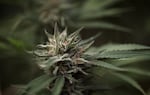
FILE - A Southern Oregon cannabis plant in 2014.
John Rosman / OPB
Many states in the U.S. have legalized cannabis either medically or recreationally, but without legalization at the federal level regulation is left to states, including testing for contaminants and THC levels. New reporting from Undark, an online science magazine, found that in some states, including Oregon, independent labs were inflating THC level numbers and providing fraudulent results. Teresa Carr, a senior contributor at Undark, joins us to share more on lab testing and what some states are doing to combat fudged results.
Note: The following transcript was transcribed digitally and validated for accuracy, readability and formatting by an OPB volunteer.
Dave Miller: This is Think Out Loud on OPB. I’m Dave Miller. You might not be able to trust the information on your cannabis package. That’s one of the big takeaways from recent reporting in the online science magazine Undark. It found that in some states, including Oregon, independent labs have been inflating THC levels and providing misleading results.
Teresa Carr is a senior contributor at Undark. I talked to her earlier this week about her reporting. I started by asking her what can end up in cannabis that consumers might not be aware of.
Teresa Carr: Cannabis is an agricultural product, so it’s going to have the same kind of things you might think of with other types of food products that could possibly sneak in there. And those things are mold, those things pesticides, sometimes heavy metals. Those are the primary contaminants that you would find that you might be concerned about, because in some cases they might pose some health risks.
Miller: I learned from your article that cannabis plants are known as hyper accumulators. What does that mean?
Carr: Well, basically, cannabis, it’s a very fast growing annual, so it goes through its entire life cycle in about, for these types of plants that are grown for marijuana, initially about five months. So it has to grow up from this little, tiny seedling to the 6 foot plant in about five, six months. So to do that, it just sucks up everything. It’s called a hyper accumulator. It gets a lot of water, everything from the soil. It also gets anything else that is in that soil.
And as we point out in the story, it was a form of cannabis called hemp that was actually used around Chernobyl to try to clear some of the contamination from the nuclear disaster. And it is also used in other applications for remediation. So that’s what makes it a hyper accumulator. It’s like hyper-accumulating stuff from the environment.
Miller: Including things like heavy metals that might be present in the soil. It’s for all those reasons you were mentioning that cannabis is tested. I know that there are different rules in each state. It’s a very state by state system that we have because of federal prohibition. But broadly speaking, how does testing work?
Carr: Your grower or in some cases your producer, which might take the raw products, the raw material and make it into something like an oil or an edible or something like that, whoever’s on that end of the chain is then going to pay a testing lab. And that testing lab is going to test that product for whatever is required by that state. So mold, typically, not always; pesticides, all states have some sort of testing for pesticides; heavy metals; and they’re also going to look at the level of THC.
Now, they’re going to give that product – they’re testing samples of it – a certificate of analysis or a COA, and that COA then goes with that whole batch. So when that batch of products winds up on the shelf, it can be identified by that COA. A consumer could technically look that up and see how it’s tested. And of course if it doesn’t pass, if it has too much pesticides, too much mold, heavy metals, etc., then it fails. And in some cases that can be remediated. You might take a moldy product and expose it to UV light or something to get rid of the mold, but in some cases it can’t and it supposedly gets thrown away.
Miller: A number of people you talked to pointed to a kind of original sin in this system or series of systems. In Oregon, when the recreational marijuana system was being set up, our state opted to license independent labs, so it would be paid by producers rather than a state lab or having the state pay for testing. Why did it do that?
Carr: That’s just how it evolved. There’s probably some economics in there, there’s testing expertise in there. And I should be clear, Oregon did this. Oregon was one of, as you probably know, the earlier states to legalize cannabis, first medically and then later recreational or sometimes called adult use. But basically all states kind of have this system. That system is that the producer or the grower pays the testing lab, so they’re the client of the testing lab. Therefore, there’s kind of a perverse incentive for the testing lab to pass a product because then they get the repeat business, or let’s say make the THC level higher. We may get to this a little later, but …
Miller: Let’s get to that now. I mean, you basically say that producers or growers can do lab shopping. So first of all, why? What’s the incentive for being able to put a product on a shelf that has a higher THC level on the label?
Carr: Well, that’s pretty simple. So the incentive is basically it’s gonna sell for more, right? The OLCC did a report on that themselves and they found that nearly three-quarters … They did like secret shoppers, so they went and bought products off the shelves. They found that like nearly three-quarters of those contain less THC that’s on the label. This is the regulatory body for Oregon.
And then they did the math and they showed there’s really this strong incentive to fudge the numbers. Every percentage point of THC higher it is, it’s gonna sell for more. I think this is an example we use in the story: a pound of 25% THC product is going to sell for $500 more than a pound of 20% product. So you can see as you get into the hundreds and sometimes even thousands of pounds, what a huge difference this makes in terms of your profits.
Miller: How would a grower be able to get a number on the label that is as high as possible? What do they do?
Carr: Oh yeah, I don’t know. They talk to their local lab. I mean, I can’t … The state in Oregon has cracked down, has accused a few labs of THC inflation and there have been reports that they – they, being the testing lab or the samplers – were sprinkling the samples with Kief, which would be a concentrated THC product, to return a higher THC level. There are other ways that you could potentially change your calibration a little bit. So if you used a different sample to calibrate your instruments, everything would test a little high.
I mean, there are a variety of ways one can do this. And in terms of the deals themselves, I don’t know. I’ve talked to lab managers who said they were very much pressured to do that. I talked to lab managers who said they have lost business, huge amounts of business because they won’t do that. So I don’t know exactly the arrangement that happens. I talked to one grower in Oklahoma, who said that basically he just took his product, he rolls several joints from the samples. He sent it off to different labs. The one that gave him the best result was the one he used.
Miller: And there’s nothing illegal about that?
Carr: No, there’s nothing illegal about that. I don’t know if you want to talk about our data analysis, but we did show when you had outlier labs that were producing on average higher THC levels or passing things for contaminants at higher rates, they tended over time to gain market share. So whether people were intentionally going there, whether they had some sort of arrangement, I had no idea. But those labs were definitely gaining market share, while labs that were not producing those favorable results were losing it.
Miller: You wrote about an example of a lab in Corvallis that had been accused of tampering with the samples to lead to higher THC levels, but also a lab – I’m actually forgetting in which state – where it seemed like there was the possibility of lab shopping for contaminant levels as well. What happened there?
Carr: Through open records request, Undark was able to get data from a few states. We looked at Oregon. We also looked at Massachusetts, just going completely on the other side of the U.S. And what we were looking at in Massachusetts specifically was the mold. So we could see a similar pattern in Massachusetts as we saw in Oregon, except in Massachusetts, we were looking specifically at mold. So some labs were passing products for mold at a much higher rate than others. And what is, having talked to experts, probably an unrealistically high rate, if you can imagine, mold is pretty ubiquitous and you’re going to expect a little bit in everything. It’s pretty rare to have zero unless you’ve just hosed it down with a fungicide.
So we’re seeing some labs having what seemed to be unrealistically high passing rates. And then we also looked at one of those outlier labs and we can show that gaining a bigger piece of the market, over time, as producers switch to the testing business that’s gonna give them the most favorable results, the highest passing rate.
Miller: So what are possible solutions to this? I mean, what you’re describing is a system that seems, because of the perverse incentives, so rife for abuse. It’s the producers paying the labs, being able to choose which lab they go to and being savvy enough because they’re under immense financial pressures.
In Oregon, there are so many producers making so much cannabis that the margins are really slim. There’s all kinds of incentives that could lead the producers and the testers to let things go on the shelves either with lower than are actually in the package amounts of bad stuff or higher than are actually in the package amounts of the stuff that people want, the THC.
So all this is the background. What are solutions?
Carr: It’s interesting. I talked to people at all points along this industry, everybody from growers, to lab managers, to end users and activists, to actually regulators. And a lot of people are really pushing for reform. One of the key things that appears to be – and this is still pretty new – a solution to this, is the idea of having a state quality assurance lab.
I’m gonna back up here for a minute, before I put too much blame on regulators, and say in most states cannabis was legalized overnight and there is no federal framework like there would be for any other agricultural crop. There’s nothing like that. So there’s no testing framework in place, there’s no regulations in place and everything. So as cannabis became legal overnight, all of a sudden you now have a regulatory body that’s charged with overseeing that. And that’s a really yeoman’s task, especially if you don’t have the technology in place. You don’t have the infrastructure, you don’t have even the money, the budget and all of that.
So that’s where these state regulators start. What we’re beginning to see now – Oregon is an example of this, I also went to Oklahoma, another example where they’re opening a state lab – is opening a state quality assurance lab and what that does is provide stricter oversight. So they can do things like the secret shopper test, so they can go and test things. They can do things like do audits of the licensed testing labs and surprise you. You don’t necessarily know when you’re doing that. So what it does is it provides this stronger regulatory environment that I think gives labs more of an opportunity to be honest and stay in business.
Miller: In the absence of those official labs, which, the one in Oregon, as you note, it came online this past fall. Oklahoma, it’s in the process now. But in the absence of that, there have been a group of activists in Oklahoma who’ve, it seems like they’ve been taking this upon themselves. What have they been doing and what effect has it had on the system?
Carr: I talked to a couple of activists. And this is actually where my investigation of this story started because I became so interested in this idea of people taking this into their own hands. In Oklahoma, only medical marijuana is legal at the moment. I talked to a couple of people who use it as patients. One person, Summer Parker, uses it for Ehlers-Danlos syndrome, which is a disease of the connective tissues, have to have tons and tons of operations. It’s chronic pain and things like that.
Summer began using marijuana as a way to get off an opioid, a legal. She was prescribed opioid painkillers and became addicted to them. So marijuana became a lifeline to her. She and her partner Charlie got sick and wound up hospitalized several times. They are convinced that [it was] contaminated. They had the products tested and it showed contaminants. And they are convinced and have some corroboration from their medical providers that contamination caused their illness. So that set them on a journey of testing products. So far they’ve tested about 200 marijuana products or had tested in professional labs, and found contaminants in about 20% of them overall.
Miller: And they shared these results then online?
Carr: Right, they share these online. I found lab managers – Jeffery Havard in Oklahoma is also doing this, on a smaller scale, putting out some reports. Yeah, people kind of took it into their own hands and said, well, we’re going to call attention to this. We’re going to show the problem and maybe that will help push the legislature and then regulators to crack down a little bit.
Miller: In the absence of that, I mean, what advice do you have for cannabis consumers in Oregon or I suppose around the country, if they can’t be sure that they can trust the THC numbers on the package or if there’s a chance that the pesticide, the mold or the heavy metal testing is less than trustworthy?
Carr: The first thing I’m gonna say is the regulated market is still going to be far safer than the illicit market. Some of my sources told me that some products that fail in the regulated market get distributed through the illicit market, so that’s something to keep in mind. Also, of course, if you buy it, not through the regulated market, there’s going to be no testing required. So, that’s one thing to keep in mind. Don’t read this in a Undark.org and think, oh, I’m safer with the guy down the street. No, no, no, that’s definitely not true.
Beyond that point, you can look at your COAs. But if they are fraudulent in some way, that’s not gonna be much help. One of the only things I could say is to get familiar with some of your growers and testing labs, if you are really someone who uses this very much, and kind of understand who really, really is committed to making clean products. Because remember, several of these growers I talked to and people working in the testing labs, they use these products themselves and they are invested in making sure that they’re as clean as possible. So that would be my advice. It’s the greatest advice, but it’s all I’ve got to offer right now.
Miller: Teresa, thanks very much.
Carr: Sure.
Miller: Teresa Carr is a senior contributor at Undark.
“Think Out Loud®” broadcasts live at noon every day and rebroadcasts at 8 p.m.
If you’d like to comment on any of the topics in this show or suggest a topic of your own, please get in touch with us on Facebook, send an email to thinkoutloud@opb.org, or you can leave a voicemail for us at 503-293-1983.