A plan to help endangered salmon could put the drinking water that nearly 200,000 Salem residents and business customers rely on at risk. It could also have drastic impacts on Salem’s water filtration system and could limit firefighting resources in the region.

FILE - Water flows from a tap.
Rebecca Roberts Galloway / OPB
OPB investigative editor Tony Schick has been covering efforts to protect salmon, and joined OPB on-air host Lisa Wood to explain the trade-offs between clean drinking water and thriving fish. Their conversation has been lightly edited for clarity.
Click play to listen:
Lisa Wood: Can you explain to us what a drawdown is?
Tony Schick: Dams hold back a lot of water. They basically turn a river into a big reservoir of water. But dams also have these gates where you can adjust how much water you’re holding back.
A drawdown is just opening up enough of those gates to let water flow through the dam, kind of draining that reservoir down, so it’s flowing more like a natural river and more water is flowing through the dam instead of getting held up behind it.
Wood: And why are they doing that to Detroit Lake’s Reservoir?
Schick: It has to do with salmon, which are on the brink of extinction in the Willamette Valley, because these dams in the Willamette Valley, including Detroit, were built without fish passage in mind.
They’re flood control dams, so they’re really high dams, and they can hold a lot of water back, but they don’t have a good way for fish to get through.
These dams are too high for fish ladders, which you’ll see at Bonneville Dam or somewhere like that. These are too high for that. But you can, with some degree of success, trap fish at the base of the dam when they’re adults coming back, and truck them up past the dam.
The bigger problem is the young juvenile salmon on their way out to sea don’t have a good way to get past the dam when it’s just this big lake. So the reservoir is being drawn down, to kind of flush those fish downstream – the way that a natural river would flush them downstream.
In the places this has been done before, it’s been really effective at getting salmon downstream.
Wood: Why does this cause such a problem for Salem and other communities downstream?
Schick: In Salem, it hasn’t caused a problem yet. But they’re anticipating it could. When you are trapping water behind a dam, think about all the stuff that flows downstream in a river. It’s not just water. It’s silt, sediment, things like that, dams trapping all of that too.
Related: Reports: Muddy water from reservoir drawdowns strains Willamette Valley cities’ water treatment
So underneath the water in these reservoirs are just giant deposits of mud and silt that have been gathering there for decades.
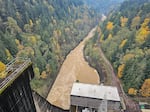
FILE - Water downstream of Green Peter dam on the South Santiam River, seen here on Nov. 3, turned muddy after a deep drawdown of the dam’s reservoir.
Courtesy of Chase Berrier. / Courtesy of Chase Berrier
This has been done a few other places and the water basically looked like chocolate milk. It flushes a lot of sediment downstream. That can be a problem for water treatment plants. They’re used to some level of murky water, but when there’s so much sediment in there, it really taxes the drinking water filtration systems.
Wood: So, is this a problem for any water treatment facility, or is the Stayton water treatment facility not equipped for this?
Schick: I would say a little bit of both. The Stayton facility, which provides the drinking water for Salem – they have been making upgrades and have been planning upgrades.
You don’t want to be overly reliant on one system because, for instance, there have been like cyanobacteria that can get into the surface water there, and you want to have backup supplies. So they’ve been working on things like that.
But this is a new challenge in terms of the amount of sediment that’s getting flushed downstream.
Wood: So the Army Corps of Engineers, which runs the dams on the Willamette, has proposed the possibility of a very expensive solution that involves a kind of fish vacuum. How would that work?
Schick: The scenario that was put forth in some of the plans from the Army Corps to avoid a drawdown would be creating what’s called a “floating fish collector,” which is like a giant apparatus of pumps – basically a vacuum to suck up a bunch of river. These are giant structures.
Related: ‘Killing salmon to lose money’: A costly, questionable plan on the Willamette
This one at Detroit would be like the size of a football field, basically, and it would suck up a huge chunk of river and suck up fish with it. And then you would trap the fish in tanks, then load them onto trucks, then truck them downstream – and then capture them again, once they’re adults and come back and track them back upstream.
The problem with that is the price tag, and also there’s very little evidence of this type of thing working before.
Wood: Are there any other possible solutions?
Schick: Well, the Army Corps can help local governments with construction projects.
If you’re going to continue these drawdowns, the Corps could help fund new treatment plants, additional water supply systems, those types of things to make sure that these drawdowns are not affecting the drinking water supplies.
Wood: Great, Tony, thank you for joining us.
Schick: Thank you.
Related: Salem considers declaring drinking water emergency ahead of Detroit Lake deep drawdown