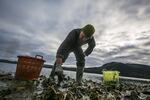
FILE - Oyster farming at Whiskey Creek Shellfish Hatchery in Tillamook, Ore., in this 2020 file photo.
Karina Ordell
In the late 2000s, unexplained mass die-offs of oysters at Whiskey Creek Shellfish Hatchery in Tillamook, Oregon, helped scientists uncover a major threat to coastal ecosystems: ocean acidification.
Today, Oregon’s coast remains one of the areas most affected by this phenomenon. Each summer, deep ocean waters rich in carbon dioxide and low in oxygen rise to the surface — a natural process known as upwelling — creating corrosive conditions that make it harder for shellfish like oysters and crabs to form shells and survive.
Researchers at the National Oceanic and Atmospheric Administration and Oregon State University are currently on a scientific cruise to track acidification and low oxygen levels in real time along the Oregon Coast. Zachary Gold, a researcher with NOAA’s Pacific Marine Environmental Lab, joins us to share what scientists are seeing right now in Oregon’s waters.
Alan Barton, production manager at Whiskey Creek Shellfish Hatchery, talks about what these conditions mean for local shellfish growers and how they’re working to adapt.
Note: The following transcript was transcribed digitally and validated for accuracy, readability and formatting by an OPB volunteer.
Dave Miller: This is Think Out Loud on OPB. I’m Dave Miller. In the late 2000s, mass oyster die-offs at Whiskey Creek Shellfish Hatchery in Tillamook helped draw global attention to a major threat to coastal ecosystems: ocean acidification. The Northwest coast remains one of the areas most affected by this phenomenon. Every summer, deep ocean waters rise to the surface, creating corrosive conditions that make it harder for shellfish like oysters and crabs to form shells and to survive.
For an update on the latest science and mitigation efforts, I’m joined by Zachary Gold, a researcher with NOAA’s Pacific Marine Environmental Lab, and Alan Barton. He is the production manager at Whiskey Creek Shellfish Hatchery. It’s good to have both of you on the show.
Alan Barton: Thanks for having us.
Zachary Gold: Thanks.
Miller: Alan, can you explain just briefly the business model of the Whiskey Creek Shellfish Hatchery?
Barton: Whiskey Creek’s been around since 1978 and basically all we do is produce oyster larvae. So we take adult oysters, fertilize the eggs from those oysters and grow them through a three-week larval period. When they get to the end of that larval period, that’s our product. That’s what we put in boxes and ship out to farms all over the Northwest. So in a good year, we produce approximately 10 billion oyster larvae. They go out to farms all over Oregon, California, but mostly up into Washington and Willapa Bay.
Miller: There’s a good chance then that if people are buying oysters, getting oysters from Northwest oyster farms, that the larvae might have come from your hatchery?
Barton: About a third of all the oysters in the Northwest come from Whiskey Creek.
Miller: Can you tell us about what happened at the hatchery in 2006?
Barton: Sure, I want to begin by saying what we do is farming. We have good weeks and bad weeks, bad months sometimes. But what my boss experienced in 2007 and then 2008 was pretty unprecedented. Rather than just a few bad weeks, week after week after week, all of the larvae that we tried to produce died in the hatchery.
It’s a small business. There’s only five or six of us that work in the hatchery. So a year-and-a-half of losing all of our revenue was a big problem for Sue but also a big problem for hundreds of growers who depend on our products coming out the door. So this was different from the normal variability that we see in farming.
Miller: Zach Gold, why is it that the waters off the West Coast have been acidifying faster than anywhere else in the world?
Gold: One of the big drivers here is that we often already had fairly corrosive waters with upwelling just from natural conditions. With climate change increasing CO2 emissions in the atmosphere, that’s more carbon that’s entering the oceans. It’s driving it even faster, so starting at relatively low pH across the global scale and pushing it even lower to more sour and more acidic waters.
Miller: You were recently on a research cruise for over a week. What exactly were you measuring?
Gold: Yeah, we were out there with researchers from the Pacific Marine Environmental Lab at NOAA, as well as NOAA Fisheries, as well as Oregon State. We were going in and out of Newport with a really amazing group of scientists, including biologists and chemists, and really pairing the observations of oxygen, pH, temperature, salinity, and all the way from microbes to zooplankton and fishes. [We] tried to take our long-term observations that we have in the Pacific Northwest for the last 30, 40 years, look at what we were seeing here, and put this all in a bigger context to try to attribute how the impacts of ocean acidification are driving population patterns and stress on individual organisms.
This is a cool effort in that we’re also bridging observations that we’re making in the field to experimental work that’s happening back in the lab ... [voice cuts off]
Miller: Seems like we’ve just lost Zach Gold’s Zoom connection. We’ll work on that.
Alan Barton, I’m curious … Obviously, we were starting by talking about ocean acidification, which, as Zach said, is both a question, on the West Coast, of natural processes of upwelling and more naturally corrosive water, in addition to the global effects of climate change. But he mentioned other things as well. He mentioned warming waters and hypoxia, less oxygen in the water that’s dissolved. How do all these combine to make it harder for you to grow oysters?
Barton: In a high CO2 ocean, the balance changes a little bit. Because we have a lot of productivity in the summertime over the Oregon coast, we also have a lot of die-off associated with that productivity. So right now, actually, I believe Zach would tell us, there has been a huge low oxygen event along the Oregon coast, which is impacting us in the hatchery. So we don’t really get to pick and choose the variables we deal with in the hatchery. We just take whatever the ocean brings us. So we’re having to understand how to correct the pH of our incoming water to add oxygen back into our water, which has been very low in the last couple of months.
So we basically have a life support system at the hatchery in order to keep treading water through these rough periods. And I would like to point out that we’ve been here since 1978, so there were several decades where certainly we had variability. But the window of time where water conditions are good on their own is very small for us now. So we’re always buffering our water to raise the pH. We’re always adding oxygen into our water, so it’s become a lot more difficult for us to make money growing oysters.
Miller: Alan, I did read recently that the rate of ocean acidification is speeding up, meaning not only is the problem getting worse, but that the worsening is accelerating. Have you seen that locally?
Barton: Yes, absolutely. I think Zach would probably do a better job than me. But the water that’s upwelling this summer, along the Oregon coast, last saw the atmosphere maybe 30 to 50 years ago. So it goes up near the North Pole, sinks down to mid depths in the ocean, meanders down near the equator and then comes up eventually along the Oregon coast. So what that means is the effects of fossil fuel emissions on the atmosphere affected this water that’s upwelling now, decades ago. So no matter what happens from here on out, we’re still gonna have decades more of increasingly impacted water that’s been affected by the atmosphere in the decades since then.
Miller: Wow, it’s baked in, over the course of perhaps half a century?
Barton: Yeah, we sent ourselves a present, but we can’t send it back.
Miller: Wow. Zach, what broadly can farmers and hatcheries do to adapt or respond?
Gold: One of the things that we’ve been involved with, and we’re trying to even try out new technologies, is to be able to develop real-time instrumentation so we can provide the data that the farmers need, like Alan has down in Whiskey Creek, to be able to know what the pH, what the oxygen is, and how to best adapt and mitigate that.
So we’re working on how to build better sensors, more accurate sensors, to be able to provide that kind of real-time data. In the same way that NOAA provides information on weather on your phone, [we want] to be able to provide the same kind of ocean weather for farmers to be able to adapt to that.
From a bigger picture, it’s about how we work towards making sure that the longer-term impacts of acidifying our oceans and hypoxia are under control. Those are the bigger societal challenges we’ll have to tackle.
Miller: Alan, how worried are you? I mean, if your success, at this point, depends partly on good monitoring and good science from federal scientists like Zach at NOAA, how worried are you about cuts to these very programs?
Barton: I’m definitely concerned about it. I always like to say that we don’t collect data to write papers. We collect data to make money. So the type of monitoring we’re doing is really applied to our industry. We’ve had a great partnership with NOAA over the last 15 years or so. We started monitoring here at Whiskey Creek. But then working with NOAA, the state of Washington, the state of Oregon, we expanded our monitoring network to up to 15 sites where shellfish are grown.
And people are interested in better understanding water conditions. So I definitely played a part by participating in that. Today, I’m looking at the water conditions out in the bay and I dumped the water for a couple of hours today because the oxygen level in the morning was really, really low. So that data has just become part of our normal practices in the hatchery. It’s our day-to-day information and we really rely on these guys from NOAA to get that data.
Miller: Alan, just to go back to this idea that so much of the more acidic water is already baked into this system and it’ll get worse in the coming decades, even if we have a gigantic drop in current fossil fuel burning, do you think you’ll be able to keep raising shellfish 50 years from now?
Barton: A friend of mine used to say that the best oyster farmer has a size 50 shirt and a size one hat. You don’t wanna be too smart in this business. You don’t wanna think about it too much. We basically just try to keep going and do what we can. Certainly, having the data now gives us some headlights on the car. We kind of know what’s coming at us and that’s kept us open, frankly.
I don’t think we’d be here without that data, and we have a debt of gratitude to Burke Hales, George Waldbusser and Chris Langdon, people in Oregon State, as well as all the NOAA scientists for doing that. But I don’t think too far ahead. We just do it again in our business. I try to be optimistic and hope that things will turn for us.
Miller: And Zach, we have about a minute left. But we’ve been talking about oysters. What about other marine life, coral reefs or marine mammals, and everything all the way down the line? What does acidification mean?
Gold: Yeah, well, they keep it local on the West Coast. Some of the species that we’re most interested in, we were focusing on [during] this cruise. We’re understanding impacts on Dungeness crab. Their larvae, we know, are quite sensitive to ocean acidification. Obviously, that’s one of the biggest fisheries along the West Coast. So there’s a handful of experiments and work we have now showing that the larvae are quite susceptible. There’s a big unknown question of what that means going forward and how productive those fisheries remain? Obviously, Dungeness crab is very important to the West Coast economy and very important to the marine ecosystems. And like you said, coral reefs, calcifiers, snails, terrapods and other things we’ve been focusing on here, it’s harder to build shells in more acidic waters.
So a big question is, how do we attribute this acidification impacts while warming is also happening and we have multi-stressor impacts on marine ecosystems? So you have a better idea what this looks like. And certainly, a lot of the results are showing that there’s going to be winners and losers, and some species … [voice cuts out]
Miller: Unfortunately, we lost Zach again. That was Zach Gold, NOAA researcher at Pacific Marine Environmental Lab. Alan Barton, thanks very much.
Barton: Thank you.
Miller: Alan Barton is the production manager at Whiskey Creek Shellfish Hatchery.
“Think Out Loud®” broadcasts live at noon every day and rebroadcasts at 8 p.m.
If you’d like to comment on any of the topics in this show or suggest a topic of your own, please get in touch with us on Facebook, send an email to thinkoutloud@opb.org, or you can leave a voicemail for us at 503-293-1983.