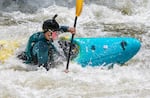
Hoopa Valley Tribal member Julian Rogers, 16, paddles through a rapid in Kikacéki Canyon on the Klamath River, June 22, 2025. Rogers is a participant in Paddle Tribal Waters, a program that trained Indigenous youth for several years to be the first group of people to paddle the free-flowing Klamath from source to sea.
Anna Lueck for OPB / OPB
A group of Native American youth recently completed the first full descent of the Klamath River since the four largest dams on the river were removed last fall. Kayakers traveled more than 300 miles over 30 days on the source-to-sea trip, which was organized by the Paddle Tribal Waters program.
Julian Rogers and Kiahna Allen both participated in the trip. They join us to share more about their experience.
Note: The following transcript was transcribed digitally and validated for accuracy, readability and formatting by an OPB volunteer.
Dave Miller: This is Think Out Loud on OPB. I’m Dave Miller. A few weeks ago, a group of Native youth completed the first full descent of the Klamath River since its four largest dams were removed. The kayakers traveled more than 300 miles over 30 days on this source to sea trip, which was organized by the Paddle Tribal Waters program.
I’m joined now by two of the young people who have participated in this historic trip. Julian Rogers is a citizen of the Hoopa Tribe who’s going into his junior year at World Class Academy. Kiahna Allen of Klamath descent is about to start her first year at Lane Community College. Congratulations to both of you and welcome to Think Out Loud.
Julian Rogers: It’s good to be here.
Miller: It’s great to have you both here. Julian, in recent years … and we can talk about just how much kayaking has become a part of your life, it’s been a major part of your life. But I’m curious when you did it for the very first time.
Rogers: Yeah, well, I started kayaking in 2022. It was the first cohort of Paddle Tribal Waters. Since then, there’s been two others. But yeah, I just started in 2022 and continued from there.
Miller: What do you remember from that first year?
Rogers: From that first year, I was pretty young. I had just turned 13. Before kayaking, I’d been on the river like every single day. My people are river people, but I’d never known about kayaking before, so this was an entirely new idea and thing for me. But I just had so many fun moments there with kayaking and there are so many fun people.
Miller: Kiahna, what about you? How were you introduced to this?
Allen: Like, how was it introduced to … ?
Miller: To kayaking?
Allen: So I joined the first cohort. I joined a trip before that, but it was more like an inflatable kayaking trip. I really had fun and enjoyed that trip. So I joined the next trip thinking it was going to be more of the same rafting type thing, but I was in fact wrong. It was two-weeks of intense white water kayaking.
Miller: So a lot more physically demanding?
Allen: Yes, and I did not know that I signed up for that [Laughter]. But I did have fun. I really enjoyed being surrounded by people that look like me and learning with more Indigenous kids, being in a new area, learning a new sport. I really enjoyed it.
Miller: Julian, can you give us a sense for what an average day at the Paddle Tribal Waters Academy has been like in recent years? I mean, what would you do in the course of just one day?
Rogers: Yeah, at the Paddle Tribal Waters Academy, you wake up at 6:30. We would have a morning workout for about 30 or 40 minutes and then you have your breakfast. You have your full day of classes and then once you’re done with your school, you’d immediately go out and you’d kayak for a few hours. And you’d come back, you’d have dinner, go back to bed, and then you just repeat that every single day.
Miller: Kiahna, what was that like for you?
Allen: Being away from home was definitely hard, being across the country in a new area and being away from my first foods at that time, too. It was hard knowing I wasn’t able to gather while I was away, but it was also a really awesome experience. I was in a new area. I thought I’d never leave the country this young. And I’m so grateful for the opportunity to this day. Some days were challenging, but it definitely was worth it and I had a great time.
Miller: Julian, so this wasn’t in the U.S. Where was this?
Rogers: Yeah, so it was one semester of school. There was one quarter we went down to Chile and then the second quarter we would come back to the Pacific Northwest.
Miller: Did you get homesick?
Rogers: Yeah, I definitely got homesick being away from my family for that long. It was definitely hard on me, but it was a lot of fun times for sure
Miller: And a lot of prep at this point, too, which eventually enabled you to do this long voyage. Had you spent time on the Klamath River or its tributaries before the dams were taken down?
Rogers: Yeah. My tribe is on the Trinity River, which is the largest tributary to the Klamath. So I spent a lot of time on the tributaries to the Klamath and I did spend a lot of time on the Klamath as well. I’ve done rafting trips on it and I went to the dams prior to their removal. And I just remember it being so dirty and gross, so I didn’t go there very often.
Miller: Kiahna, how much have you learned about the decades-long effort to get these dams removed?
Allen: So during our Ríos to Rivers trips, starting cohort one, we’d also have mandatory advocacy classes. So I learned the issues and challenges that they faced along the Klamath River up to the headwaters. So Ashia Wilson, she would come in and teach us lessons about her advocacy work. I know that there’s so much behind getting these dams down and this definitely wasn’t an easy thing to do, but it’s down now.
Miller: Had you also spent time on the Klamath River before the dams were taken down?
Allen: I did not spend much time on the Klamath River before my trip, before the cohort one trip. I hadn’t spent any time down there at all. I live in Central Oregon – Warm Springs, Oregon. And I’m a Klamath-Modoc descendant, so I go to Klamath sometimes. But I don’t spend much time on the rivers down there, more on my home watershed, which is the Deschutes. So I haven’t really been on the Klamath before. But the first time, it was very unclean and I’m very glad to see that it is much cleaner now.
Miller: Julian, what went through your mind when you heard that there were plans for this 300 mile long trip?
Rogers: Well, there’s a lot going through my mind. At first it was like, wow, this is gonna be so amazing. I’m so excited for this. But as it got closer and closer there was more talk about how difficult it was gonna be and like how much training would have to go into it. I got nervous about it, but that nervousness kind of made me put in more work to my kayaking so I’d be ready for it
Miller: Because in addition to just the length, they were class IV and V rapids.
Rogers: Yeah, class IV-plus, yeah.
Miller: Do you remember the day you set out?
Rogers: Oh yeah. The day we set out was such a cool day. Everybody was greeting each other again, because some of us haven’t seen each other in like months. And there were Klamath elders that came and they sang us their songs. They gave us their prayers and they set us off in a good way. Everybody was just happy and looking forward to this big journey.
Miller: That was the upper part of the watershed, so upstream of where you’d eventually go and be in the newly undammed part. But what was it like just to be on that river at the very beginning?
Rogers: Well, yeah, being on that river, the Wood River is such a beautiful river. It was like the most clean river I’ve ever seen before. It’s super cold, so it was super amazing to be on that river, but it’s also sad to see because the further down you got, you could see the effects of agriculture. Because it started from this crystal clear water and as you got further down you see farms everywhere. The water just became brown and gross. Nobody wanted to flip in it anymore. All that water from the farms, just the eutrophication which went into the dams, the excess of nutrients, that’s what starts like all the algae blooms and that’s why algae is such a huge issue on the Klamath.
Miller: On day two, after a 16-mile paddle, you told an OPB reporter: “I have no clue how many miles we’ve gone and how much time has passed. I’m delusional and delirious,” but other than that, you said, “It’s going pretty good.” And that was just day two. What were some of the most challenging days for you?
Rogers: Well, on that day it was definitely very hard. We had 16 miles on the Wood River. That’s why I said I don’t know where we’re at. We had so many miles on that river. And then by the time we made it to the actual first lake on that same day, it was late in the day and the wind was blowing so hard. So when we made it to the lake it was like an ocean. I got seasick on that day and it’s pretty bad. But later days, I would say none of them were too difficult. We had like 20-mile lake days that were pretty difficult and then we had, I think it was day eight, a class IV-plus section. It was like some of the biggest rapids I’ve ever done before, so that section was hard as well.
Miller: Kiahna, my understanding is that you had some prior obligations, so you joined this immense paddle a couple weeks in. What do you remember about your start?
Allen: Yeah, I went into this trip pretty burnt out. But I was determined to get there as early as I could to get as much time on the river as I could with my peers and be a part of the journey as much as I could outside of my obligations. I do remember the first day I was in a dagger boat, and that’s kind of a heavy and big boat. I was so excited to see everybody and be back on the river, but I believe it ended up being an eight- to 10-mile day and we missed our takeout by about two miles. So, we had to paddle across the river and go down more, and we had to hike up this really steep hill. And it was lots of flat water. So I had quite the tough day my first day back, but I really enjoyed being with my people again.
Miller: How did it feel for you to be out on this river that had been dammed for so long?
Allen: It felt crazy. I remember looking back to my first year of cohort one, we were paddling this river and it was so dirty you couldn’t see through it. I mean, you still can’t see through it. But I was on the shore one day and I can see the rocks at the bottom, like near the bank of the shore, and the river was starting to breathe again. It was just so cool cause you wouldn’t be able to see that. It was so dirty in cohort one. And just seeing the difference in how clean it is now compared to then, it was just a really cool moment, my first day back.
Miller: Julian, my understanding is that you’re one of the few people to do the entire trip. What does it mean to you to do that whole length, all 300 miles?
Rogers: Yeah, well, me, my brother and my cousin, we were the only three that had done every single section.
Miller: Strong family.
Rogers: Yeah, it felt pretty incredible to say that we did everything, every single section, and I kind of did that for my family. I’ve kayaked hard every single day so that I would be able to do that.
Miller: Were you thinking about your family every day?
Rogers: Yeah, I was. I definitely missed them because, prior to the first descent, I had also been gone for months on end. So I was missing them a lot. As we did the first descent, I thought about all my family that had been fighting for dams for years and years. So, that’s really why I wanted to do every single section.
Miller: I want to play part of a video from the last day. The organization that put this together would put out short videos every day and this is part of the one from the very last day.
[Video recording playing]
Speaker 1: It’s day 30 and we got three miles today, so in total that’s 310 miles.
Speaker 2: A bunch of feelings are coming to me. I’m happy. I’m excited, but I’m also sad that we’re not gonna be together like this a lot anymore.
Speaker 3: I think our ancestors are really happy that we’ve all come together as Native individuals. Seeing us all here today is probably making them really, really happy.
[Video recording ends]
Miller: Kiahna, what do you remember from that last day?
Allen: The last day I felt so happy. Me and Julian actually spoke on a panel a few days ago and he was saying how things like this aren’t always promised to us, like we can really fight and fight for it, and these things always don’t come through. So the fact that this actually happened and history was made, it made me so happy. But at the same time, I was kind of sad because it felt like an ending, because we’ve been training for years for this. We’ve dedicated our summers to training for this, trips throughout the year, leaving home across the country. It felt like an end of something, but a new beginning for the river and the life of the river. And it was emotional. I can’t think of that word right now, but it was bittersweet for sure. But it was a lot that day.
Miller: Julian, can you describe what it looked like from your perspective? I mean, the pictures I’ve seen, there’s an extraordinary mist that is coming up from the water.
Rogers: Yeah, well, from my perspective, the final mile – we had two canoes in front of us, our traditional canoes. And then we had our row of our Paddle Tribal Water students and behind us we just had like all our staff, all other people, all these rafts, so …
Miller: People from all over the world too, right?
Rogers: Yeah, people from New Zealand, China, Bolivia, Chile. We have people from everywhere, so it was just like hundreds of boats. We were all like piercing through this deep fog. I would look back and it looked like we were in a movie. And along the whole, entire river, the final stretch, there’s people, there’s Native people doing their war hoops at us and showing their support for us. So it was so crazy.
Miller: What was going through your mind at that time?
Rogers: There’s so much going through my mind. I was thinking, I can’t wait until I touched down on that beach, like the final step to this first ascent is such a huge thing. And I was also happy to see my family again because I knew they were there and I was happy to see everybody that had come out to support us, but I was sad that it was coming to an end.
Miller: At the start of the trip, Klamath Tribal Chairman William Ray, Jr. said this to you and the other folks: “I just want to say I’m so proud of all of you to take this journey, but learn from it because you’re going to be the future leaders of our tribes.” What kind of responsibility, Julian, do you feel right now?
Rogers: I definitely feel a bit of responsibility to continue fighting for rivers everywhere. That’s kind of like my main focus right now, not just the Klamath River, but we also have the Trinity River that I’m from. So much water gets diverted yearly and all these other rivers everywhere. So my responsibility, I feel like, is keeping these rivers safe and being kind of a voice for these rivers.
Miller: Kiahna, what about you? You mentioned earlier that the Deschutes River – that’s your home waters. Has doing this trip given you a different perspective on the Deschutes?
Allen: Yes, most definitely. I’ve always been connected to the river since I was a little girl as a first foods gatherer, as a first foods perspective, like eeling and fishing, and depending on it to keep our roots and our berries good. So kayaking has definitely given me a different perspective with my connection to the river, but I’ve always felt an obligation to always protect and advocate for my river. If our river is healthy, our people are healthy. So I always do my best to advocate for it.
Miller: Kiahna and Julian, congratulations and thanks so much.
Rogers: Thank you.
Allen: Thank you.
Miller: Julian Rogers and Kiahna Allen are two of the Native young people who recently took part in the first full descent of the Klamath River since its four largest dams were removed. Kiahna is going to start her first year at Lane Community College this fall. Julian is going to be starting his high school junior year at World Class Academy.
“Think Out Loud®” broadcasts live at noon every day and rebroadcasts at 8 p.m.
If you’d like to comment on any of the topics in this show or suggest a topic of your own, please get in touch with us on Facebook, send an email to thinkoutloud@opb.org, or you can leave a voicemail for us at 503-293-1983.