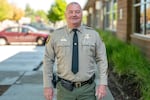
A provided image of Deschutes County Sheriff's Office Capt. Ty Rupert. Rupert was appointed to serve as interim sheriff on July 29,2025.
Deschutes County Sheriff's Office / Deschutes County Sheriff's Office
After a turbulent year in Deschutes County law enforcement, newly appointed interim Sheriff Ty Rupert says the office is at a turning point. Sworn in Aug. 1, Rupert steps into the role after the resignation of Kent van der Kamp, whose tenure ended after an investigation and a lifetime law enforcement ban. With 15 months to stabilize the department before next year’s election, Rupert inherits a department facing challenges with morale, public trust and employee retention after the controversy.
He joins us to discuss how he hopes to rebuild trust with the public and address cultural challenges within the sheriff’s office while serving Deschutes County.
Note: The following transcript was transcribed digitally and validated for accuracy, readability and formatting by an OPB volunteer.
Dave Miller: This is Think Out Loud on OPB. I’m Dave Miller. We turn now to Deschutes County. Kent van der Kamp was elected sheriff there last November with 60% of the vote, but he didn’t spend long in the office. Van der Kamp tendered his resignation last month. Over the last six months, county and state oversight agencies looked into claims that he was deceitful about his past work history and education, and the State Board banned him from working in Oregon law enforcement for life.
Now, the Deschutes County Board of Commissioners has appointed his replacement. Ty Rupert, a 20-year veteran of the office, will be the sheriff until the election next year, and he joins us now. Welcome to Think Out Loud.
Ty Rupert: Hey, good morning and thank you for having me on the show today.
Miller: Yeah, thanks very much for joining us. You recently said that, “We have a sort of crossroads in our office, and we need to change. We owe it to our community and we owe it to our employees to change.” What is the crossroads as you see it?
Rupert: Well, as you had mentioned, with former Sheriff van der Kamp, anytime we have law enforcement in the … what he created with the dishonesty, or broke the trust of the public, and also with our employees, I feel that we’re at a crossroads. And that crossroad, it’s crucial that we basically pour a new foundation of trust and it’s up to me to pour that foundation. Because I have to reestablish that trust, not only with the community, but also with our employees. They knew van der Kamp for several years, just like they do me, but I feel like I’m starting over, proving to them that they can trust me and the community. It’s important that we do that. That’s the crossroads.
Miller: Well, let’s take those one at a time. How would you describe the sheriff’s office morale right now?
Rupert: Right now, I think it’s doing well, especially the anticipation leading up to the commissioners, who they were going to appoint. Everybody was nervous and were wanting to know who their new sheriff was gonna be. And once that decision was made, it feels like things have settled down. And they’ll let me know in time. I’m sure they’ll let me know how I’m doing for them, but I can tell you the overall feel and vibe in the office is really good right now. It’s exciting to see that.
Miller: How do you go about restoring trust among employees in the sheriff’s office?
Rupert: It’s gonna take time. As you know, trust is something that’s earned. It’s not something that’s given overnight. I know who I am as a person. I’ve been here 20 years. I’ve worked in every position, from a reserve deputy all the way up to a captain. So I know the inner workings of our office very well. I’ve also had very strong working relationships for years with a lot of the people that are here and they know who I am. I’m a very genuine person. I’m a person of my word. So I just have to be me moving forward, but it’s gonna take time. Anytime you have that broken trust, it’s going to take time to reestablish that.
Miller: What about externally? How do you plan to regain trust or increase transparency with the public?
Rupert: The rebuilding of trust with the public … I started in 2005. 2006, I believe, is the year that we asked the citizens to support us in permanent funding for our sheriff’s office. At that time, our trust with the citizens that we serve was extremely high. And it’s important that we get back to that and it’s gonna take time, once again.
For me, it’s getting out there and seeing the public. I plan on having Town Hall meetings, coffee with the sheriff, maybe just stopping in at businesses, being out there meeting with the citizens, asking them, “How are we doing? What do we do good and what do we need to improve on?” We have a partnership with our community. It’s important that I get their feedback, and find out what they’re happy with and what we need to improve on as an agency, because ultimately, we work for them.
Miller: It may be that it’s too early for you to answer this question because it may be dependent on feedback following the kinds of meetings that you intend to start. But are there already specific programs or priorities that you know you’d like to expand, discontinue or change in some way?
Rupert: The one that comes to mind, because we get this information quite often – our highways, people travel at excessive speeds on the highways. We get citizens that talk about that. They’re like, “hey, we need to slow people down on the highway,” and I don’t disagree with them. And that doesn’t mean that we’re gonna go out and stop every car and write every car a citation, because a lot of law enforcement people forget, not only are we here for law enforcement action, we’re also here for education. You can educate people, too.
One of the programs that we currently have had for several years, it just seems like we’ve never been able to get it off the ground, is our CAT team, and that’s the “Community Action Target” team. Basically, they’re a traffic team. They were put in place several years ago. They were supposed to focus on traffic. We’ll probably change that name at some point.
When I first started here in 2005, we had a traffic team back then. We had four cars, and they specifically focused on traffic infractions and traffic enforcement. They could do the major crash investigations and such. But I think that’s an element. I hear it from the citizens, even prior to being a sheriff, and that is something that I would like to expand as time permits.
First and foremost though, I have to get our staffing levels to a reasonable standard, both for patrol and corrections. Our staff are incredible people, but we got to get them some help so they’re not putting in so much overtime. That’ll help their well-being also.
Miller: Does that mean getting more funding, or it’s hiring for already funded but open positions?
Rupert: It’ll be hiring for already funded positions.
Miller: Will you be able to, after that, put in more of an emphasis on traffic, whether it is education or enforcement, without more funding? I ask this because so often, especially in recent years, we’ve been hearing about funding challenges for all kinds of public agencies and departments.
Rupert: As far as funding goes, obviously my primary function is to make sure that we’re very fiscally responsible to our citizens. So once we get the staffing levels up, we’ll look at that and see if that funding is gonna be available to expand that team. Currently, we have one person assigned to that team. The other option will be, I want to explore grants. There might be grants out there that we could look at obtaining that could help fund some of those things.
Miller: I want to go back a little bit. Folks may know, especially in Deschutes County, I think they know this at this point, that you were Kent van der Kamp’s direct supervisor for nearly a dozen years, from 2013 to 2024. You did also write a letter of support to Oregon’s Department of Public Safety Standards and Training last year when it was investigating him. Why?
Rupert: Well, at the time, I wasn’t aware of the Brady issue with Kent van der Kamp, so you are correct. I did write a letter of support. Obviously, if I would have known about the Brady issues that van der Kamp had, I would have never written that letter. I can’t change the past. I can own that I didn’t support him at the time, prior to my knowledge of that Brady. And it’s sad to me, because the van der Kamp that I thought I knew, when the news broke, I started to question did I really know him? And obviously, I would have never written that letter had I known the Brady issues.
Miller: I should say, it’s been a little while since we talked about the Brady issues on the show, but this is when the district … and correct me if my short version is wrong, my layperson understanding. But if a DA decides that they can’t trust a law enforcement officer on the stand because of mistruths they’ve said while under oath, they can say we’re not actually going to put that person on the stand anymore.
Rupert: That’s correct.
Miller: So what would you say to residents who might be concerned about your ability to make a clean break from now former Sheriff van der Kamp, given that long-standing professional relationship that you did have with him?
Rupert: I can assure citizens that it’s been a clean break. I have zero tolerance for that. When I was hired in 2005, the sheriff that hired me was Les Stiles. I’ll never forget sitting in his office. He looked at me and said, “If you lie, cheat or steal, you will not be a part of this organization. Am I clear?” And I said, “Yes, sir, you’re clear.” I’ve never forgotten that.
As law enforcement, we have to be in a position where our public and the people around us can trust us.That is the pinnacle of who we are, is trust, integrity, all these things. And van der Kamp broke that, unfortunately. So for me, it’s a very easy clean break. I have no tolerance for it and I can assure the citizens that I am not that person.
Miller: In movies and TV shows, when a police officer or sheriff’s deputy is fired or leaves, there’s often a scene where they turn in their badge and their service weapons. Is that what happens in real life?
Rupert: Usually it’s what happens. It depends on the circumstances. There’s a lot of different circumstances, but yes, they will turn it in. Per policy, after so many years, you can be given your badge and your service weapon for your service, so it depends. There’s different circumstances, but yes, that is typically what happens. They turn it in and then the sheriff’s office would sign it over to them.
Miller: Do you know if that’s happened with Kent van der Kamp?
Rupert: I can tell you it did not happen with Kent van der Kamp. He still has his badge. After talking with not only our local district attorney’s office and also our counsel, the decision was made, given that he was in an elected position, to sign his service weapon over to him. Not an easy decision, but most importantly, right now, I have to take our office in a whole new direction. And I can’t get sidelined or focused on something that involves Kent van der Kamp. So I made the decision that we’re gonna sign that weapon over to him so we can move on.
Miller: Ty Rupert, thanks very much for your time today. I appreciate it.
Rupert: All right, sir. Thank you.
Miller: That’s Ty Rupert. He is the new sheriff of Deschutes County as of the beginning of this month.
“Think Out Loud®” broadcasts live at noon every day and rebroadcasts at 8 p.m.
If you’d like to comment on any of the topics in this show or suggest a topic of your own, please get in touch with us on Facebook, send an email to thinkoutloud@opb.org, or you can leave a voicemail for us at 503-293-1983.