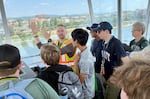
Campers crowd into the West Tower of the Morrison Bridge during a tour of Multnomah County's bridges on Aug. 4, 2025.
Tiffany Camhi / OPB
Campers in Portland State University’s Summer Transportation Camp notice things the average commuter does not.
While waiting for a MAX train at Pioneer Courthouse Square in downtown Portland, the high schoolers excitedly chatter about different trains.
“The Type 1 is a classic,” Grant High School student Jonathan Gates-Lindstrom said. “If the next train is a Type 1, I will be running to get on because it just looks so nice. It’s charming.”
Another camper, 14-year-old Aire Uusitalo, points out the raised, circular bumps embedded in the road.
“Did you see the video where they were installing these?” Uusitalo asked another camper referring to the markers used to help keep drivers out of designated lanes. “If an automobile goes across it, they’ll feel it in their vehicle.”
These campers are serious about transportation.
“I’ve been interested in transportation and urban planning for a long time,” Uusitalo, a student at Portland’s Alliance High School, said. “I’m really interested in how it can work in a really efficient way to move people around a city.”
Related: Oregon’s public transit could face cuts as lawmakers debate funding priorities
For one week, high school students from across the state get to explore their curiosity in transportation further at Portland State. Campers learn everything from how public transit systems are designed and how they impact local communities to the types of in-demand jobs available in the industry.
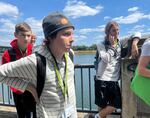
Aire Uusitalo, who attends Portland's Alliance High School, learns about Multnomah County's moveable bridges at the Tom McCall Waterfront Park on Aug. 4, 2025.
Tiffany Camhi / OPB
PSU’s Transportation Research and Education Center, or TREC, has been hosting the camp for more than a decade. The camp is completely free and there are minimal requirements for students who apply. It’s obvious that this year’s campers all have a strong interest in transit.
The camp is fully funded through the Federal Highway Administration’s National Summer Transportation Institute program. The Oregon Department of Transportation distributes the federal dollars to partner universities to run their own camps, including Portland State and Oregon Institute of Technology.
An ODOT spokesperson said Oregon State University also received funding directly from FHWA to operate a camp this year.
The future of these camps is in some doubt.
Related: Oregon counties lose transit options as federal funding remains uncertain
Several federally-funded student programs have seen their budgets slashed this year as part of the Trump administration’s cost-cutting efforts.
The transportation camps are funded on a year-by-year basis, according to ODOT. It’s not clear if funding for FHWA’s student programs is being reduced for next year. The FHWA did not respond to interview requests.
Learning about transit’s problems and potential solutions
The goal of the camp, according to TREC Director Jennifer Dill, is to help students think more critically about transit.
“Transportation is such a huge field,” Dill said. “It’s not just about designing roads or designing bridges. It touches on people’s lives every day in multiple dimensions.”
Each day of the camp is broken up into two sections.
In the morning, students are in the classroom learning about traffic safety, accessibility and land use, among other topics. They also hear from guest speakers currently working in the industry, such as civil engineers.
In the afternoon, students become pedestrians and passengers around Portland. Campers get a behind-the-scenes look at the city’s various transit systems, such as Multnomah County’s bridges, the Portland International Airport and TriMet MAX stations.
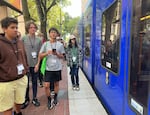
Campers take public transportation to a field trip touring Multnomah County's bridges on Aug. 4, 2025.
Tiffany Camhi / OPB
Camper Clarence Fernando was most looking forward to a tour of the Washington Park TriMet tunnel and riding different MAX light rail lines. The 16-year-old lives in Corvallis and attends Crescent Valley High School.
“It’s really interesting for me to see city transportation in a bigger city, especially in Portland, which has really invested in the transportation network,” Fernando said.
Students work on a group project throughout the week too.
This year, campers are focusing on Portland’s 82nd Avenue. They’ll be coming up with plans that re-envision certain parts of the corridor with an eye towards accessibility, safety and community use.
The busy and high-crash corridor has been a challenge for transportation planners for years. The road is especially dangerous for pedestrians and bicyclists.
Dill said the project will force students to think comprehensively about the history and future of existing transit systems.
“Part of what we’re trying to teach here is that there’s a long history. 82nd Avenue did not end up like it is randomly,” she said. “It doesn’t have to be like that. So how can we make it better for the people who live there now, who work there and go to school there?”
Today’s campers could be tomorrow’s transportation workers
Blake Greenwell, who attends Medford’s Logos Public Charter School, is passionate about exploring transit solutions that can better serve communities. He’s also eager to get some hands-on experience in the transportation industry.
“I’m really excited for the project because I’ll get to see whether I’m actually cut out for this, if this is something I want to do with my life,” Greenwell said. “I’m hoping to learn as much as I can in this camp and get that experience.”
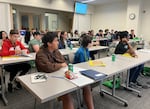
Campers hear from people working in transportation careers, like civil engineers, on their first full day of camp at Portland State on Aug. 4, 2025.
Tiffany Camhi / OPB
Transportation and warehousing was the fastest growing industry in Oregon from 2018 to 2023, according to the most recent Oregon Talent Assessment. And a 10-year projection by the Oregon Employment Department in 2023 predicted that jobs in this sector will continue to grow by 12%.
Jobs in the field of transportation are wide-ranging, covering everything from truck drivers and road maintenance workers to logistics managers and civil engineers.
Dill said it’s important to get young people interested in transportation careers now as the industry is undergoing turnover.
“We are finding in the transportation sector, public agencies in particular, that a lot of people are retiring,” she said. “We need younger people to step into those careers and we also need a wider range of perspectives in those positions.”
Related: TriMet announces sweeping cuts to services starting in November
Alumni of the camp have gone on to study civil engineering or urban planning after high school and obtained jobs in the transportation industry, Dill said. Others have taken the experience and joined local planning groups, like a bicycle advisory committee.
Campers in this year’s cohort aren’t sure of their career trajectory just yet.
Seventeen-year-old Cooper Garcia could see himself as an urban planner one day. For now, he’s grateful for the chance to dip his toes into the transportation world.
“I think doing stuff like this summer camp is great because it could get people into this field so that we can make a difference,” Garcia said.
“I just want to make this place that I love, I want to make it better.”