
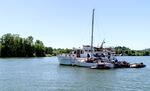
FILE - Boats anchored in the Willamette River near Ross Island appear to be abandoned, in this 2022 file photo.
Kristyna Wentz-Graff / OPB
From small fishing boats littered across state ports to a massive 384-foot ship rusting in the Columbia River, Oregon’s waterways continue to be dotted with abandoned and derelict vessels. Now, a first-of-its-kind partnership between the BoatUS Foundation and NOAA is bringing fresh funding to tackle the problem. The effort aims to remove more than 300 abandoned and derelict vessels from local waters across six states — with Oregon set to clear dozens of its highest-risk boats over the next two years.
Josh Mulhollem, who manages the state’s Waterways Stewardship Program, joins us to discuss how the funding will be utilized and how this effort could make a difference for Oregon’s coastal and river communities.
Note: The following transcript was transcribed digitally and validated for accuracy, readability and formatting by an OPB volunteer.
Dave Miller: This is Think Out Loud on OPB. I’m Dave Miller. From small fishing boats littered across state ports to a massive 384-foot ship rusting in the Columbia River, Oregon’s waterways are dotted with abandoned and derelict vessels. Now, a first-of-its-kind partnership between the BoatUS Foundation and NOAA, the National Oceanic and Atmospheric Administration, is bringing fresh funding to tackle this problem. The state is going to receive about a million dollars and plans to use it to remove dozens of high-risk vessels over the next two years.
Josh Mulhollem manages the Waterways Stewardship Program for the Oregon Department of State Lands, and he joins us now. It’s great to have you on the show.
Josh Mulhollem: Well, thank you for having me, Dave.
Miller: Can you give us a sense for the scope of the abandoned vessel problem right now in Oregon waters?
Mulhollem: It’s fairly extensive. There are quite a few boats in coastal ports up and down the coast, as well as many vessels in the Columbia River Basin, some on the Willamette. And I don’t like to characterize it as just the abandoned boats, the derelict boats that are sunk, but also the many boats in the state that are at the end of their useful life. There’s a marine debris kind of issue associated with that. Oregon, unfortunately, and not unlike other coastal states, certainly Washington and California, has a whole lot of old boat and vessel waste that still needs to be disposed of.
Miller: What is supposed to happen … let’s say somebody has some old crabbing boat, they’re getting out of the business. Why would that not be sold to someplace or end up in the correct place for it to be chopped up and recycled?
Mulhollem: Well, oftentimes, once a vessel gets on our radar, it’s probably been passed on multiple times. I mean, we are talking about vessels in some cases that were built in the ‘20s, ‘30s, ‘40s. So, they are often sold and sold again. But a vessel, just like anything else, only has so much life left in it. So, oftentimes, when they get to the end of the line, the options for what to do with it are fairly limited.
Some older fishing boats cannot easily come out of the water where they might be moored. Some of the smaller ones, even if they can get out of the water, to dismantle a vessel, to follow all the appropriate environmental regulations, it’s expensive.
Miller: It’s expensive and it’s supposed to be the owner of that vessel who would pick up all those costs. That’s part of the requirements of ownership?
Mulhollem: It is a responsibility as a boat owner to throw away your garbage, essentially, for lack of a better way to say it. But again, that’s an expense that some owners cannot easily afford. So we deal with a lot of vessels that are dumped, ones that are sold for pennies on the dollar to someone who doesn’t have the ability to maintain them. And unfortunately, that’s the problem that we’re trying to address and work with all these other partner entities to address as well.
Miller: Just to be clear, 10 years ago we devoted a full hour on this show to an issue some people call “aquatic squatters” – people living in boats anchored, some of them in the Willamette River, really close to our studios right here. Many of those boats were inoperable and many of them were serving as the only home that people had. Are those kinds of boats included in what you’re talking about?
Mulhollem: Yes, they absolutely are. That’s a little bit different than some of the vessels that we’re dealing with on the coast, older fishing vessels, things like that. But our program’s purview certainly extends on to those live-aboard vessels, that, yes, you’re correct, some I passed on the drive up here today. Dealing with those, we work with local enforcement, local jurisdictions to determine the priority for those. Especially if those vessels become beached, sunk, create an issue for navigation, for recreation, are a threat to the aquatic environment, then we are also poised to intervene in those situations.
Miller: What are the different kinds of environmental hazards or other kinds of hazards that these boats can create?
Mulhollem: When we get the report of a vessel sinking, especially if it’s one that has been in recent use, the initial concern is the release of fuels and other fossil fuels – so, diesel oil, gasoline. And there is an emergency response system that includes the Coast Guard, the state’s Department of Environmental Quality, that deals with those short-term kinds of issues. But there’s also some more long-term issues associated with some of these vessels that are left to decay in the state’s waters.
We recently finished a project, it was an old dredge vessel that we intervened on, in Rainier, ultimately had it dismantled and disposed of. But some of the testing for paint that was on that vessel revealed pretty uncomfortable levels of PCB. We see a lot of lead-based paint as well. When we’re dealing with especially older vessels, some of the things that went into production of those, we know now, are not very friendly to the aquatic environment. So it’s one of the reasons why we try to intervene when we can.
Miller: Can you tell us about one huge abandoned ship, the 384-foot ship that was used, as I understand it, to transport tanks to shore during the Vietnam War?
Mulhollem: Yeah, that’s absolutely correct. It’s still in Oregon. It’s interesting, I don’t think there’s a lot of Oregonians that know that is our biggest abandoned derelict vessel by far. It’s the USS Washtenaw County. It’s moored on the Columbia where it’s been for at least 20 years, downstream of Rainier. It is 384 feet long and it was a tank landing craft used by the U.S. military in the Vietnam era. It’s an example of a vessel that, once no longer of use to the federal government, gets auctioned off, decommissioned, goes into private ownership.
And with that one, like a few others that our state as well as Washington have dealt with in recent years, it was in private ownership to someone that had good intentions to celebrate its historical significance. But that didn’t work out, and the vessel remains on the Columbia and likely will for a while longer.
Miller: I mentioned the $1 million grant that the state got from this nonprofit and NOAA. That’s $1 million. What’s your best estimate for how much it would cost to actually take care of that one gigantic former military boat?
Mulhollem: An almost 400-foot, old military boat, given what I know that much smaller Coast Guard vessels have cost … I don’t think it’s irresponsible to say $30 [million] to $40 million at least, somewhere in that range. I mean, that is a giant ship.
Miller: So what can you do with this new grant? What are the plans?
Mulhollem: For this grant, this is specific to address abandoned and derelict vessels that have been left at Oregon public ports. So, we partnered with the Public Ports Association to develop an inventory of what we had up and down the coast, as well as up into the Columbia, at Oregon’s ports. The ports are prime economic drivers for their regions, so this partnership seemed to really make sense.
So we built an inventory of vessels that they had been essentially left with, put into the application that you mentioned and fortunately we received funding to address that inventory. That inventory has dozens of boats and the state is also prepared to contribute some matching funds as well, to make sure that all those vessels get taken care of.
Miller: I’m curious if you think there would be a way to prevent boats from being abandoned in the first place, without creating this perverse incentive for anybody who wants to not have to do what is actually their duty as a boat owner? Is there a way to thread that needle?
Mulhollem: I think so. Prevention is one of the primary tenets of our program. Yes, we do vessel removals, we work in some other realms, but we also want to … The state is not going to make progress on this issue without some proactive type of work and that’s in the prevention realm. So we’re looking into opportunities, we’re looking at other sources of funding as well, so that we can make it easier for folks to do the right thing, as you said.
I mean, we get calls to our office all the time, “Hey, I have this old vessel that I inherited, that I don’t want. What can I do?” Depending on where they are, it might be, “You have to take it a couple of hundred miles away and pay more than you’d expect to get rid of it.” So I think there’s ways that we can grease that, so to speak, to make that a little better.
Miller: Josh, thanks very much.
Mulhollem: Absolutely, thanks for having me, Dave.
Miller: Josh Mulhollem is the Waterway Stewardship Program manager at the Oregon Department of State Lands.
“Think Out Loud®” broadcasts live at noon every day and rebroadcasts at 8 p.m.
If you’d like to comment on any of the topics in this show or suggest a topic of your own, please get in touch with us on Facebook, send an email to thinkoutloud@opb.org, or you can leave a voicemail for us at 503-293-1983.
