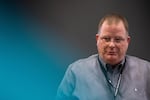
Patrick Allen, at a press conference Monday, March 16, 2020.
Kaylee Domzalski / OPB
On June 30, 2021, former Oregon Gov. Kate Brown held a Reopening Oregon Celebration at Providence Park in Portland to celebrate the end of most COVID-19 restrictions. Years later, Oregon schools and businesses are fully open, many workplaces have returned to in-office work and people regularly gather together inside. Patrick Allen is the former director of the Oregon Health Authority. He ran the agency during the height of the pandemic and joins us with details of what he learned working through a once-in-a-century crisis.
Note: The following transcript was transcribed digitally and validated for accuracy, readability and formatting by an OPB volunteer.
Dave Miller: This is Think Out Loud on OPB. I’m Dave Miller. We end today with a voice that’s going to be very familiar to longtime listeners. Patrick Allen was the director of the Oregon Health Authority from 2017 through 2022. We talked from time to time in the first few years of his tenure. Then the pandemic hit, and it seemed like he was on every month or so to talk about shuttered businesses and closed schools, about surges and new variants, about mask mandates and vaccination priorities.
He stepped down in January of 2023 after Tina Kotek took office as governor. He became the secretary of the New Mexico Department of Health, a position he held for two years. Last week, he emailed me saying he’s been thinking about the pandemic and memory and the perspective that five years can bring. So I asked if he’d be interested in coming back on the show to talk about all this. He said he was, and he joins us now. Patrick Allen, welcome back.
Patrick Allen: Thanks for having me back.
Miller: Why did you reach out to me?
Allen: Mark Twain said something to the effect of the problem with old men is it’s not what they don’t know, it’s what they remember that just didn’t happen. And as we’ve gotten further from the pandemic, I worry that a narrative has been hardening about it, that it has got some things that just aren’t true in it. And with a little bit of space and time, it feels like maybe we can start to have a conversation about what happened. What did we do? What didn’t we do? What worked, what didn’t work? And maybe try to help inform that narrative before it really gets locked in or before we forget the whole thing.
The flu pandemic of 1918-1919 kind of passed completely from memory until a couple of important books came out about it, almost 25 years ago now. And now that I’ve been through a pandemic, I can see why you kind of don’t want to talk about it anymore and you forget things. But I think we’re not doing ourselves a service if we either don’t remember it at all or remember it wrong, because this will happen again and what we learned, I think, is really important.
Miller: What are the most important things that you think we might be already remembering wrong?
Allen: A couple of things. I think there’s sort of this general notion that COVID turns out wasn’t very serious and that a lot of what we remember that was bad during that time was not the disease, but the reaction to the disease. And I don’t think that’s right. We’re beginning to remember things like, “well, vaccines really didn’t work very well,” and I think that’s demonstrably not true.
And then there are a bunch of things, on the flip side, that we did during the pandemic that I wish we had maybe done differently or thought about differently, but that also aren’t getting talked about as part of that narrative beginning to freeze up.
Miller: Let’s go step by step here. I’m curious even just for you, when you realized that COVID was going to upend our lives. I mean, there was a trickle of information about it going back to December of 2019. And it was a kind of slow crescendo for many of us. As the director of the public health authority, was there one day when you said, “oh my gosh, this is, this is for real, it’s gonna change everything?”
Allen: Well, there was, there’s a day I remember in about January, I think, where I went to a meeting of state agency leaders. I said something to the general effect of, look, this could go a couple of ways. Either this could end up being a seasonal thing that hits us right now and goes away in the summer, just like the flu does, or it could be something very different and we’re going to be hanging on until there’s a vaccine. And that might be a couple of years. Of course, it turned out A) that it was more like hanging on until there’s a vaccine. B) didn’t quite take two years, which was really good. But that was really the first point when I started thinking this is going to really upend things if it goes down that path.
Miller: Wow, that is many months before what I’ve come to, and even at the time, think of as the day that changed everything globally, which was March 11. That was when the World Health Organization officially declared a global pandemic, the NBA shut down, people started going crazy in supermarkets. Tom Hanks announced he’d gotten positive. All these things sort of small, silly and global all at once, and everything changed. But you’re talking about months before.
Allen: Potentially, yeah. I mean, February 28 for the first case in Oregon, March 8 when the governor declared an emergency, March 23 when we shut down schools. I remember these dates like my own kids’ birth dates.
Miller: Wow. Take us inside, if you will, the decision-making process for some of those things and the things that followed. I mean, how were major decisions made, whether it was a school closure, an emergency declaration, a mask mandate, vaccine prioritization? We can talk about some of those individual decisions in particular, but broadly, how were those major decisions arrived at?
Allen: Yeah, broadly, I have to really hand it to the governor. She sat down with us, with Dean Sidelinger – who you remember was the state epidemiologist – others on our team, outside advisers. And we would have extremely regular, sometimes daily, certainly weekly, discussions about what did we know, what was happening, what did we think would happen next and what kinds of recommendations did we have?
I remember Dr. Sidelinger doing kind of a decision tree that started with telling people to wash their hands and ended up with putting a medical cordon around the entire state and shutting down entry in and out. But we never obviously got that far. We went all the way down that tree pretty quickly. Those were all decisions where we really sat down with the governor, had conversations about them and collectively worked together on what were the right next steps.
Miller: How did you, for all of those decisions, think about the potential health benefits of any given restriction and then the social or economic problems that might follow from those well-meaning restrictions?
Allen: Yeah, it was challenging. By happenstance, I again vividly remember that kind of critical week, that second or third week in March, where we began to shut down gatherings, restaurants and those kinds of things. And a friend I’ve known for 30 years was running the tourism association and another friend who I had known for nearly as long was running the restaurant association, calling these guys up, telling them what’s going to come, and really understanding the impact that was going to have on so many people and so many lives.
In terms of schools, I was, at the time, chairing my local school board. My kids were out of K-12 schools, they were in college at the time, but all of those decisions just felt so very visceral because you could see exactly what was happening and what was coming. At the same time, you knew that more than probably any other decision or set of decisions you make in a health agency, real life lives were on the line and not hypothetical deaths from cancer down the road, but real people like really getting sick right now, getting hospitalized right now and potentially dying right now.
Miller: Do you have any regrets about the way Oregon handled school policies as a whole over those, say, the first two years of the pandemic?
Allen: Yeah, a couple of things. I mean, first, it’s worth remembering we were the ones who actually tried to keep schools open. The first cluster of cases were all related to schools – the Lake Oswego custodians, someone at a basketball game in Pendleton, a school case in Hillsboro. We pulled together educational leaders, OEA and the school administrators, association leaders from large districts, and we talked through the reasons it’s important to keep schools open.
We all came to agreement that that’s what we were going to do. A case cropped up at South Meadow in the Hillsboro district, and after doing a deep clean, they brought kids back. I was on the phone daily with the superintendent. The first day, half the kids didn’t show up. The next day, they had like 60% attendance, so it ticked up and we thought we were on a pretty good track. And then Ashland closed its district on its own and Lake Oswego closed its district, despite the fact that one of their board members was one of our senior public health managers. She got outvoted. Then basically parents were voting with their feet and pulling their kids out of school regardless. So at that point, the governor decided, and we agreed to go ahead and close schools.
I think I never appreciated how hard it was going to be to get them back open again. I think the decision to prioritize teachers for vaccines without getting an agreement at the same time that once teachers are vaccinated, then that’s when we’re going to go back to school was a big misstep, in the pandemic. I think we didn’t learn enough, quickly enough about air movement, ventilation systems in schools and how to figure out if you had enough ventilation to be able to make things work.
We heard lots of criticism that, “Well, kids don’t get very sick,” which was true. But kids go home to Grandma, who watches the kids in the afternoons when parents are at work or circulate with neighbors and those kinds of things. So there were a lot of challenges layered in there, but I think we were closed for too long and it was much harder to get them open than I ever anticipated.
Miller: Well, maybe you just answered this, but I just want to put it in the most stripped down ways I can … because if I had to sort of boil down the sentiment that I’ve heard in recent years, even among people who were initially in support of school closures in Oregon, it’s that in this state, officials focus too much on the very real negative health effects that being in person would introduce or could exacerbate, but not enough on the negative education, social and mental health effects of not being in person. Do you agree with that sentiment in general?
Allen: I think I agree with it in general. I would say, going back to trying to keep schools open at the beginning of the pandemic, we absolutely understood that this was a trade-off. And after people started getting vaccinated, tried to come up with strategies by which we could get schools open. Again, people tend to forget, schools were reopening at different points and different times in the state. In Central Oregon, school districts opened when they hit metrics that had been established to reopen and then they stayed reopened. It was really in the Portland metro area that we had some of the most challenges getting reopened. And, again, it was this challenge of not having worked out a deal with teachers that they’d get vaccinated and then come back to teach.
Miller: Do you think the state should have forced metro area districts to open up faster?
Allen: I don’t know what that would have looked like. Individual school districts were making their own decisions from the beginning of the pandemic. If teachers were adamant and as they truly did believe that their health and lives were at risk, they wouldn’t have come back, or at least not in sufficient numbers. So we talked that through and ultimately the governor had a call to make on whether to do that or not, and we just really couldn’t get there.
Miller: I want to turn to vaccines, the incredibly fast development and then deployment of a vaccine. It’s one of the true amazing success stories of the pandemic, more than masks, more than social distancing. It was vaccines that changed the direction of the pandemic. And yet vaccines broadly, right now, are being called into question at the highest levels, in ways that outstrip what we saw in terms of vaccine skepticism pre-pandemic. Money is being taken away from the development of future vaccines right now.
In retrospect, do you think that that anti-vaccine movement, that backlash, could have been lessened in some way, in a way that wouldn’t have significantly jeopardized public health?
Allen: By anything, do you mean just in general?
Miller: Well, yeah. I’m trying to keep it open ended to start with. I mean, obviously what we saw was a kind of push from public health authorities, especially in blue states, to get people vaccinated. Then there was a response. And the response has been so big, in ways that haven’t become fully evident yet. That backlash could have its own serious public health effects.
So I’m wondering, if you could thread the needle differently, and whether we’re talking about Oregon or nationally, if you think there could have been a better way?
Allen: I don’t know. This is challenging and I do think about this a lot, almost every day. People say – and this is one of the things, I think, we’re maybe learning or remembering wrong – that on vaccines and a number of other topics, public health, it destroyed its own credibility. So now we don’t have a valid voice on topics like this. And I think that ignores the fact that we were swimming against an absolute tidal wave of misinformation, either shared legitimately or I think a lot of it not shared legitimately, that claimed all kinds of things, from the ridiculous like chips in the vaccine to claims that they simply didn’t work, or these kinds of things.
And I think that we really struggled to figure out how to adequately respond to that misinformation. If you’ve ever gotten in an argument with someone who’s opposed to vaccines, you’ll make a point and they’ll send you, I’m not kidding, links to 30, 50 or 70 studies showing why you’re wrong. And if you go look at them, you’ll find either they don’t say what they think they say or there’s deep problems in the methodology or whatever. But nobody has time to go through 30, 50 or 70 studies. And when you do, then there’s another 30 or 50 links to something else and it’s just an impossible task to try to overcome that.
So I think we were running into that headwind in ways that I honestly don’t know what we could have done differently. I think the other challenge is things changed over the course of the pandemic and people really struggled with that. When the vaccine first came out, it was in fact extremely effective at stopping the spread of disease. You were less likely to get COVID if you had been vaccinated, far better than anyone expected with the vaccines, something like 90% effective at being able to keep you from getting infected. That led to lots of things like vaccine requirements for people in health care positions and those sorts of things.
The virus mutated, so that changed. And what happened now is you maybe weren’t less likely to get COVID, but you were less likely to get it seriously and to have it for less time, and thus you would be less likely to spread it to somebody else. What that means is, in both cases, there’s less COVID because of the vaccine, but for different reasons. And in just running through that in 90 seconds, that’s super nuanced and we don’t do nuance very well. Trying to keep up with that and explain that to people was just inordinately difficult. I really struggled to try to figure out how could we have approached that differently while still maintaining what was true, which was the vaccine was a good thing that changed everything, that made a big difference and saved lives.
Miller: Although it is striking, as you said, you think about this every day and even so, you don’t see an obvious better path, even in retrospect.
Allen: Yeah.
Miller: Near the end there, you were talking about the challenge of communication when the science or our awareness of the science changes. What lessons have you drawn about how to communicate given, say, in the early days, a real lack of knowledge about what we’re dealing with? Or, when those things change, what’s the best way for public health people to communicate to the public when they’re either unknowns or changes?
Allen: Yeah, I think early in the pandemic, we had a pretty good discipline. I remember my talking points for press conferences would usually say something like, “Here’s what we know,” and I would go through points. And then I would pivot to, “Here’s what we don’t know.” And I think somewhere along the line, we maybe lost a little of that discipline and probably should have really focused on, “Here’s what we know, here’s what we don’t know, here’s what’s changed and here’s what that means.” And try to really be maniacal about sticking to that.
But I would actually turn to the media a little bit and put a little bit of this into what lessons can the media learn from this. Because one of the things that was a little bit maddening was, if you’re doing a story on something, you want to say, well, this person says this, but here’s a person that … here’s another, another point of view. And what we found during the pandemic is reporters could find a professor somewhere to say just about anything.
Every time we would go out and try to communicate, here’s what we know and here’s what we don’t know, and here’s what’s changing and here’s what we think you should do, stories would inevitably have somebody who said, “Well, they’re doing it all wrong. They shouldn’t be doing that at all. They should be doing this thing over here. They’re interpreting that wrong.” And that was, again, really hard to overcome.
Miller: This may sound like a strange question, and I ask it without intending to ignore any of the terrible losses from the pandemic, but I’m wondering if you miss anything from those days?
Allen: Oh, that’s a great question. Well, certainly, like any kind of a difficult job to do, under difficult circumstances, there’s a sense of camaraderie that I miss with the hundreds of people at OHA who were involved in pandemic response. In fact, back in April, I think we had a little bit of a reunion of sorts to kind of mark the fifth year and just spend a little bit of time together again. I miss that. I miss, a little bit, the sense of sort of a single overriding purpose.
In a big agency like OHA, you’ve got literally a million things to do, and you’ve got literally a dozen top priorities. And for a period of time, the mission of OHA was to beat COVID. And that offered a degree of clarity that I think was something that you don’t frequently get. We may have stuck with that clarity a little too long, but those are two things I can come up with. I can’t come up with a whole lot of things I missed from the pandemic, honestly, Dave.
Miller: Yeah, I don’t think very many people can. Before we say goodbye, it seems inescapable as I was thinking about talking with you, that I’ve been thinking if you were still in charge of the Oregon Health Authority right now, you’d be overseeing the massive shrinkage of the Oregon Health Plan, the end of health coverage for maybe hundreds of thousands of Oregonians and the reduction of benefits for the people who are still going to be on it. Have you been thinking about what that would be like?
Allen: I have. And I worry a lot that the generation of policymakers, who had a role in shaping over decades what the state’s approach to health and health care looks like, have largely passed from the scene. I worry that people don’t really appreciate what it is Oregon has, and why it’s so valuable and why it’s so important to try to figure out how to keep the wheels on, even though the federal climate is changing so much. Well, that’s a topic for another day, maybe.
Miller: And it is a topic that we hope to talk about with the current Oregon Health Authority director Sejal Hathi, the director of the OHA. We have made many requests, and we are eager to talk with her, but Pat Allen, thanks so much for your time today.
Allen: Thanks for having me.
Miller: Patrick Allen is the former director of the Oregon Health Authority.
“Think Out Loud®” broadcasts live at noon every day and rebroadcasts at 8 p.m.
If you’d like to comment on any of the topics in this show or suggest a topic of your own, please get in touch with us on Facebook, send an email to thinkoutloud@opb.org, or you can leave a voicemail for us at 503-293-1983.