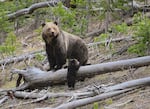
FILE - This file photo provided by the United States Geological Survey shows a grizzly bear and a cub along the Gibbon River in Yellowstone National Park, Wyo., April 29, 2019.
Frank van Manen / AP
A federal plan to bring grizzly bears back to Washington’s North Cascades appears to have gone into hibernation under the Trump administration.
Federal officials said there is no timeline for reintroducing any bears but declined to provide further details on the project approved under the Biden administration.
“While agencies made a decision in 2024 to restore grizzly bears to the North Cascades ecosystem, there is currently not a timeline for when translocations may begin,” North Cascades National Park spokesperson Katy Hooper said by email.
That sentiment was echoed by U.S. Fish and Wildlife Service spokesperson Andrew LaValle.
“No translocations have occurred and there is no timeline for when any may begin,” LaValle said by email.
In response to requests for further updates on the project, both agency spokespeople referred a KUOW reporter to a webpage that appears to have had no information added since 2024, during the Biden administration.
“Nobody left who cares at FWS or NPS [National Park Service] is foolish enough to stick their neck out for bears or much else at this point. Sad state of affairs not just for bears but for rule of law,” Mitch Friedman, executive director of Conservation Northwest, one of the environmental groups that advocated for restoring the North Cascades’ apex predators, said by email.
Related: Feds to restore grizzly bears in Washington’s North Cascades
Republican Congressman Dan Newhouse, whose district includes the eastern half of the North Cascades, has introduced a measure in a 2026 appropriations bill to block any spending to bring grizzlies back to the Cascades.
He has introduced similar language in previous years.
Newhouse, through a spokesperson, declined to be interviewed but provided a letter in which he urged the new director of the Fish and Wildlife Service to block the grizzly reintroduction.
“The administration should halt the movement of grizzly bears to establish a non-essential experimental population in the North Cascades Ecosystem,” Newhouse urged newly confirmed Director Brian Nesvik in an Aug. 7 letter. “It is imperative for the safety of residents, their livestock, and their crops that this population is not established.”
Nesvik was previously the director of the Game and Fish Department in Wyoming, home to a stable population of about 1,000 grizzlies.
Scott Schuyler with the Upper Skagit Indian Tribe said the tribe takes the long view on returning the majestic animals to the tribe’s traditional territory.
“These creatures coexisted with us since time immemorial, and if we have to wait another three to five years to get the animals brought back to their ancestral homelands, we’re OK with that,” Schuyler said.
The National Park Service gave the final go-ahead to reintroducing grizzlies to the North Cascades in April 2024, after planning and public processes stretching back half a century.
Grizzlies were officially protected as a threatened species south of Alaska in 1975.
Related: Proposal To Restore Grizzlies To Washington Draws Hundreds Of Voices
The first Trump administration, under Interior Secretary Ryan Zinke, initially backed a proposal for reintroducing the bears to the North Cascades. The National Park Service and the Fish and Wildlife Service are both branches of the Interior Department.
“I’m in support of the great bear,” Zinke told a small audience at North Cascades National Park Headquarters in Sedro-Woolley, Washington, in 2018.
Zinke resigned later that year while under federal investigation. The Interior Department under his successor scuttled the proposal, which was in the midst of a lengthy public process.
“They quietly made it go away,” said Jack Oelfke, then the chief of natural and cultural resources at North Cascades National Park. “They just ended the process with no decision made.”
In April 2024, the Interior Department agencies announced they planned to airlift three to seven bears each summer into the rugged wilderness northeast of Seattle from healthy populations in Montana, Wyoming, and British Columbia.
Oelfke, who retired in 2020, said it is within the department’s powers to do an about-face on grizzly reintroduction or other programs.
“Yes, the administration in power at the moment can make the decision not to pursue it,” Oelfke said.
“The Park Service, it was part of our mandate to recover native species that were gone,” Oelfke said. “Will they ever implement it is a question. But I personally don’t hold out much hope.”
Oelfke said he is still in touch with his former colleagues at the Park Service.
“It’s hard times. Morale is not great,” Oelfke said.
The National Park Service has lost 24% of its permanent staff nationwide since the start of the Trump administration, according to the nonprofit National Parks Conservation Association.
North Cascades National Park lost its lead wildlife biologist, and a nationwide hiring freeze is stopping the park from hiring human-bear conflict specialists to respond to incidents involving the park’s black bears.
The Trump administration is proposing to cut the Park Service’s budget by 37% for 2026.
“The 2026 Budget supports the Administration’s priority to streamline government,” the administration’s proposed budget for the National Park Service states.
Oelfke said when he catches up with his former colleagues, he offers words of encouragement.
“When I see people, I try and encourage them to stay strong, be courageous, and keep working for the ideals of environmental conservation and in this specific case, ultimately, for grizzly recovery,” he said. “I want to believe that the time will come.”
John Ryan is a reporter with KUOW. This story comes to you from the Northwest News Network, a collaboration between public media organizations in Oregon and Washington.
It is part of OPB’s broader effort to ensure that everyone in our region has access to quality journalism that informs, entertains and enriches their lives. To learn more, visit our journalism partnerships page.