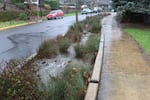
In this 2015 photo provided by the City of Portland, a green street on SW Marigold Street is pictured.
Courtesy of City of Portland/BES
Over the past few decades, Portland has built one of the most extensive green stormwater infrastructure systems in the country. Instead of relying only on pipes and drains, it has created thousands of rain gardens and green streets to help keep sewage out of the Willamette River. Much of that work has not only involved city engineers but also local community members — from volunteers who ‘adopt’ and maintain storm drains to nonprofits that rip out pavement and replace it with trees and plants.
A new study in the journal Sustainability looks back at the first 30 years of Portland’s green stormwater infrastructure, but questions remain about whether the city can keep up with climate change and rapid urban growth.
Our guests are study co-author Adrienne Aiona, a civil engineer at the city’s Bureau of Environmental Services and Ted Labbe, finance and partnerships manager of the nonprofit Depave. They join us to talk about the city’s work and the role of local stewardship in keeping Portland’s green stormwater system alive and well.
Note: The following transcript was transcribed digitally and validated for accuracy, readability and formatting by an OPB volunteer.
Dave Miller: From the Gert Boyle Studio at OPB, this is Think Out Loud. I’m Dave Miller. Over the last 30 years, Portland has built one of the most extensive green stormwater infrastructure systems in the country. Instead of relying only on pipes and drains, it’s created thousands of rain gardens and green streets to help keep sewage out of the Willamette River. That work has involved not only city engineers, but also local volunteers and nonprofits.
A new study in the journal Sustainability found real successes in the last 30 years and highlighted the importance of this work as climate change intensifies. Adrienne Aiona is a civil engineer at the city’s Bureau of Environmental Services [BES] and one of the co-authors of this new study. She joins us now along with Ted Labbe. He is the finance and partnerships manager of the nonprofit Depave. Welcome to you both.
Adrienne Aiona: Thank you.
Ted Labbe: Thank you.
Miller: Adrienne first: for people who may not be familiar, what exactly is included in this term “green stormwater infrastructure?”
Aiona: So when we’re talking about green stormwater infrastructure, we’re really focused on systems that use more natural processes to help manage stormwater. That includes things like green roofs, green streets – so they’re streetside planters that take stormwater runoff – rain gardens and people’s yards, those kinds of systems.
Miller: As opposed to sewers.
Aiona: As opposed to pipes in the ground, yeah.
Miller: Ted, one of the things I’ve heard is that you prefer the term rainfall to stormwater. Why is that?
Labbe: Yeah. Stormwater is like pollution, right? And rainwater is a resource that’s got tremendous potential if we can get it into the soil at a site. It is gonna help us, enable us to achieve our climate goals with regard to rebuilding soil carbon in green spaces within the city. So we might as well make use of it. And it can also grow food for people, it can cool the city, so it’s got many, many benefits. So instead of just thinking about it as a pollutant that we have to deal with, it kind of flips it; and it’s a resource for us to achieve our very ambitious goals that we have in the city around climate.
Miller: How successful has that language argument been for you? I mean, not having people think about it that way, but having people actually change the words they use.
Labbe: I think a lot of people in Portland, including folks like Adrienne at BES, get that, right? But I think, traditionally, from a sort of a top-down regulatory approach, Clean Water Act, it’s treated as a pollutant. But we have a lot of gardeners in the city that get that – and I think on a grand scale, that’s what we’re doing is gardening, right?
Miller: Adrienne, we get heavy downpours sometimes here, but the most often version of liquid precipitation here … there’s occasional snow, there’s sometimes terrible ice, but basically, it’s sort of medium-level or low-level drizzle. What does that mean in terms of infrastructure needs compared to other cities?
Aiona: So that’s really different. Something that’s unique about stormwater is that the challenges are different in different locations because the climate is different and the rainfall patterns are different. In Portland, it makes it somewhat easier for us to manage our stormwater because it comes in these drizzles. But if we’ve sized our systems to manage that, when we get a big downpour, then our systems become overwhelmed.
Miller: And you have to build these systems for those for the potential flooding events; otherwise, you’ll have disasters.
Aiona: Yes.
Miller: What programs do you think have made the biggest difference in Portland over the last 30 years? What is it that has made us a national leader, as this report says?
Aiona: Right. So, Portland is a leader partially because we were an early adopter of green infrastructure. As Portland urbanized, like many other cities, we put our stormwater and our sewage all together in the same pipes and sent that directly to the river. We built our wastewater treatment plant in 1952. But even after that, we had stormwater and sewage overflowing into the Willamette River whenever it rained.
So, recognizing the environmental and public health impacts of that, sort of in the early ‘90s, the city started focusing on managing stormwater. And we used gray infrastructure for that, the Big Pipe Projects, but then leaders in Portland recognized the need for green infrastructure to help manage and remove stormwater from the combined system to prevent those overflows into the river.
Miller: And part of that was having what’s called downspout disconnection?
Aiona: Yeah, the downspout disconnection program was a really big win for the Big Pipe Project. City staff went door to door to work with property owners across the city to remove the downspouts – the pipes that come off their roof – from the storm system and send that water into their yard instead. Through that project, they disconnected 56,000 downspouts and removed 1.2 billion gallons of water from the system a year. And that resulted in significant savings for the Big Pipe Project.
Miller: Ted, that’s an example of the community taking part in this. I mean, we’re talking about infrastructure here, but what role do Portlanders, or people anywhere, play in these systems?
Labbe: Yeah, I think my definition of green stormwater infrastructure, or more broadly green infrastructure, is maybe a little bit broader and that people are part of that network, right? Because green infrastructure is, it’s cheaper to build, but it’s actually more expensive and more involved to maintain, and you’ve got to engage the community in that. And that, to me, is the special sauce that Portland has, is these partnerships that Bureau of Environmental Services has with community groups like Friends of Trees, like Depave, to engage the community in creating these pocket green spaces, maintaining them.
And without that, I think we would not have made the great strides that we’ve made. Because we’re the part of how we communicate this to the public, and bring people in, and explain that, hey, we’re all in this together.
And I would argue, actually, that the community-driven aspect of the story goes back to the very beginning. Because we wouldn’t have had this leadership, the Bureau of Environmental Services, if a certain special person by the name of Nina Bell with Northwest Environmental Advocates had not sued the city and got us the compliance order under the EPA Clean Water Act to create the leadership by people like Adrienne and others at BES. So I think from the very beginning, it’s been community-driven, it remains so. Let’s hope it continues.
Miller: What does Depave do?
Labbe: Depave is a community-based nonprofit, and we tear out derelict, underutilized pavement at community hubs like schools, churches, other community hubs. Our newest project is in the street, and we transform those spaces into amenity-rich green spaces – places for kids to play, places for food gardens, places for tree canopy. Yes, green stormwater infrastructure as well, but also stages. Kids love to jump up on stages, middle schoolers do – my daughter’s a middle schooler. And just places to build community and build ownership in those spaces.
We work a lot in parts of the city that don’t have good access to parks and green spaces, and we really focus our energies there. And the way we do our work is, volunteers are tearing out the pavement [and] that creates a certain amount of ownership in that space that people are not going to walk away from it and neglect it.
And as Adrienne can probably tell you, that’s the challenge for stormwater managers. How do we maintain this green infrastructure over time? It’s a distributed network. We’ve got to have the community involved. We’re part of that special sauce, I guess. And we are growing a network of affiliates across the country and the world with our community organizing model, but …
Miller: You’re talking about a lot of potential benefits that can come from jackhammering asphalt and putting greener stuff in its place, but what are the specific stormwater benefits of doing that?
Labbe: Yeah, the climate is changing. I think Adrienne described the runoff patterns. We’re getting a lot more of these storm burst events in the early fall. So, part of the design storm events is to plan for bigger storms. We super-size a lot of our green stormwater infrastructure and then we actually just remove the need for it, in a lot of cases. Strangely, depaving is not a best practice, as defined by the Bureau of Environmental Services, in Portland or anywhere in the world, as far as I can tell. But we know that if you pull the pavement out, the water has to go somewhere and into the soil. And that’s sort of the preferred technology, if you will.
Miller: It seeps in, if you will, as opposed to flowing in larger volume in some particular place.
Labbe: That’s right. And instead of going down in the storm drain and overflowing to our rivers, causing pollution, causing flooding for low-lying areas, impacting natural ecosystems that we value here.
Miller: Adrienne, we’re talking a little bit about climate change and Ted was getting to it there in terms of, say, in the fall, more severe quick storms. What are the other ways that climate change is complicating this work going forward?
Aiona: So, in Portland, we’re seeing warmer, wetter winters and hotter, drier summers. And the changes in our rainfall patterns, like Ted’s correct about seeing more of those cloud bursts and atmospheric river events that are bringing more of our precipitation in bigger bursts. We’ve worked with University of Washington and other local utilities to look at downscale climate models and are evaluating that to figure out how to kind of modify our designs, to manage these, changing rainfall patterns. And we are incorporating that into some of our larger projects.
For green infrastructure, those facilities can be a little bit more flexible and manage different kinds of storm events better. So they have storage capacity that holds water if it comes all at once and lets it slowly soak into the ground. And then they also provided, like Ted said, other climate adaptation benefits by creating increasing green space and potential for providing habitat benefits.
Miller: Is it harder to keep some of those bioswales alive though if it’s 101 degrees for five days in a row?
Aiona: Yeah, so one of the big challenges for us has been keeping plants alive in a lot of these facilities. They’re in a really tough environment surrounded by a lot of pavement. They have sandy soil that drains quickly, so those hotter, drier summers have been challenging and will continue to be challenging for us. We’ve made some design modifications and are working on our plant lists, but those are only going to get us so far.
Miller: What do you think Portland could learn from other places? I mean, this article, it says … and I should say it was you, who works for the city, and some folks at PSU saying Portland’s doing well and other cities could learn from us. But what could we learn from other places? Who is doing something that you want to emulate?
Aiona: Yeah, in the early days, because Portland was an early adopter of green infrastructure, we were, as this article says, a leader. But something that’s excellent that’s happened in the recent decade is that other municipalities are doing more green infrastructure and we have peers to learn from.
So we’ve been listening to New York City – they have a big cloud burst program where they’re looking at flash storage for large storm events. We can look to Seattle, who’s looking at novel soil media to put in facilities that help reduce the amount of nutrients that are exported. So those are the kinds of things that we can learn from other jurisdictions and it’s nice for us to be in a place where that is the case.
Miller: There’s an irony that the Big Pipe Project that you were talking about earlier that’s really reduced the frequency of sewer overflows, they’re very rare in the summer now [and] they’re much less rare in the winter as well, but now we’ve got more toxic algal blooms than we did before in the summer. So if part of the idea was, let’s have this river be livable and swimmable, and now we have for a different reason also connected to climate change, a reason that people are told, “don’t go in the river,” how do you think about the totality of this environmental work?
Aiona: It’s daunting, but I feel like there are a lot of opportunities, right? For stormwater, we’re kind of building a system where there wasn’t one before, to help emulate the natural processes.
Miller: Before everything was turned into human infrastructure.
Aiona: Right, exactly. So the more we do that, the better we get kind of more functional environment.
Miller: Ted, I want to go back to one of your main points: that the secret sauce here is the human infrastructure, the social piece of this. How do you keep that going in a society that in some ways feels more fractured?
Labbe: Yeah, it’s a great question. I call myself the old man of Depave because I helped get it going in the beginning. And it’s amazing to me the number of people that come out to our events to destroy pavement. It’s a strange subculture of Portland, but it’s popping up in other places in the world. And there is something to that sort of creative destruction and people taking their aggression out on legacy infrastructure that’s not working for us anymore in a changing climate.
The other thing I would say is that – and I don’t know quite how to think about this, Dave – in an era when we have escalating rates of depression in young people, and old people alike, actually, people are coming to our events, whether they’re planting events or depaving events and they’re finding solace, they’re finding healing in working together for a larger purpose. I’m not a religious guy, but there’s something to that that creates something. We’re creating something when we create these green spaces together, and people are finding community, and they’re finding a way to be part of a solution that we desperately need. We need to accelerate the pace that we’re doing this and that’s where I would love to think about together how we do that.
Miller: Ted and Adrienne, thanks very much.
Labbe: Thank you.
Aiona: Thank you.
Miller: Ted Labbe is the financial and partnerships manager at the nonprofit Depave. Adrienne Aiona is an engineer with the city. She is with the city of Portland’s Bureau of Environmental Services.
“Think Out Loud®” broadcasts live at noon every day and rebroadcasts at 8 p.m.
If you’d like to comment on any of the topics in this show or suggest a topic of your own, please get in touch with us on Facebook, send an email to thinkoutloud@opb.org, or you can leave a voicemail for us at 503-293-1983.