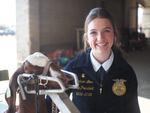
Madison Love, vice president of the Crater FFA chapter in Central Point, Oregon, poses for a photo with her goat, Rasputia, at the Oregon State Fair in Salem on Aug. 22, 2025.
Dave Miller / OPB
The 160th annual Oregon State Fair in Salem wraps up on Labor Day. The 10-day event features live music, monster trucks, carnival rides and competitions that showcase excellence in Oregon art, livestock, agriculture and more. From the tallest sunflower grown to blue ribbons awarded for beef and dairy cattle, the fair is also an opportunity to honor the hard work of future farmers, ranchers or hobbyists who’ve waited months to compete and show off their skills.
We visited the fair on opening day to talk with folks about what brought them there, whether it was livestock to judge, veggies to show off, deep-fried Oreos to sell or childhood memories to rekindle.
Note: The following transcript was transcribed digitally and validated for accuracy, readability and formatting by an OPB volunteer.
Dave Miller: This is Think Out Loud on OPB. I’m Dave Miller. We have a special show for you on this Labor Day. We’re going to spend the hour at the Oregon State Fair. Today is the last day of the annual celebration of fried foods, agricultural displays, competitions for arts and crafts and hobbies, not to mention rides and carnival games.
We went on opening day this year when it hit a blistering 101 degrees. We got there before the rides opened and went straight to the agricultural pavilion. Madison Love was there. She is the vice president of the Crater FFA chapter in Southern Oregon. She was grooming a goat, and she’d brought more than a dozen sprays, lotions, bottles and powders. I asked her what she was doing.
Madison Love: When you show goats, you do this thing called “fitting.” It’s very big in the livestock industry. You do it with most all species that you show. On goats, we use adhesive to hold their leg hair up …
Miller: This can says “Tail Adhesive.”
Love: Yes, we use it on their legs to hold their leg hair up …
Miller: Oh, It’s sorta fluffed out a little bit. OK.
Love: … and we brush it in an upward motion to fluff it out. Then after that …
Miller: It’s sorta like super hairspray?
Love: Yes. It’s super hairspray.
Miller: Except for goat tail hair.
Love: I’ll use it on my hair if I’m in a hurry at a show and I need to slick back my baby hairs. [Laughter]
Miller: It does say, “Extremely flammable.” Not hazardous, just flammable. OK, so it’s fine to use on your own hair.
Love: Yes. It’s specifically made for animals and I’ve never had a problem with it in my hair.
Miller: So, that’s number one. What’s this next one?
Love: This is called Powderful. It’s basically like baby powder in an aerosol can. You spray that on the legs after you use the glue to just amplify the hair, make it look a little bit bigger and fuller. You can also use baby powder – that works as well. I use Powderful, the aerosol can, and then I put baby powder on top of that. And then you also use the baby powder to powder their bodies.
Miller: Man, but you’ve only gone through like half of the things here.
Love: A lot of the other stuff is … I have a lot of soaps. It’s very important for our show doe’s to have really nice hair. I rinse with water and conditioner every single day of the week. I use cold water and I rinse their hair, and it just helps their hair grow and keeps it healthy.
Miller: Who do you spend more time taking care of, your own grooming or your livestock?
Love: Probably my livestock. I drive 20 minutes out to my barn, both directions, twice a day, and then I’m out there for probably four to five hours a day.
Miller: Do you mainly focus on goats?
Love: I also show sheep. They aren’t my favorite, but I enjoy it.
Miller: Sheep are not your favorite.
Love: No, they’re not my favorite.
Miller: Why not?
Love: I don’t think their personality is as good as goats. Goats have really fun personalities. Now, if you ask a person who just show sheep, they would say sheep are the best species ever.
Miller: But that’s because they don’t know goats?
Love: Yes.
Miller: What’s the difference in general between a goat personality and a sheep personality?
Love: I would say that goats are like dogs. My big doe that I have at home, she just follows me around. I can let her out of the barn and she follows me around. I say her name and she comes right to me. If I tell her to go back into her pen, she goes back into her pen.
I had her out of the barn the other day and my boyfriend was out with me. He was standing on the other side of his truck and she was on the opposite side from him, looking under the truck to see where his feet were. Then when he moved around, she ran at him to chase him, like she was playing a game of tag with him. They’re spunky and they’re more fun than most of the species that I’ve interacted with.
Miller: When you come to a state fair or a county fair at this point, are you excited at all about all the other stuff that people come here for – the rides and the food – or are you just done with that?
Love: I have never been a big ride person, ever. So I don’t really pay that much attention to the rides. And yes, I like the food and I like getting to see people and interact with people. That is one of my favorite things about the state fair is, in our county, at our county fair, everybody who’s at the fairgrounds for the most part knows what’s happening. And at the State Fair I love getting the questions that people ask, even if they may feel like, “oh, this is a dumb question to ask,” I love hearing those questions and answering them, and interacting with people who don’t necessarily know about this part of the livestock industry.
Miller: Like me, who knows nothing.
Love: Yeah.
Miller: What’s the dumbest question you’ve gotten?
Love: I had someone ask me if they could pet my dog and it was a goat. But I get a lot of questions like, “Oh, is this one a boy or a girl?” And it isn’t always easy to tell, so there’s just little things like that, but I don’t necessarily think I’ve gotten an outrageous question.
Miller [narrating]: That was Madison Love with her goat Rasputia.
After hearing from somebody who’s raising livestock for competition, I wanted to see what the competitions are actually like. So I headed over to the arena where the judge, Jordan Ash, was announcing the winners in the Wether Dam Commercial Doe Show. I had to look this up. It means female goats that are bred for meat production. Here’s Jordan describing the qualities he liked in the winner:
Jordan Ash: … Skeleton. She’s so expressive, so dimensional, and when young lady gets her propped up like that, certainly paints a good enough picture for me to win this class …
Miller [narrating]: After the competition, I caught up with Jordan Ash. He raises sheep and goats professionally in Lancaster, Pennsylvania. In the last few years he’s been all over the country – Georgia, Mississippi, Ohio, Indiana – as a judge. I asked him what he’s looking for in the arena.
Ash: So really, honestly, judging is a lot of personal preference and opinion. That’s definitely something we try to express to the kids, that way they don’t take the opinion too harshly if they don’t have a successful day.
But in regard to what we’re looking for, just high quality animals, in regards to how they handle, with their muscles, structural integrity. I like to tell people a lot of the time it’s very, very similar to an AKC dog show. So when you’re sitting with your family at Thanksgiving watching that, it’s a lot of similar things. Fortunately, with this we can do a lot of personal preference. There isn’t a breed standard or characteristics that we look into, so that’s kind of what we’re looking for.
Miller: Did you do this as a kid? Before you judged, did you raise animals?
Ash: Yeah, I was very fortunate enough to show livestock … showed livestock across the country at all levels.
Miller: What kind of responses do the winners get when they find out that they won?
Ash: It depends on the size of the show. A lot of the kids are really excited, just because raising livestock obviously is a time consuming extracurricular activity, as is anything. Regardless if you’re playing travel baseball or any sport, it requires a lot of time and dedication. So definitely, kids are always super excited when they get the opportunity to have the champion handshake.
Miller: Has any kid come up to you and said, “Hey, if you give me a first or second place, I’ll slip you a little something?”
Ash: [Laughs] No, that does not happen. No.
Miller: [Laughs] OK, just curious. Thank you. What are you looking forward to seeing while you’re here?
Ash: Just evaluating the livestock and getting to work with the kids.
Miller: That’s it? You don’t go on rides, you don’t stop and eat funnel cakes in every state?
Ash: No, nothing like that. I try to keep it professional, and just come in here and do a good job, and work with the kids and give them an accurate opinion, and go back to the hotel and then fly home.
Miller: Thanks very much.
Ash: Yes, thank you.
Miller [narrating]: Outside the livestock competition, I met up with Kim Grewe-Powell. She’s worked for the Oregon State Fair and Exposition Center for 15 years now. She’s been the CEO for the last five years. I asked if she remembered going to fairs as a kid.
Kim Grewe-Powell: Yes, I do. I loved the fair growing up.
Miller: Are you an Oregonian?
Grewe-Powell: I’m an Oregonian. I was born and raised in Salem.
Miller: Right here?
Grewe-Powell: Yes.
Miller: So, do you remember how old you would have been the first time you came to the fair?
Grewe-Powell: Probably around 5 or 6. Yeah, our family always came. It was one of the highlights of the summer.
Miller: What time is it? It’s 10:15 right now … 10:14, I don’t want to cheat you. So that means 14 minutes ago, people walked in for the first time. How long have you been getting ready for this moment?
Grewe-Powell: Our team gets ready for this year-round.
Miller: So the day the 2024 fair ends, you start thinking about it?
Grewe-Powell: Absolutely. Yes, we’re already thinking. We’ll have a meeting during the fair with our core staff, core managers, and we’ll talk about things that we can change and improve upon for next year.
Miller: Last year, in the middle of the fair, you were talking about this year?
Grewe-Powell: Yes, absolutely.
Miller: What’s one thing that changed from last year to this year?
Grewe-Powell: The layout. The layout is huge. We’ve expanded. We’re almost using every inch of 185 acres. We have 30 new food vendors. We have just so much entertainment here that is free with fair admission.
Miller: I’m curious what you think the fair means now, at a time when our country is really divided. I mean, it strikes me that this is a place where people from all kinds of experiences, political beliefs, end up going to the same place.
Grewe-Powell: Yes, our fair brings people together. And it’s a time to come and celebrate, celebrate all backgrounds. Whatever you believe in, you’re safe here.
Miller: So, how are you gonna spend the next week-and-a-half?
Grewe-Powell: Walking around talking to people, seeing kids smile – that’s what makes my job so awesome. I get to see people that really enjoy being here and are having fun. And like I said, my team works very, very hard to ensure that this is a safe place to go and also a place where you can have fun.
Miller: When you’re walking around, what are you looking for?
Grewe-Powell: I’m looking for trip hazards. [Laughs] Truthfully, I’m always looking for safety, things that we need to change, pivot, but that’s key. Also, for areas that we can improve upon, like I said, for next year. We can pivot a little bit, but it’s kind of hard to move a food vendor right now when we are using every inch of electricity that we have.
Miller: What are the other logistical things that fairgoers probably wouldn’t think about, but you have to think about?
Grewe-Powell: Let’s see, there’s a lot. We have to think about, like I said, the electricity, the plumbing, making sure everything is flowing, making sure everything is working. It’s like putting a small city together. So it’s a lot of work, but the end results are amazing.
Miller: Have you had to put out fires already today?
Grewe-Powell: Yes.
Miller: Like what?
Grewe-Powell: People not being able to bring in opened containers. We’ve had issues in the past where, unfortunately, people would bring in alcoholic beverages. So we had to make the hard decision that you cannot bring in an open container. You can bring in an unopened container – a full bottle of water, a full Pepsi, whatever …
Miller: But not a Nalgene full of vodka.
Grewe-Powell: It cannot be full of vodka. You can bring in a vessel with ice. Just can’t be full of water. We do have filling stations throughout the grounds, but that was an unfortunate, hard decision that we had to make.
Miller: But when you say, “yeah, that’s a sort of a fire,” meaning, some people were unhappy about that. So they’re in line and they were making a scene?
Grewe-Powell: Yeah. But we have signage everywhere. It’s all over our website. We try and get the message out. We started this last year. You know, it was a hard decision.
Miller: You don’t have a sign that says, “I’m the boss.” It just has your name. Admin/CEO at the very bottom. OK.
Grewe-Powell: Well, it does have that on the bottom. I’m a little bit of everything. I’m the janitor. I’m the cleaner. I’m whatever is needed to be done. You will see me out here and I’ll be working alongside my staff, because I truly believe that if I expect you to do something, I’m gonna do it myself.
Miller: Do you see any trip hazards here?
Grewe-Powell: Yeah.
Miller: That root.
Grewe-Powell: But we try and cover it with a garbage can. [Laughs]
Miller: Is that why it’s there?
Grewe-Powell: Yeah, I place things. I move a lot of garbage cans throughout the day, trying to make it so people don’t go over the trip hazards.
Miller: Do you ever go to other fairs?
Grewe-Powell: I go to a ton of fairs.
Miller: To see what you can emulate or what not to do?
Grewe-Powell: Absolutely. I try and go to three or so county fairs a year. I think I’ve been to almost all of them in Oregon. I also travel across the United States to see what large state fairs are doing.
Miller: What’s a good state fair you’ve been to and what’s one that could use some work?
Grewe-Powell: California State Fair is amazing. I think that a lot of fairs can use work, including my own.
Miller: That’s a very diplomatic answer.
Grewe-Powell: Yes, that’s PC, correct? [Laughs]
Miller: Thank you very much.
Grewe-Powell: Thank you so much. I appreciate you coming here and taking your time to visit with us.
Miller [narrating]: Inside Columbia Hall, out of the heat, was a Creative Living Exposition, a cornucopia of crafts and hobbies – from pickling and cake decorating to table setting and textile arts. There were some extraordinary quilts on display.
Mary Fitzgibbons was there. She is with the group, Northwest Quilters. She hadn’t entered the competition, but she was making some lovely looking flowers as a demonstration. I asked how long she’d been a quilter.
Mary Fitzgibbons: Let’s see, my son is going to be 50, so I’ve been quilting for 50 years. I wanted to make him a baby quilt.
Miller: So, did you start before he was even born?
Fitzgibbons: Oh, yes, yes. Back in the day, where you had to cut cardboard templates out and you had to use scissors, and now we have rotary cutters and all sorts of easy tools. But yeah, I started it with a Cheerios box.
Miller: A Cheerios box. Does he still have that quilt you made him?
Fitzgibbons: Well, no, because it took me 10 years to make it, so no baby ever slept under that quilt, I still own it. [Laughter]
Miller: What are you working on right now?
Fitzgibbons: I am making improv roses.
Miller: Improv?
Fitzgibbons: Which means you don’t really have a pattern, you just sort of wing it, like an improv speaker.
Miller: I would have thought that quilting doesn’t work like that. It seems so specific and careful, but you can actually “wing it?”
Fitzgibbons: You can wing it. Improv is all about spontaneity. You can follow the idea of a traditional pattern, but you can make it your own.
Miller: Do you eat any foods here or do you bring your own food?
Fitzgibbons: I bring my own food, because fair food isn’t good for you. I am tempted by the ice cream though. [Laughs]
Miller: If you were gonna eat something, it would be the ice cream?
Fitzgibbons: It’d be the ice cream.
Miller: OK. And if someone said, “I’ve got a free elephant ear that’s as big as a dinner plate,” you would say …
Fitzgibbons: A what? [Laughs] A free elephant?
Miller: Ear.
Fitzgibbons: Oh, elephant ear.
Miller: It’s like fried dough.
Fitzgibbons: Yes, back in the day, I would be first in line.
Miller: Back when you started the quilt for your son.
Fitzgibbons: Yeah, 50 years ago I could eat an elephant ear without feeling guilty. [Laughs]
Miller: It’s quiet here right now. Are people gonna come?
Fitzgibbons: Yes, they trickle in. And especially when the heat starts in the middle of the day, it’s gonna be really busy.
Miller: This is a lovely, air-conditioned space and it’s going to be 100 [degrees] outside.
Fitzgibbons: Everyone should come to the Columbia Hall.
Miller: Thank you very much.
Fitzgibbons: You’re welcome.
Miller [narrating]: In another section of the huge craft and hobby building, Carrie from Portland was looking at a cabinet full of jars of preserved foods. It was like a pickle library. I asked if she’d entered anything into the competition … she had.
Carrie: Tomatoes in their own juice, salsa verde, dilly beans and tomato chutney.
Miller: Four different things.
Carrie: Four different things.
Miller: And how did they do?
Carrie: Well, three got first place.
Miller: Three first places.
Carrie: It looks like the salsa verde did not get anything.
Miller: Are we near one of your first places here?
Carrie: Yes, the dilly beans here.
Miller: All right, how’d you do it?
Carrie: Well, last year I’d entered them and the judges said they had too much salt. So we reduced the salt this year, and then we have green beans and yellow beans from our garden, and we have a pepper, garlic and three types of dill. We have dill seed, dill weed and then a dill flower in the can.
Miller: Very dilly.
Carrie: Very dilly.
Miller: How did you find out you’d won?
Carrie: Oh, we have to come here, the first day to find out.
Miller: Oh, you just found out 15 minutes ago?
Carrie: Oh yeah, two minutes ago. It’s very exciting.
Miller: So I imagine you have more of your own cans at home?
Carrie: We do, because we can each summer to give our friends and family Christmas gifts, so we have tons and tons of stuff.
Miller: When you do that this Christmas, in four months, are you gonna say, “This is the state champion that I’m giving you?”
Carrie: Oh, absolutely. We hang up ribbons in the pantry. It’s very exciting. We have a good time.
Miller: Well, have fun. Congratulations.
Carrie: Thank you.
Miller [narrating]: After I met Carrie, I took a tour of champion fresh vegetables – basically the prettiest tomatoes and squashes of the year. While I was gawking at gourds, I heard some squeals of delight. A boy named Archer Brooks had won first prize for some beans he grew. I asked him what they were.
Archer Brooks: Dragon’s tongue beans. They taste like normal green beans, but they’re supposed to look like a dragon’s tongue.
Miller: I love them. They’re sort of greenish yellow and purple, all speckled.
Brooks: Yeah.
Miller: How’d you grow them?
Brooks: Well, we just picked them out. They were originally going to go in the oddest food category, but they didn’t end up there.
Miller: Oh, so they’re not even in the oddest, they’re in a different category. And you just found out that you won?
Brooks: Yeah.
Miller: Do you like the way they taste or just the way they look?
Brooks: They just taste like normal green beans, but they look really cool.
Miller: What else do you grow?
Brooks: Not much else. One year, we threw away all our overgrown pumpkins and squashes into our compost pile. It actually grew a hybrid between squashes and pumpkins.
Miller: From the compost pile?
Brooks: I called them squash-kins. [Laughter]
Miller: What did you do with the squash-kins?
Brooks: Well, we tried carving them. It didn’t go so well, but we tried carving them for Halloween.
Miller: So you’ve grown green beans, you’ve had some mutant squash-kins. What else do you like to grow?
Brooks: A lot of tomatoes. We grow a lot of tomatoes, my family.
Miller: Do you like to eat all this stuff or just to grow it?
Brooks: Stuff like this and the squash-kins, I just like to grow, but the tomatoes, we eat almost all of them.
Miller: What’s your favorite thing to eat at the fair?
Brooks: I’m gonna have to say Oregon Dairy Women’s strawberry-vanilla ice cream sundae.
Miller: Oregon Dairy Women’s strawberry-vanilla ice cream sundae. Is that gonna be today?
Brooks: No.
Miller: OK, another day. How many days are you gonna come to the fair this year?
Brooks: Five, at the most.
Miller: At the most. Congratulations, again.
Miller [narrating]: Now, people might come to the fair to look at prize-winning vegetables, but they’re much more likely to eat huge turkey legs, burgers, corn dogs and fried dough. So after talking with Archer, I headed over to some of the food stalls. Allen Galbert was working at a place called Monster Food.
Allen Galbert: We serve Monster everything: Curly fries, corn dogs, burgers, onion rings … what else? Elephant ears.
Miller: I came over because I saw a sign that said “Monster Burger, $40.” What’s the Monster Burger?
Galbert: It’s 1 ¼ pounds of burger, on a bun that’s made especially for the State Fair here.
Miller: This bun is, I don’t know, it’s probably 8 inches in diameter …
Galbert: Something like that.
Miller: How much beef is it?
Galbert: It’s a pound and a quarter.
Miller: A pound and a quarter. How often do people order that?
Galbert: It’s one of them novelty things, but we get people that order them quite often. We’ll probably serve seven, eight, maybe, in a day.
Miller: And then, is it one person who just chomps the whole thing or is this for like a family?
Galbert: Sometimes. Or sometimes they share it.
Miller: Could you eat a Monster burger?
Galbert: If I was hungry enough, yeah. I like my burgers. [Laughter]
Miller: It seems like a snake. You eat that meal and then you’re good for a day, and you have your meal the next day.
Galbert: Yep. Now if they ordered a Monster fry with it, then we got another story because then they’re in trouble.
Miller: What’s a Monster fry?
Galbert: It’s a big basket of fries.
Miller: I need to see the basket size here.
Galbert: That’s our baby hanging right here.
Miller: Which is like a regular …
Galbert: Joyce, will you hold up a Monster basket? That’s full of fries.
Miller: That thing, full of fries. Like a couple of pounds of fries.
Galbert: Probably.
Miller: It’s pretty quiet, right now … is it gonna get busier as the day goes on?
Galbert: It should definitely get busier.
Miller: What’s the busiest time of the day, normally?
Galbert: Dinner time, right before concerts.
Miller: Is it crazy?
Galbert: It gets pretty crazy.
Miller: And what are you doing at that time?
Galbert: Oh, I’m usually right behind there, in the pit.
Miller: In the pit, with the fryer.
Galbert: With the fryers, yeah.
Miller: Is that the hottest part of the tent?
Galbert: Oh, yeah. Always.
Miller: So, it’s gonna be 101 degrees today and you’re going to be near five deep fryers, just spitting out the fries.
Galbert: Oh, yeah. Fries, corndogs.
Miller: So what’s your plan to keep cool?
Galbert: I don’t know. I do this all summer long, so it’s nothin’ different for me. It’s just another day for me.
Miller [narrating]: After 1 ¼ pounds of beef, a face-sized bun, and three pounds of french fries, what you really need is some fried dough for dessert. So I headed over to Shelby’s Deep Fried Treats, which is a multi-generational affair. Deborah Bohannon was in charge. The stand is owned by her son and daughter-in-law, and two of her granddaughters were working alongside her. I asked Deborah what the most popular item is.
Deborah Bohannon: Oreos, deep fried Oreos.
Miller: How do you make a deep fried Oreo?
Bohannon: We take it and we dip our oreo in funnel cake batter, and then fry it up till it’s golden brown. Then we put a little powdered sugar and a little chocolate syrup on it.
Miller: And is it like a stack of Oreos or just one at a time?
Bohannon: It’s five cookies in each order.
Miller: And each one is individually dipped and fried. And that’s the most popular one you do.
Bohannon: Yeah. That, and then I would say elephant ears.
Miller: Does it make you think like, I just wonder what the next thing that you can deep fry is?
Bohannon: Oh, we come up with all kinds of weird ideas. [Laughs]
Miller: Like what?
Bohannon: We’ve done Snickers, Hershey bars, Twinkies, Little Debbies.
Miller: Twinkies, holy moly.
Bohannon: Yeah, they’re time consuming. They’re really good, especially with strawberries on them.
Miller: What’s the craziest order someone has had here?
Bohannon: Well, we had one gentleman that wanted a deluxe funnel cake, which is strawberries and whipped cream. And then he asked, could we put peanut butter, chocolate, caramel and Oreos on it, so he wanted everything on his funnel cake.
Miller: Every single thing.
Bohannon: I think that was the weirdest.
Miller: Is the customer always right? If the customer says, “ I want all this stuff,” you say, “OK, here it is. We’ll charge you a couple bucks more and here’s your 15-pound plate of sugar?”
Bohannon: Yeah, it’s like the honey butter ears are really popular, but we’ll have people that say, “Can you put peanut butter on them?” Or, “Can you put strawberries on them?” Sure.
Miller: Do you go on any of these rides?
Bohannon: No, I’m a scaredy cat. [Laughs] I’m a big chicken at heart. There is one ride that we’re all gonna try. The whole crew has decided we’re gonna ride it.
Miller: Which one is that?
Bohannon: The scary one … it’s like a haunted house. We’re all gonna try it.
Miller: But you tell me you’re a scaredy cat?
Bohannon: I know.
Miller: Are you gonna hold their hand?
Bohannon: Yeah, probably, but The Conjuring, we all said we wanted to go.
Miller: Oh, the Conjuring …
Bohannon: Yeah, because it’s brand new. None of us have ever rode it.
Miller: When are you gonna do that?
Bohannon: I don’t know. I gotta work up to it.
Miller: OK, you have 10 days to get ready for it.
Bohannon: Or 10 days to back out and convince them they need to go. [Laughter]
Miller: Thank you.
Bohannon: Yeah, thank you.
Miller: Take care.
Bohannon: Yeah, enjoy, have fun out here.
Miller: Thank you and have fun in the haunted house. I hope you’re going to do that. You think you might chicken out?
Bohannon: I told the girls I would do it, so grandma’s got to set a good example. [Laughter]
Miller: Take care.
Bohannon: Thank you.
Miller [narrating]: Now, a day at the fair would not be complete without some rides. The Cliffhanger is sort of like a ferris wheel that’s been tipped diagonally. Instead of seats, people lie on their bellies as they fly through the air in circles with their feet dangling behind them. Caden Thompson and his little brother Emmett rode The Cliffhanger with their mother, Serena. I caught up with them after their ride. Caden gave it a positive review.
Caden Thompson: It was pretty fun. It was scary at first, but now it’s fun.
Miller: Cause it’s like you’re on your tummy, flying through the air diagonally. It’s scary at first?
C. Thompson: It was pretty scary at first, until I got used to it, then it got fun.
Miller: What’s your favorite ride you’ve done here?
C. Thompson: Oh. It probably has to be this one.
Miller: This one.
C. Thompson: It’s pretty fun.
Miller: Yeah. Did you like it?
C. Thompson: I don’t really know what it felt like, but it was fun.
Miller: What about you? Did you like it?
Serena Thompson: Yeah, it was a lot of fun. They were scared at first, but I told them, “Just relax, let the ride take you.”
Miller: Were they screaming?
S. Thompson: No, they weren’t. I was really proud of them.
Miller: Were you screaming?
S. Thompson: I was a little bit. [Laughter]
Miller: I would have been.
Emmet Thompson: The coaster that we’ve been on … what’s that one called, mom? The one that spins and it goes a little fast, and it goes up and down, fast – that was my favorite.
Miller: Up and down, fast? Man, I don’t think I’m going to do that one. Is there a gentle ride you can recommend for an adult who doesn’t like feeling dizzy?
E. Thompson: Bumper cars?
Miller: Bumper cars? I don’t know if that qualifies … actually, I do love bumper cars. Maybe I should do that. Haunted house? Have you been to the Haunted House?
E. Thompson: Yeah.
Miller: Is it scary?
C. Thompson: It was kinda scary.
E. Thompson: I keep holding onto Caden’s like that cause it keeps scaring me …
Miller: It’s good to have a sibling for that.
E. Thompson: We don’t really like each other that much.
Miller: All right, well, have fun. Thank you so much.
Thompson Family: Thank you.
Miller [narrating]: After hearing about the haunted house ride for the second time, I had to check it out. As Deborah, the Oreo fryer mentioned, it’s called The Conjuring. You can actually hear some of the screams as you get close. I got the skinny from four folks as soon as they got off the ride.
Speaker 1: It was really cool, pretty dark, there’s some stuff that jumped out.
Speaker 2: It definitely has been upgraded from the last few years.
Miller: Oh, so you did it before, and it was scarier this year?
Speaker 2: Actually, they changed the whole ride. It used to be a one-story and now it’s a two-story, and it’s a different theme now.
Miller: What was the scariest part?
Speaker 1: The thing that dropped down from the roof scared me. It scared me.
Miller: Was yours? Wait, she hit you?
Speaker 1: No, my hand was around him like this, so when it made me jump, I went like this with his head. So it’s kinda scary …
Miller: Did you scream?
Speaker 1: Yeah, probably a little bit. Yeah, I did.
Miller: What about you?
Speaker 3: Oh yeah. I liked it. It was pretty fun.
Miller: What’s the best ride at the fair?
Speaker 1: I’m gonna have to say that it is the frozen one that spins around with the bubbles. What is that one called … the freezer or something?
Speaker 4: I don’t know.
Speaker 2: The Sleigh Ride.
Speaker 1: The Sleigh Ride! That’s my favorite ride here.
Miller: What makes The Sleigh Ride the best?
Speaker 1: You spin around, it plays music and has bubbles going everywhere, and then it slows down and goes really fast, so it’s like playing like corners to corners. It’s really fun.
Miller: All right, thanks guys, take care.
Speaker 3: Thank you. Have a good one.
Speaker 2: Have a good day!
Miller [narrating]: At one point, I found myself talking to a guy named Dennis. I mentioned that I hosted a show on OPB and he asked which one.
Miller: It’s called Think Out Loud.
Dennis: Think Out Loud.
Miller: Yeah.
Dennis: Shut the front door!
Miller: I asked Dennis how he was spending the day.
Dennis: Having fun with my family, enjoying the Oregon State Fair like we do every year.
Miller: Every year? It’s a family tradition?
Dennis: Yes, it is.
Miller: You always come on day one?
Dennis: No, we came because we’re going to go see a concert tonight.
Miller: Nice. But where’s your family?
Dennis: All the way back there. I’m just looking for the corn on the cob, which is another half a mile away.
Miller: Luckily, there is a 40-foot-tall inflatable corn.
Dennis: I may be able to follow that direction.
Miller: What’s your favorite part about fair?
Dennis: Actually, being with my son and just enjoying what I did as a kid, as well. He’s 14.
Miller: And you came, you’re an Oregonian, and you came this far as a kid.
Dennis: Yes, I grew up in Salem.
Miller: So you’re right here. What was your favorite part, as a kid?
Dennis: Sneaking in! [Laughs]
Miller: Really? How’d you do it?
Dennis: So back this way, there used to be a horse track, and they would have all the horse trailers and stuff back against the fence, and me and my friends would just jump over the fence.
Miller: Did your parents know?
Dennis: I didn’t give my last name, did I? Because I’m not sure…
Miller: The statute of limitations.
Dennis: … is over 40 years. [Laughs]
Miller: How terrible would it be if I just called the police on you right now?
Dennis: Trooper Griffith has seen us like four times. He must be doing amazing miles today.
Miller: Oh, it sounds like so much fun. So you and your friends, you’re 15 years old or whatever, you’d sneak in …
Dennis: Oh,yeah, and it was always on bracelet day. So when we were younger, there was a specific bracelet day. You bought a bracelet and you could ride rides unlimited.
Miller: So it’s something that basically every kid in Salem or Kaiser schools knew about?
Dennis: I would say yeah, but it was definitely my group of friends and I would like, yeah, we’d have mom and dad drop us off in the back. “Isn’t that pretty far away?” “No, no, no, we’re fine.” [Laughter]
Miller: Have you told your kid about this?
Dennis: He’s 14. I don’t want to give him bad advice.
Miller: I guess it is harder to sneak in now. I just assume security in general has stepped up all around the world.
Dennis: I think it may have, yeah.
Miller: So, that’s one of your favorite memories, is sneaking in. And once you’d get in, what would you do?
Dennis: I’d hang out, ride rides all day and eat really bad food.
Miller: Well, thank you. Have a fun day.
Dennis: You’re welcome, fun public broadcasting.
Miller: Amen.
Game host [commentating]: … one big winner. And it look like it’s gonna be number three [bell rings]. Great job, great job, number three!
Miller [narrating]: The games at the fair haven’t really changed that much over the decades. They remain diabolical, ingeniously crafted to seem easy, but to be nearly impossible. The ring toss is maybe the perfect example. All you have to do is throw a plastic ring around the top of an old Coke bottle, and there are so many Coke bottles, but the rings almost always just bounce off. Then again, some people seem to have the touch.
Speaker 5: It was only my third ring and I won it.
Miller: Did you win one of these gigantic stuffed animals?
Speaker 5: I did, and I’m going to let my daughter pick. I think she wants this big alien.
Miller: How are you doing with the flinging yourself?
Speaker 6: I’m really bad at it. I’m hoping.
Speaker 5: You can do it. Do it, do it! We’re trying to win two. If we won two big ones, that’d be amazing.
Speaker 6: Come on, lucky last one!
[Rings clinking off bottles]
Speaker 5: Ah, OK. All right, so, which one d’ya want?
Speaker 6: I gotta go with the alien.
Speaker 5: She wants the alien. Thank you! Yay!
Miller: It really is as big as you are!
Speaker 6: I know.
Miller: What’re your plans for the rest of the day?
Speaker 6: Probably play a few more games and then go on that ride, right there.
Miller: Nice.
Speaker 5: We’ve never been on it before.
Miller: You may need to buy a ticket for your alien.
Speaker 6: Yeah, I may have to.
Miller: Thank you very much. Take care.
Speaker 5 / Speaker 6: Thanks.
Miller [narrating]: All the rides at the fair are intended for groups – all but the mechanical bull. No one was riding the bull in the middle of the afternoon. I asked operator Joshua Hawkins if it was more of a nighttime attraction.
Joshua Hawkins: It definitely gets busier at night, yeah.
Miller: People have a couple of drinks … ?
Hawkins: Yeah, people get a few drinks in ‘em. Mostly in the morning, early afternoon, it’s mostly kids. And then, yeah, definitely as the party gets going at night, definitely more adults are riding it.
Miller: How long, on average, does someone stay on it?
Hawkins: You know, we try to give everyone a good ride.
Miller: It’s up to you?
Hawkins: It’s up to me, yeah.
Miller: You take it to 10, they’re off?
Hawkins: Well, it’s all hydraulic control, so there’s not like a button. It’s very controlled by me, the spin motion and then how fast and hard it bucks. So we try to give everyone a fair … but if someone’s really good, we try to do like 30 seconds to a minute each ride. If we wanted to get someone off, like, in five seconds we could, no problem. But yeah, really skilled riders, they can still go for 15, 20 seconds.
Miller: If an actual professional rodeo rider comes here, could they stay on as long as they want?
Hawkins: No.
Miller: So you could buck them off, too?
Hawkins: Yeah, we could buck them off, too. I mean, it’s a lot of power that we could put to the bull, so we could buck off in, like, two seconds.
Miller: Wow. OK. It can be more powerful than an actual bull?
Hawkins: Absolutely.
Miller: If someone’s never done it before and they want to have their best shot of actually not embarrassing themselves, what are your recommendations?
Hawkins: You wanna sit … there’s an axis point on the bull where the handle is. You want to get your body as close to that axis point as you can so you’re not bucked back and forth as much. You’re kind of in the middle on that axis point. So you want to basically sit on your hand or get as close to your riding hand as you can, and then when that bull leans, you want to lean back and try to stay in that sweet spot.
Miller: When the bull goes back, you go forward.
Hawkins: Exactly.
Miller: What’s the most embarrassing thing you’ve seen someone do?
Hawkins: I’ve seen some people wearing some loose clothes and maybe their pants don’t stay up very good. They dismount. It’s not very pretty and something might slide down sometimes. So yeah, that’s embarrassing.
Miller: Do people ever go up, maybe to try to impress their girlfriend, boyfriend …
Hawkins: Oh, yeah, 100 %.
Miller: … and they just totally don’t?
Hawkins: Yeah, absolutely, all the time. More the boys.
Miller: I would assume that. They want to show and then it does not work.
Hawkins: Yeah, they want to show off and I usually give it to them, though, because I want to embarrass them a little bit. And the crowd loves it, everyone loves it. So yeah.
Miller: Do you ever ride it?
Hawkins: No.
Miller: Why not?
Hawkins: If you don’t do it, it is in a totally different set of muscles than you are used to using, so the inside of your thighs get very sore. Like, you wouldn’t think that they could get so sore in 20 seconds.
Miller: Oh, I would, I think this would kill me.
Hawkins: It’s ridiculously like … it’s just a whole different group of muscles. So, have I done it? Yes. Do I do it? No, I don’t. [Laughter]
Miller: You’re too smart.
Hawkins: Yeah, I’m smart, yeah.
Miller: Well, thank you.
Hawkins: Absolutely.
Background Voice: We’re demonstrating the Wonder Chopper, the only manual food processor on the planet with three speeds. It has four blades and six cuts. We’ll start out with the dreaded onion ...
Miller [narrating]: It is hard to overstate the tremendous variety of things you can buy at the fair. There’s clothing, keepsakes, tchotchkes, hats, candies, chocolates and jerky made from every species in the zoo. But people are also selling big things like solar panel installations, huge massage chairs and hot tubs with competing stores, each with their own posse of salesmen. They told me some people go to the fair specifically to buy hot tubs.
You can also buy small marsupials that hang out in your pocket. That’s what Elisa Quitos was selling.
Elisa Quitos: So we are actually adopting out sugar gliders.
Miller: What’s a sugar glider?
Quitos: They are a marsupial and a lot of people refer to them as like a flying squirrel. They look a little bit similar, but they’re marsupials, their closest relatives are koalas and kangaroos. They’re born in pouches just like them.
Miller: And where do they come from normally?
Quitos: They’re indigenous to Australia and Indonesia, but they’ve been here in the U.S. for over 20 years. So they are perfectly legal to have as a pet here in Oregon and we do have the babies available for adoption here today.
Miller: Do you have one on you right now?
Quitos: I have about five on me right now.
Miller: Five? Where?
Quitos: Yeah, I have one in this pouch, one in this pocket and then two on the back of my shirt here. These are all mine.
Miller: You have five of your own.
Quitos: Yes, these guys are all mine.
Miller: When did you become a sugar glider person?
Quitos: Three years ago.
Miller: OK, why?
Quitos: I just fell in love. Yeah, I had devoted my life to not having a pet. Then I met these guys, and now I’m at ten and I can’t stop.
Miller: Before that, you devoted your life to not having pets?
Quitos: Yes.
Miller: I had never heard of that as something to devote your life to.
Quitos: Yeah, I was like, “Never in my life will I have a pet.”
Miller: Because you didn’t want to have to take care of them, clean up after them?
Quitos: The responsibility, the smells, all of that. And now, these guys, because they like to groom themselves, they take really good care of themselves, they actually don’t have any rodent kind of odor or anything like that. And because they are marsupials, their feces and urine have no smell.
Miller: Wait. I never heard that.
Quitos: Yeah, all marsupials in general, that’s their only natural defense in the wild – so that they can’t be found by their predators.
Miller: They are like secret pee-ers and poopers.
Quitos: [Laughs] Unless you smash it, then it smells, but you’re not going to go around smashing their poop.
Miller: [Laughs] I’m learning a lot today. If you smash a marsupial’s poop, then it smells. But if you don’t touch it, just sort of scoop it and throw it out, it doesn’t smell.
Quitos: Correct. Yeah, it just falls onto their paper that you see in the bottom of their cage, it won’t smell. It’s just little pellets and it’ll dry up.
Miller: Thank you so much.
Quitos: Yeah, you’re welcome. Thank you.
Miller [narrating]: Late in the afternoon when the temperature hit 100, I went back to an air conditioned exhibition hall. Even within one small part of the building, the sheer variety at the fair is extraordinary, and frankly, moving. It’s full of people who are so excited about their hobbies or crafts that they want to share them with the world. There was the American Cribbage Congress, a booth for Oregon authors, the Daughters of the American Revolution, and the more rare but just as dedicated Sons of the American Revolution.
There were a whole bunch of amazingly detailed Lego dioramas right next to some robots toddling along in a little ring. And then along one wall, with a whole system of homemade antennas behind them, was the National Association for Amateur Radio. John Bachofner was at the table and eager to talk. I asked him what a ham radio hobby looks like at home.
John Bachofner: Oh wow. With me, it’s a room filled with a bunch of radios and a bunch of antennas outside my house.
Miller: And you talk with people … how far away?
Bachofner: I talk with people in Australia, Europe, Japan, all over the world.
Miller: Radio signals, if they’re right, they can go all the way to Australia?
Bachofner: That’s correct. They can go to Europe from here. We can do – when the conditions are right, and we’re talking on “HF,” or High Frequency radio, then you’re getting a skip off the ionosphere, and that allows your signal then to be bouncing off. You can also talk to the space station, the International Space Station.
Miller: What keeps you interested in this at a time when people have cell phones in their pockets? I assume you have a cell phone in your pocket, right now.
Bachofner: I have a cell phone, right here. And a handheld radio right here.
Miller: Right there. So what is exciting about this kind of amateur radio, when we can talk with people all over the world, instantly, with our phones?
Bachofner: There’s more of a challenge to it, but there are also lots of activities. We have people that volunteer in ARES [Amateur Radio Emergency Service]. If there is an earthquake, if there’s a hurricane, it’s ham radio operators that are still able to make contacts.
It’s a great activity for kids, because it also gets them excited about electronics and things. You can learn so many different things. And we’ve got kids on the radio talking to some folks. There’s a guy out in Eugene who has been communicative, telling jokes back and forth with some of the kids. I can make contact with a gentleman we’ve been talking to a lot, if you like. Would you like to talk to him?
Miller: You talk to him.
Bachofner: OK. This is Whiskey 7 Oscar, wanting to have a QSO. K-9 C-A-N, you there?
Chris [over radio]: Whiskey 7 Oscar, This is Kilo 9 Charlie Alpha November. Go ahead.
Bachofner: Yeah, we’ve got Dave Miller here from OPB. He’s interviewing us here about the state fair booth and wanted to hear a little bit about what’s going on with you.
Chris [over radio]: Hey Dave, this is Chris, Kilo 9 Charlie Alpha November. How’s it going there today? Are you enjoying the fair?
Bachofner: Just press to talk.
Miller: Yeah, I’ve had a marionberry sundae that was fantastic. Where are you right now?
Chris [over radio]: I am located in Eugene, Oregon and kind of delegated my day to being present. But it’s always good to have another station out there that you can contact, so I happen to be that station here in Eugene.
Miller: John told me when you’ve been talking to him today, you told him some jokes. Can I hear your best joke for a 6-year-old?
Chris [over radio]: My best joke for a 6-year-old … I think I’ve got a good one. Why did the strawberry cry?
Miller: I don’t know, why did the strawberry cry?
Chris [over radio]: Well, his parents were in a jam.
Miller: [Laughs] I asked for it and I got it. Thank you very much. I hope you have a good day.
Chris [over radio]: Fantastic. I’m really glad you stopped by, and it was my pleasure to speak with you there, Mr. Miller.
Miller: Likewise, thanks very much. Take care. Have a good day.
Chris [over radio]: You as well. Whiskey 7 Oscar, this is Kilo 9, Charlie Alpha November. I’ll be standing by the truck.
Bachofner: And this is Kilo Juliet 7 Alpha Oscar Lima using the Whiskey 7 Oscar at the Oregon State Fair. Come on, stop by the booth, 73.
Miller [narrating]: Near the end of my day at the fair, I saw a few women wearing T-shirts that read, “Wool Nerd Team.” They were at a table at the fleece show – that’s the place where exhibitors bring their wool from all different kinds of sheep. There were 100 big, clear garbage bags full of raw wool. I asked the nerds who I should talk to and they were very clear: Amy Wolf.
Amy Wolf: I’m a judge. I’m also a sheep shearer, and I process wool into yarn and into garments.
Miller: Can you take me to one of these bags and you can show me what you’re looking at?
Wolf: Yes. Let’s choose something that is absolutely exquisite and lovely. So this wool, this is a merino fleece.
Miller: Merino is a kind of sheep?
Wolf: It is a kind of sheep. It is the finest of the fine wools. So when you see things like “merino” socks or a “merino” shirt, this is where it comes from.
Miller: They’re way softer than some other wools.
Wolf: They are the softest of the soft.
Miller: Can I touch it?
Wolf: Yes.
Miller: Thank you. Oh wow, it really, it’s an entire, I don’t know … This is 50 gallons of wool. It’s soft and lovely. There are dozens of bags of wool, but you said this one is special. What makes this one special?
Wolf: This one is the best by breed standard. And because I’m a sheep shearer, I’m shearing all these different breeds of sheep. I’m seeing what they will yield. I will work with the wool and make garments, socks, hats, whatever with wool, so I know what it should be. So I’m comparing it to its breed standard. All of these different breeds, exhibitors asked if I would come down out of the state of Washington to come judge their fleeces, because I shear and have been doing this since 1978.
Miller: So, you just look and you basically know immediately?
Wolf: I have to touch it, but yes. So, there are some things that I need to do.
Miller: What makes this one in particular such a good example of its breed?
Wolf: Do you see the character, the style? I have to handle this one very carefully because it’s very valuable, but the crimp structure in there, the little waves in the wool – that has to be equitable all over this bag. So if you look everywhere on this fleece, there’s no dirt, there’s no debris, but the crimp style and structure is all the same. We test it for strength, so I’ll pull on it. I’ll test it for color. White needs to be really white, because we’re going to dye this.
Miller: You said this is really valuable. How much might a full, clear garbage bag get?
Wolf: About $600, sitting right there.
Miller: $600 worth of raw wool. Wow.
Wolf: $600 worth of raw wool and it is worth every single penny. And there are people standing in line waiting for it to be shorn off the sheep. These sheep are pampered.
Miller: They’ll wait when it’s being shorn and they just take it home.
Wolf: They’re standing in line. There is an online process, like you have to win a lottery ticket to be able to purchase one of these.
Miller: So you said you’ve been doing this since 1978?
Wolf: We moved to the state of Washington in 1978 and started raising sheep.
Miller: You were a kid. So you grew up doing this.
Wolf: I was just a kid. I was raised in the wool barn, in the sheep barn, and I took a liking to it. I started in 4-H. I still have 4-H friends that are on the Wool Nerd Team. We still get together.
Miller: Friends from when you were in grade school?
Wolf: Yeah, it’s pretty awesome … raised sheep and goats. My dad said, “You need to find a vocation and a profession.” So I started shearing sheep. Shearing sheep put me through college. I became an educator. Then I taught for 30 years in the school districts, sheared sheep and did wool things on the weekends, retired from teaching, and now do shearing full time and working with wool.
Miller: Do you do it quickly, because I feel like I’ve seen speed races, but that seems different than what you’re doing?
Wolf: There is speed-shearing. What I’m doing, I need to make sure that the sheep is completely comfortable and just a puddle in my hands. And once they relax – because they’re laying up against you – then I can manipulate their body and get them shorn off. It’s relaxing for them. Then the very last stroke, they’re just laying there like, “Ok, I just had the best spa day ever.”
So I shear a little differently than the gunner shearers that are out there making a living, a full time living, shearing sheep. That’s a little bit different. They need speed. I take my time. I’m shearing for customers that need their fleeces to come off just right. Sometimes those older sheep need a little extra, so I’m there to help them.
Miller: Can you imagine not doing this, not shearing sheep, not being immersed in wool?
Wolf: No, I taught Algebra to junior high kids for 20 years and I loved it. It was the best, but my passion was … I’d come into my classroom after the weekend, they’d say, “Mrs. Wolf, tell us a story that happened over the weekend because they’re pretty good.” [Laughs]
“Well guys, I did unintended mutton busting,” which is where the sheep goes underneath you, picks you up, and takes off with you, and you can’t touch the ground – something like that. But they would always come in early to my classroom to listen to stories, so why not just live that life?
Miller: What’s the best part about fairs for you?
Wolf: Camaraderie. This is the reason that we come. If you just look here at this group of people, the man standing in the plaid shirt over there, with the hat on – he’s been raising sheep for 60 years. He was a mentor of mine. He comes here. This gentleman here, I used to know him when he was little and his parents would tag him around, carry him around in a little red wagon.
Miller: And now he has his 4-year-old daughter …
Wolf: His daughter … and they flew out from Oklahoma to be here with her best friend from Oregon.
Miller: So it’s a reunion for you, too.
Wolf: It is. It’s so awesome. For me, it’s a sorority of sisters that I bring in and we kind of say the same thing: “Well, how do we get to travel, how do we get to do something fun and also be productive?”
Miller: Thank you very much.
Wolf: Thank you. This was great.
Miller [narrating]: That is it for our show today. Thanks very much to Alex Hasenstab and to all the fairgoers who did not mind me sticking a microphone in their faces.
“Think Out Loud®” broadcasts live at noon every day and rebroadcasts at 8 p.m.
If you’d like to comment on any of the topics in this show or suggest a topic of your own, please get in touch with us on Facebook, send an email to thinkoutloud@opb.org, or you can leave a voicemail for us at 503-293-1983.