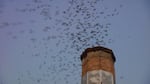
FILE - On September evenings, thousands of Vaux's swifts have traditionally funneled into the chimney at Chapman School in Portland. But as of 2024, the birds appear to have abandoned the chimney.
Nick Fisher / OPB
Vaux’s swifts are small, migratory birds that travel from their breeding grounds in the Pacific Northwest to Central and South American each fall, roosting in chimneys and hollowed-out trees along the way.
For a few weeks in September, huge flocks of the birds have spiraled into the chimney of Chapman Elementary in Northwest Portland. The nightly display has entertained crowds for decades, but as of last year, the birds appear to have abandoned the chimney.
Joe Liebezeit is the statewide conservation director for the Bird Alliance of Oregon. He joins us to talk about why the birds might be moving and what to expect from the swifts this year.
Note: The following transcript was transcribed digitally and validated for accuracy, readability and formatting by an OPB volunteer.
Dave Miller: From the Gert Boyle Studio at OPB, this is Think Out Loud. I’m Dave Miller. Vaux’s swifts are small, migratory birds that travel from their breeding grounds in the Pacific Northwest to Central and South America each fall, roosting in chimneys or hollowed out trees along the way. For decades now, huge flocks of these birds have spiraled into the chimney of Chapman Elementary School in Northwest Portland for a few weeks in September. Their nightly display has mesmerized crowds. But last year, most of those swifts did not show up. They appeared to have abandoned the Chapman chimney.
Joe Liebezeit is a statewide conservation director for the Bird Alliance of Oregon. He joins us now with more details. It’s good to have you here.
Joe Liebezeit: Yeah, thanks for having me come on.
Miller: Can you tell us a little bit more about Vaux’s swifts?
Liebezeit: Yeah, I think you did a good introduction there, but they’re a small bird that comes up here to the Northwest every summer. When they’re breeding, they are paired together and they nest in chimneys, usually in residential chimneys. But when we get around this time of the year when it’s fall migration, the birds start to cluster in bigger groups. They find places to roost for the night and Chapman Elementary is such a place. They’ve been going there for decades and sometimes by mid-September, in the past, we’ve had as many as 16,000 birds spiraling in there every night.
Miller: What makes a particularly good chimney for a swift? What do they look for?
Liebezeit: Well, there can’t be a furnace that’s working during the fall, so that’s one thing. And the furnace at the Chapman chimney was decommissioned years ago for that purpose. They need a brick facing inward to be able to grab on with their tiny claws. And there’s a belief that the thermal conditions in the chimney are important because they keep warm there during the cold fall days.
Miller: Can you describe the annual scene at Chapman over the last few decades for people who have not been there before?
Liebezeit: Yeah, it’s quite a little party. We’ve had as many as 3,000 or 4,000 people on a given night, gathering on the lawn. Oftentimes, you see kids going down the hillside on cardboard, having fun.
Miller: Kind of a dirt hillside in September.
Liebezeit: Yeah, it’s a grassy hillside on the side of the school. And thankfully the school has a lot of room for people to come and, in the past, enjoy the swift spectacle.
Miller: So when did you first realize that the swifts were maybe making different migratory decisions last year?
Liebezeit: Just to preface that, swifts are known to sometimes abandon chimneys. We’ve been monitoring chimneys throughout the Portland metro area for many years. We have seen, in some of the smaller roofs that maybe people don’t know so much about, that there’ll be several years where you maybe get a couple thousand birds. And one year, they’re just not there. So last year, it was kind of a surprise at Chapman because people have gotten so used to seeing them there for many decades. We saw them arriving around this time of year, late August, early September. But their numbers were a little bit lower. And by the middle of September, they were gone.
Miller: Do you have any idea why?
Liebezeit: There’s a lot of speculation. I think part of it could be, in other places where swifts use chimneys in large numbers, people have found that predators, like hawks and sometimes crows, land on the chimney and can get a quick meal every night when the swifts are most vulnerable going into the chimney. People think that maybe the predator numbers were scaring them off. We have monitored, in addition to counting swifts, the number of predators at the chimney at Chapman for many years. We looked at that data and didn’t see any real correlation between the activity of the predators and the swifts. So we’re not really sure if that’s the cause.
Miller: What about humans? We are our own kind of predator or at least we can be distracting. I mean, thousands of people are there. They clap. They “ooh” and they “ah.” The kids are screaming. Was there any difference in human pressure last year compared to earlier years?
Liebezeit: No. And that’s something we’ve been asked about for many years. We’ve had, like I said before, sometimes thousands of people there every night and we’ve no indication that they have ever impacted the swifts. We have had some, in more recent years, incidences of people using recreational drones. And sometimes the drone swooping through the swifts can definitely disturb the birds and make them move elsewhere.
Miller: Why do they form these beautiful spirals at a certain point and then in great numbers all go down together?
Liebezeit: It’s a little bit of a mystery. They call it “murmurations” and it’s not just swifts that do that. Big schools of fish in the ocean and can have uniform, synchronized movements, herds of wildebeests and things like that. So it’s a response. Some people say there’s a hypothesis about avoiding predators, because you have a lot of eyes out there. As the birds are getting ready to go in the chimney, they can spot a predator and maybe not go in right away.
It often reminds me of the situation where, if you’ve seen an animal show where penguins are getting ready to go into the water and they want to avoid that leopard seal, and they’re kind of gathering there and gathering there, and all of a sudden they start jumping in – that’s kind of what we see with the swifts up at Chapman. They’ll spiral and spiral around, and all of a sudden, they’ll just start going in.
Miller: Are you pretty sure where big numbers of swifts are going to go this year, if not Chapman?
Liebezeit: Well, we’ve started monitoring the chimneys already around town and so far we’ve not seen any at Chapman. Now we’re expecting it could be like last year again, but we’re not sure.
Miller: Like last year, where a small number do go but not in the numbers that we used to see in earlier years?
Liebezeit: Yeah, last year what we saw was the birds not going … After they left Chapman, they were going to other chimneys, in smaller numbers and a larger number of chimneys, throughout town. So we don’t know exactly what we’re gonna see here in Portland this year. We’re monitoring it. But what we do know is that the best way for you to go out and enjoy seeing the swifts this year, is to look in your neighborhood for active chimneys. We’ve already heard about some popping up and we are monitoring those. And we’ll be in touch with the public about where the best places to go are.
We’re encouraging people to use a bike or use public transit to go to some of these places and just be really respectful. Chapman was really unique in that we had an agreement with Portland Public Schools. There’s a lot of lawn there where people could sit. We worked with the community there about parking and things like that, and trash pickup. So we really want to be protective of the birds. But we also want to be protective of some of the new chimneys that may be occupied and the people, the businesses and places that own those places.
Miller: Are you having conversations with neighborhood leaders or building owners in various places right now, in advance?
Liebezeit: Yeah, actually, we started talking to some of the places that we’ve had swifts going to in the past year, just to try to get a strategy on how we can make it easiest for the public to enjoy those places without upsetting the landowners.
Miller: Am I hearing you correctly, between the lines, in saying that you already know some places where swifts might be going, but you don’t feel like announcing that on a statewide public radio show because you don’t want to inundate neighborhoods?
Liebezeit: Yeah, that’s exactly right, Dave. We want to be really careful because we know what can happen. There were tensions up at Chapman over a decade ago when a lot of people were going up there, parking was really difficult. So it takes time to work with the community to see the best way that we can enjoy these birds and draw people there without causing a lot of tension with the community.
Miller: What do you think these birds have meant for your overall ability to get the public to care about birds?
Liebezeit: They’ve been a great resource for us. We live in a big city with over a million people in the area around us. And it’s a great tool to talk to the public about conservation of birds and the wildlife and habitats. Swifts themselves are declining. Their populations have been declining over decades. And we know that they have historically depended on hollowed out large old growth trees. We know that with the loss of many of our old growth forests, these birds are facing struggles. So it really ties in well with connecting the public about enjoying such a great spectacle and then connect to our conservation work that we do at the Bird Alliance of Oregon.
Miller: Joe, thanks very much.
Liebezeit: Thank you.
Miller: Joe Liebezeit is the statewide conservation director for the Bird Alliance of Oregon. He joined us to talk about Vaux’s swifts. They’ve roosted in an elementary school chimney in Northwest Portland for a few decades now, but they seem to be choosing different stopover sites as part of their annual migration.
“Think Out Loud®” broadcasts live at noon every day and rebroadcasts at 8 p.m.
If you’d like to comment on any of the topics in this show or suggest a topic of your own, please get in touch with us on Facebook, send an email to thinkoutloud@opb.org, or you can leave a voicemail for us at 503-293-1983.