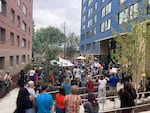
Community members gather to celebrate the opening of the Albina One housing development in Northeast Portland on Saturday, Sept. 6. It's the first step in a broader effort to restore the Albina neighborhood that was harmed by the city's pursuit of growth decades ago.
Bryce Dole / OPB
Hundreds of people gathered in Northeast Portland on Saturday to celebrate the opening of a new housing development.
Community leaders say it’s a first step toward correcting a historical injustice against Portland’s Black community by revitalizing the Lower Albina neighborhood.
Called Albina One, the 94-unit affordable housing development sits on North Flint Avenue just north of the Moda Center. For decades, many families here were displaced and disenfranchised by city policies and development that leaders say prioritized growth over the lives of those who lived and worked there.
But Saturday’s event was joyous, a visible example of progress for many people who have waited years to see the return of a vibrant community that was once home to 80% of Black Portland.
“I see it as a very good start to something very special,” said Carl Talton, a longtime community advocate who grew up in the area. He added: “Certainly it will be an opportunity to reestablish the culture that was once here.”
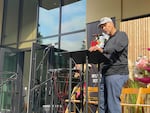
Carl Talton, a longtime community advocate who grew up in Northeast Portland, speaks before a gathering at the opening of the Albina One housing development on Saturday, Sept. 6.
Bryce Dole / OPB
The development marks the first major milestone for leaders with the Albina Vision Trust, which has worked for years to get state and local government leaders on board with a broader push to redevelop the area. By the time the project is completed, the area will have its own ZIP code.
The development includes 75 units leased through the city’s preference policy, which prioritizes people for housing based on their family history. The goal is to “re-root” families with historical ties to the area, many of whom were pushed out and harmed by redlining, disinvestment and urban renewal.
Related: Portland to pay $8.5M settlement to descendants of displaced Black families
‘More than just a building’
On Saturday, community leaders announced that some people have returned to the area for the first time in about 40 years, ever since their families were displaced through the process of eminent domain.
So far, at least 10 families have moved into the Albina One building. Adorning the tables around the event were fliers that said: “Albina, Welcome Home.”
“Today, let’s mark this moment clearly,” said Winta Yohannes, executive director of Albina Vision Trust, which spearheaded the Albina One project. “Albina One is more than just a building.”

Fliers adorned tabletops at the celebration for the opening of the Albina One housing development in Northeast Portland on Saturday, Sept. 6. Leaders say that displaced community members are returning to the area for the first time in 40 years.
Bryce Dole / OPB
Rhythm and blues music mixed the sounds of the large crowd gathering between two large buildings. Musicians set up speakers and tested microphones on a stage decorated with flowers. Vendors lined the street beside the building, handing out pastries, jewelry, beauty products and more.
Inside Albina One, the smell of applewood smoked bacon lingered near the air as community members sipped orange juice and coffee. A sign on the wall read: “Joy is an act of resistance.”
“A lot of our Black, African American roots have been erased because of gentrification and displacement,” said Robert Thomas, a digital marketer who grew up in Northeast Portland. “As a longtime resident who has returned back to the city, it’s just great to see that this type of movement has actually gotten off the ground.”
Related: New digital archive showcases Albina neighborhood’s Black history and culture
In addition to Albina One, the group also acquired the building directly across from it and is poised to purchase the Portland Public Schools North District headquarters to provide further housing units.
‘Harlem on the Willamette’
The development sits in the area near the Rose Quarter, where Albina Vision Trust leaders continue to advocate for caps allowing further development over Interstate 5.
ODOT built the freeway through this area in the 1950s and 60s, destroying homes and businesses and severing a community that some leaders still call “Harlem on the Willamette.”
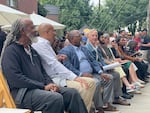
Portland Mayor Keith Wilson, fourth from left, sits among other local leaders at the celebration of the opening of the Albina One housing development in Northeast Portland on Saturday, Sept. 6. Acknowledging the past harms done to the area's Black community, Wilson said: “Our job today is to flip the script."
Bryce Dole / OPB
Saturday’s event brought out many of the region’s most prominent political leaders, including U.S. Rep. Maxine Dexter and Metro Council President Lynn Peterson, who pledged to continue to push for more affordable housing developments like Albina One.
In a speech, Portland Mayor Keith Wilson acknowledged that the city’s actions decades ago “left lasting scars on this neighborhood.”
“Our job today is to flip the script,” said Wilson. He added, “We must be responsible.”
The Albina One development was designed and built by Black leaders and contractors from Colas Construction.
“The project marks only the second time a Black-owned construction company has put a crane in the sky in Oregon’s history, both of which have been projects constructed by Colas,” a press release from the Albina Vision Trust said.
The Portland Opportunities Industrialization Center, a group that advocates for underserved Portlanders, will provide a variety of on-site services for its residents, including mentorship, job training, education and other career support. The building is also fully electric, with solar panels on its roof.

Community members gather in Northeast Portland to celebrate the opening of the Albina One housing development on Saturday, Sept. 6. “Today, let’s mark this moment clearly," said Winta Yohannes, the executive director of Albina Vision Trust, which spearheaded the project. "Albina One is more than just a building.”
Bryce Dole / OPB
‘This really is justice’
Those who gathered at the event were of all ages. Many of them had deep ties to the area. Some spoke of how their families struggled over generations to navigate an unfair housing system and build a financial foundation that would allow them to find a home in Portland.
“For me, this really is justice,” said Nikki Sandoval, a longtime resident who recently bought a home in the area and recalled the challenges of living in affordable housing as a single mother.
“It’s just a homecoming,” she added.
Now, as city leaders appear keen on backing the area’s development, some residents are optimistic about the opportunities for young people and the potential for the community to return to vibrancy.
“If they stay that thoughtful, this will be a thriving community,” said Liz Fouther-Branch, a local archivist and retired special education teacher.
“Kids will be happy to be here.”
Correction: An earlier version of this story misstated the status of one of the buildings that Albina Vision Trust plans to purchase, and the number of affordable housing units in the development. OPB regrets the error.