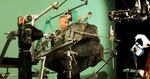
A video still from the making of the movie "ParaNorman" by LAIKA.
Courtesy LAKIA Studios / Courtesy: LAIKA Studios
Movies like “The Goonies,” “Animal House,” and “One Flew Over the Cuckoo’s Nest” are among the most famous of those filmed in Oregon, and they’re points of pride for Oregon film buffs. Television shows like “Grimm” and “Portlandia” and animation studios like Laika and ShadowMachine burnish the state’s production portfolio.
While newer projects continue to shoot in Oregon, the industry was disrupted by the COVID-19 pandemic, a lengthy writers and actors strike and an industry-wide shift to overseas production.
Tim Williams is the executive director of Oregon Film, a semi-independent state agency that promotes movie and TV production in Oregon. He joins us to talk about how the industry is faring in Oregon.
Note: The following transcript was transcribed digitally and validated for accuracy, readability and formatting by an OPB volunteer.
Dave Miller: From the Gert Boyle Studio at OPB, this is Think Out Loud. I’m Dave Miller. Oregon has never been an international powerhouse for film and TV production, but it has churned out some iconic work. From “One Flew Over the Cuckoo’s Nest,” “Animal House” and “The Goonies,” to TV shows like “Grimm” and “Portlandia,” and animated work by Laika and ShadowMachine, Oregon seems to punch above its weight. New projects continue to shoot in Oregon, but the industry was disrupted by the COVID-19 pandemic, lengthy strikes by writers and actors, and an industry-wide shift to overseas production.
So what does its future look like right now? Tim Williams joins us to answer that question and more. He is the executive director of Oregon Film, the semi-independent state agency that promotes movie and TV production in Oregon. Welcome to the show.
Tim Williams: Thanks, Dave.
Miller: So I mentioned some of those iconic movies which are from the ‘70s and ‘80s: “One Flew Over The Cuckoo’s Nest,” “Animal House,” “The Goonies.” How far back does film production in Oregon go?
Williams: 1909, actually. We had a film production here in Oregon before we actually had it down in Southern California. We had three silent movie studios up here before they did. Then they discovered they had better weather, so things moved south. We’re actually the oldest state film commission in the United States. Moab is the only older commission than us and they’re a regional commission. We were formed in 1968 by Governor McCall to help “Paint Your Wagon” get the Department of Transportation permitting out in Baker County. So we’ve had it here for a very long time, it’s part of the Oregon culture.
Miller: It’s interesting to think about Tom McCall .. so, “shoot your movie here because then you’re gonna go home,” as opposed to visiting and staying, “we don’t want you to stay, but shooting a movie was OK.”
Williams: Yeah, it’s like a big commercial. Exactly.
Miller: Have there been different eras in Oregon movie making over the last 116 years?
Williams: Yeah, many. There was a big Western contingent that was shooting sort of Mount Hood, in Eastern Oregon. There was a sort of indie thing around the ‘60s and ‘70s with Paul Newman coming with “Sometimes A Great Notion.” Jack Nicholson was there [for] “Five Easy Pieces” down in the central Willamette Valley around Eugene. Obviously, there’s the Gus Van Sant period in the ‘80s here in Portland. There was a movie-of-the-week period that sort of went through the ‘80s and ‘90s. We started picking up sort of larger scale TV series with “Grimm” and “Portlandia,” “Librarians,” “Shrill.” Just last year we had a very large TV series called “Criminal” that hasn’t come out yet.
So yes, there’s ebbs and flows, larger things and smaller things. But we’ve always done the sort of medium size, independent, spirited project really well, things like “Pig” with Nicolas Cage and “Leave No Trace” that Debra Granik directed. That’s kind of the thing we do really well.
Miller: And I would put movies-of-the-week in that same category of medium-sized productions.
Williams: When they were being done. Yeah, exactly.
Miller: Now, I suppose the equivalent would be streaming studios doing their own stuff on a fast pace and maybe with smaller budgets than a huge superhero blockbuster. Maybe that’s the version we have now?
Williams: And that’s shifting a lot too. You had a period right before the strike and after the pandemic, there actually was a period of just peak content, where there was a lot of content out there. And streamers like Netflix had various divisions. They had an animation division, they had an independent division, they had a TV series division, they had drama, they had comedy, they had documentary. That’s all started to shrink down a little bit. So we were getting things that had independent spirit to them. That could mean they were a tiny movie, it could mean they were a very large movie with an independently spirited director, cast or storyline to it.
As an alternative for us to Vancouver, BC, we’re easy to get to, you don’t have to cross an international line, and you can get in and out of Oregon fairly easy if you’re coming in from LA. But we also have four or five very talented crews. We just talked about having more than a century of history here, so we have very deep talent that lives here, actors and crew. As you said in the intro, we punch above our weight class very well.
Miller: What has typically drawn filmmakers to the state? You mentioned some of those things, the workers here actually know what they’re doing, have experience. What else?
Williams: That’s the biggest thing. I keep calling them repeat offenders and I know that’s the wrong simile to be using …
Miller: People with helpful experience, as opposed to criminals.
Williams: Well, no. People who come here and are totally surprised by how good it is.
Miller: Oh, those are the ones who did this and they wanna come back.
Williams: They’re like, “oh, we want to come back and we want to do that again!” They’ll come in thinking, “we’re going to bring this person and this person,” and they’ll hire almost everybody locally. They’ll be like, “that’s the best crew I’ve ever worked with, I gotta come back.”
We’ve had several entities, directors. Dave Franco was one of those. He did “The Rental” down in Bandon and then “Somebody I Used to Know.” [He] came back simply because he had such a good time on shooting “The Rental.” We’ve had a lot of experience on that.
Obviously, we have an incentive program. Thirty-two, 33 states and all of Canada have incentive programs. We’re sort of a middle size incentive program, we’re not huge. For example, Georgia turns over about $900 million a year in their incentive program; ours is about 25. We’re a cash rebate, we’re customer friendly. I was a producer for a long time, so I take pride in the fact that I listen to the production problem, I figure out whether it’s a good fit. I review their budget, make sure what they’re gonna spend is gonna be where we need it to be.
So we get things that are not huge and going to Vancouver like Marvel, but we’ll get things that have a fairly broad need for diverse locations. You can get to the mountains, the river, the ocean, the desert within a couple hours. You have production centers in Portland, Bend, Ashland and Eugene. And we have a crew base and a talent base that’s second to none.
Miller: Why is it that Marvel would be much more likely to, if they’re not gonna be in LA, go to Vancouver than Portland? You say that almost in passing, but it’s worth coming back to.
Williams: Infrastructure. And they go to Atlanta … or they used to go to Atlanta a lot. Purpose-built studios.
Miller: Huge sound stages.
Williams: Exactly. And we don’t have those.
Miller: With all the special effects, green screen and whatevers, you need a really big building or big lots to make those huge movies.
Williams: You’ll go in and you’ll shut down central Atlanta and do a big sequence in there. But a lot of it is on a 30,000 foot stage with a big green screen behind you. And we have a lot of warehouse space, and things like “Shrill,” “Grimm” and “Portlandia” use those as sound stages, but they’re not purpose-built. So the power may not be right or the HVAC may not be right, but they use them. But because we don’t have those sound stages, we don’t get the larger projects, because they spend a lot of time in three or four stages for six or seven months.
Miller: How did the pandemic change things, industry-wide, but specifically in Oregon?
Williams: I was actually really amazed at Oregon during the pandemic in our industry. We came back in July of that year, which was really fast.
Miller: July of 2020, a couple of months after the full shutdown?
Williams: “Shrill” was back here shooting season three, I think, in July of 2020.
Miller: Doing COVID-safe protocols for shooting, but still shooting.
Williams: What happened was a bunch of groups – my office, SAG-AFTRA, the IATSE, which is the stagehands, the OMPA – all came together really early and said, “what do we need to do?” And we gathered a bunch of protocols from a bunch of different places. I remember we got some stuff from Iceland, some stuff from the UK, some stuff from California. And we built this sort of protocol that everybody agreed with. And there were calls with 50-60 people on there. We put together this protocol package probably in about two to three weeks.
A lot of this is being driven because “Shrill” wanted to come back, but also there were a couple of feature films that Netflix wanted to do at the same time. Everybody agreed to these protocols, and when everything came in, it kind of worked really smoothly because everybody had been part of the protocols. So we came back pretty strong in the pandemic, early on in the process.
Miller: You were talking earlier about the consumer side of this, where a lot of folks were stuck at home or not going out for entertainment, so people wanted more and more stuff. How much less content are people watching now? Can you calculate that and can you see the reduction in productions as a response?
Williams: I wish I was smart enough to calculate it. But yes, there has been a drop off in content because people are not sitting home 24/7 watching all the time. There has been a distinct drop in content production, in overall deals, the amount of money that’s being spent, the budgets are coming down. That’s all within the last 10 to 12 months. There’s also a consolidation going on in our industry. So Discovery bought Warner Brothers, Disney is sort of taking on Hulu, Paramount, Viacom and Skydance. All this consolidation is also pushing down on the number of people making projects, money making projects, and the amount of projects being made.
And then there’s, I wouldn’t call it a mandate, but there definitely is a feeling of late that it’s just much easier for us to go to Europe cause it’s cheaper there. If you really look at it, and I just wrote an article about this last week, it’s not actually cheaper to shoot there. It just appears so. There’s these waves of things where everybody’s going to Hungary, everybody’s going to the Baltics, everybody’s going to Asia, and so we’re gonna take everything over there and we’re gonna start writing things for over there. It’s cyclical, but at the same time, it’s very, very present and it’s very, very important to the people working here that there’s a big downturn because a lot of things are heading offshore.
Miller: Are there specific projects where producers came to you and said “Hey, Oregon, what can you do? We’re thinking about shooting there or maybe in Hungary?” Or is it more subtle than that?
Williams: There’s sort of two answers to that. There is a specific project that was based on a very popular Oregon-based book that was right in the wheelhouse of what we do, last year. We were tracking it and trying to figure out where it’s gonna be shot. It’s all set in and around the central Willamette Valley in Eugene. I tried to get in touch with the producers. I tried to get in touch with the production companies because what I do is review the budget and say here’s what we can do, and here’s why our place is better, and here’s how we could do it.
Miller: This was proactive on your part? You reached out to them because you knew about this project set in Oregon, and then you said, “hey, please come shoot in Oregon, talk to me.” And did they talk to you?
Williams: They did not. They didn’t send me the budget and they ended up shooting the whole thing in Malta. And I sort of had done some research in it and I’m like, “well, Malta for Oregon, that seems a little bit of a stretch to me, but OK.” It’s done, it’s coming out fairly soon. I gotta work with all these people, so I don’t want to call anybody out.
The second half of that is I actually just got a call fairly recently from somebody that was doing an under $5 million dollar movie and was like, “We really want to bring this to Oregon. Can you solve this piece of the puzzle for me?” And it had to do with number of people, what positions were union covered, what weren’t union covered, how many days they’d work – sort of a math problem, to be totally honest. And they were like, “We’re getting pressured to take this somewhere else. What can you do to help us?” And I’m like, “here’s what I think, here’s what I can do.”
It’s still in discussion, so it’s not like it’s a fait accompli. But I have not gotten that specific of a question in a very long time, “we’re gonna take this somewhere else unless you do this, this and this.” And there’s only so much I can do statutorily, I can’t bend all the rules all the time.
Miller: You mentioned that working with labor and management and regulators for the COVID-19 protocols. It does remind me of the big strikes – writers’ strike and actors’ strike. Do you feel like you’re seeing the impact of those strikes today?
Williams: Yes and no. We had the busiest year on record last year. We had 55 projects we worked with. “Criminal” was here and “Criminal” was a massive Amazon series that we haven’t had in a long time. It wasn’t just because “Criminal” was really big that we had a busy year. We had 55 projects come in. That, to me, was a knock-on effect from the strike, because there were a lot of projects that stopped during the strike, they had cast and financing available. They had to pause. When the strike ended in October, they were all like, “we gotta go right away or we’re gonna lose our finance or we’re gonna lose our cast.” A lot of those came up here because we were so easy. They could just come out of LA, put it together here. They didn’t have to go into Canada and they got it done.
The second half of that is, that’s all started to drop off. Those all got done and now we’re sort of settled into the studio routine. And as I said, the studios are looking at things differently now. They are making calculations based on very, very specific things. The budgets have come down, the amount of content has come down and the bottom line has come down. So suddenly, there’s this rush to Europe, or to Canada, or to Asia to figure out, is that gonna be cheaper? They got to bring people over there and they gotta bring talent over there, and sometimes they don’t pay out as fast. So there is these ebbs and flows that are going on at the same time.
Miller: Do you have a sense right now for how AI is going to change the location-based shooting questions? Going to some place to shoot a movie with actual real people in a real place?
Williams: I wish I did, I’d be like Johnny Carson with the hat. Sorry, that dates me.
It’s both sort of invigorating and terrifying what AI may or may not do to both of our industries. And I don’t know what that’s gonna look like. Virtual reality and augmented reality came, I’m like, “oh, there’s a production aspect to that,” so there are people involved. And then when the volume wall and “The Mandalorian” came out, I’m like “I get that, there’s people, they gotta program.”
AI, what does that even look like? Who’s involved in that? How, from an economic development point of view, do you attack that? What do you do to embrace that? And I don’t have those answers. We look at it a lot, we study it a lot, we listen a lot and we try to react as much as we can, but I don’t have a crystal ball.
Miller: Tim Williams, thanks very much.
Williams: Thank you, Dave. I appreciate it.
Miller: Tim Williams is the executive director of Oregon Film.
“Think Out Loud®” broadcasts live at noon every day and rebroadcasts at 8 p.m.
If you’d like to comment on any of the topics in this show or suggest a topic of your own, please get in touch with us on Facebook, send an email to thinkoutloud@opb.org, or you can leave a voicemail for us at 503-293-1983.