Bicycle and pedestrian advocates gathered at Portland City Hall on Wednesday night to support a lofty and as-yet-unattained pledge to finally put an end to traffic deaths in the city.
The city has poured hundreds of millions of dollars into Vision Zero in the decade since City Council first made this zero-deaths goal, yet traffic deaths have largely continued to rise.
But as another generation of Portland City Council leaders made assurances to end these deaths, one of the city’s main tools to crack down on traffic fatalities was offline.
Since late July, the 32 speed and red-light cameras have been turned off, while the city switches to a new company to operate the program.
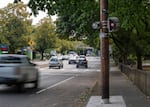
Cars drive by a traffic camera on Southeast Powell Boulevard near Southeast 23rd Avenue on Thursday, Sept. 18, 2025 in Portland, Ore.
Saskia Hatvany / OPB
According to the Portland Bureau of Transportation, the speed cameras won’t be fully operational until November.
As days become months, drivers speeding through the city’s most dangerous intersections essentially have a free pass, barring a police officer being nearby. No one is getting captured on cameras that could lead to a citation.
And 11 people have died in traffic crashes in that time span, according to the Portland Police Bureau. Several of those fatalities occurred near intersections with inoperative speed cameras.
“This is one of the worst times of year to go dark on enforcing speed limits,” said Sarah Iannarone, executive director of Street Trust, a transportation advocacy group that focuses on street safety.
“Actions speak louder than words,” she said. “We’re being told the city is committed to Vision Zero, but the cameras are down just as the days grow shorter and our kids are crossing busy streets again with back-to-school.”
Related: As traffic deaths surged, Portland transportation bureau fell short of safety goals, audit says
PBOT spokesperson Dylan Rivera said the longer pause shouldn’t come as a surprise, due to expected delays that come with switching companies.
“While there is a gap in coverage while we transition to the new contractor, we are trying to make that gap as short as possible,” Rivera said. “We believe it’s critically important to install more cameras on more deadly corridors as soon as we can.”
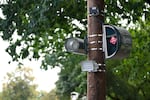
A new traffic camera installed on Southeast Powell Boulevard.
Saskia Hatvany / OPB
For years, the city has relied on a company called Conduent to operate its traffic cameras. But city leaders had long bemoaned the company’s slow pace of work. In its August press release, PBOT celebrated switching to a new company called NovoaGlobal, saying the company offers “turnkey programs to help combat the ongoing crisis of traffic-related injuries and fatalities.”
Since Portland first installed speed cameras on busy streets in 2016, when a change to state law allowed for their use, they’ve proven to be effective.
According to PBOT, drivers speeding more than 10 miles over the speed limit have dropped 88% at speed camera locations since 2016. City data also shows a 43% decline in car crashes where cameras were installed, compared to the years prior.
Speeding tickets generated by the cameras help cushion PBOT’s budget. In 2023 and 2024, PBOT collected more than $1 million from speeders. Those funds go directly back into the camera program.
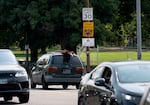
Signage warns drivers to adhere to speed limits on Southeast Powell Boulevard on Sept. 18, 2025 in Portland, Ore. The cameras are currently offline while the City of Portland replaces them with an upgraded system.
Saskia Hatvany / OPB
Shortly before introducing speed cameras, the city launched Vision Zero, a campaign meant to eliminate all traffic deaths and serious injuries by 2025.
Despite spending more than $200 million on city projects to reduce fatal crashes, more people are dying in traffic crashes now than when the program began in 2016.
Last year, 58 people were killed in car crashes on Portland streets. When Vision Zero was adopted in 2015, 35 people died from vehicles that year. In all, more than 500 people — pedestrians, cyclists, motorcyclists and drivers and their passengers — have been killed on Portland streets in the past decade.
PBOT says speed is the leading cause of all traffic deaths.
Related: PBOT on Portland traffic safety and budget cuts
Councilor Tiffany Koyama Lane introduced the Wednesday resolution to recommit to Vision Zero a decade after its start. In a statement to OPB, she said she understands that there’s “some required downtime” needed to transition the traffic cameras.
“Regardless of camera status, traffic safety is the responsibility of all drivers,” Koyama Lane wrote. “And I have been assured that PPB is still enforcing traffic laws and focusing their efforts on high-crash corridors!”
The city hopes to increase the number of traffic cameras to 60 by 2028.
Correction: A previous version of this story inaccurately stated the window of time PBOT had anticipated keeping the cameras offline. OPB regrets the error.