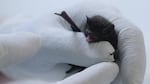
A silver-haired bat is inspected for signs of white-nose syndrome at a wildlife rehabilitation center near Seattle in this undated file photo.
Michael Werner, OPB / EarthFix

A little brown bat (Myotis lucifugus) at the Oregon Caves National Monument, shown here in a provided photo from 2025.
Emma Busk / BLM
White-nose syndrome is a fungal disease that grows on hibernating bats, causing them to wake up in the winter. The bats then burn up their fat stores while searching for food and die as a result. The disease was first detected in the northeastern U.S. in 2006 and has since spread to 40 U.S. states.
The Oregon Department of Fish and Wildlife recently announced that the fungus that causes the disease has been detected in bat excrement, or guano, from a bat roost at Lewis and Clark National Historic Park in Clatsop County. While no bats in the state have been observed with symptoms of white-nose syndrome yet, it’s the first documented case of the fungus in Oregon.
Emily Armstrong Buck is a wildlife health lab biologist at ODFW and the agency’s white-nose syndrome surveillance coordinator. She joins us to talk about the spread of the disease and what it could mean for Oregon bat populations.
Note: The following transcript was transcribed digitally and validated for accuracy, readability and formatting by an OPB volunteer.
Dave Miller: From the Gert Boyle Studio at OPB, this is Think Out Loud, I’m Dave Miller. White-nose syndrome is a deadly fungal disease in bats that was first detected in the Northeast about 20 years ago. It has since spread westward to 40 states. You can now add Oregon to that list. The Department of Fish and Wildlife recently announced that the fungus was found in a bat roost in Clatsop County.
Emily Armstrong Buck is a wildlife health lab biologist at ODFW and the agency’s white-nose syndrome surveillance coordinator. She joins us now. It’s great to have you on Think Out Loud.
Emily Armstrong Buck: Hi, thank you so much for having me. It’s a pleasure to be here.
Miller: What is white-nose syndrome?
Armstrong Buck: White-nose syndrome is a term for a disease in bats that is caused by a fungus. So it’s a fungal infection. And get ready, the scientific name of the fungus is Pseudogymnoascus destructans. So it’s a bit of a mouthful, but the key is the second half there, the “destructans”.
Miller: That does not sound good.
Armstrong Buck: No, it’s not ideal. This fungus actually invades the skin of the bats and causes a whole host of issues. And as you said, it was found in 2006 in New York, has been making its way across the country on a slow crawl towards us.
Miller: How do scientists think it’s actually been traveling?
Armstrong Buck: So we think that the transmission is mainly bat to bat, meaning that bats are coming into contact with each other when they are roosting or other activities. And also environment to bats, so when they are roosting, some of the fungal spores that could be on their fur are transferring to the substrate they’re attached to, and then the next bat that comes along can pick that up. We think those are the primary ways that it’s transferred bat to bat and environment to bat, but it can also be spread on shoes, clothing and equipment if they are not decontaminated after visiting a site that does have the fungus.
Miller: So to go back to that pretty scary official scientific name that ends “destructans,” what is it about this fungus that is so dangerous or potentially deadly to bats? What does it do?
Armstrong Buck: It’s a pretty interesting story actually. So first, we will take ourselves back and try to imagine where this fungus came from in the U.S. Because typically, when a species evolves with a disease, they have some resistance to that disease. There’s an arms race going on and they can kind of combat that with their immune system. But when this hit our bats in New York, it was very clear they could not combat it. Certain species were hit very hard, devastated, killing millions of bats. It was very, very scary and upsetting.
And over in the east, as you can imagine, they have some colder temperatures than we do. And this fungus is actually interesting in that it is a psychrophilic fungus, it is a cold loving fungus, so it likes the cold caves and mines and things that bats like to hibernate in on the East Coast. It doesn’t get quite as cold in their spaces over here, so things are acting a little bit differently than they did on the East Coast
But what the fungus actually does is it invades their skin. And since it is a cold loving fungus, you are a happy little bat and you have gone to your winter roost, your hibernaculum. Not all of our bats hibernate, but some of them do.
Miller: And the places where they hibernate are called hibernaculums?
Armstrong Buck: Oh yes! Sorry, I meant to make a big point about that because it’s one of my favorite words: hibernaculum, plural hibernacula. So that’s a delight. Hopefully, that’ll show up in a crossword before the end of my life. I’m still waiting.
Miller: To go back to your story which is about to have a sad turn, this happy bat is getting ready to go to sleep for a couple of months in its hibernaculum, but it has this fungus. What happens?
Armstrong Buck: So happy bat contacts the fungus. When the bats go into hibernation, they lower their body temperature considerably. And unfortunately, they lower their body temperature to the temperatures the fungus likes. So while the bats are “sleeping,” hibernating, this fungus does not encounter as many immune responses either, as it normally would when they are fully up and around, because those immune responses are costly. And so the bat is cold and it does not have as strong of an immune response as it normally would, so the fungus is kind of free to proliferate in its skin. And this is where it starts causing problems.
What do you suppose a bat’s wing is made out of, Dave?
Miller: Uh … there’s fur on the outside a little bit, right? I don’t know, something wonderfully elastic and powerful but light? I don’t know.
Armstrong Buck: You are correct, it’s skin. It’s a membrane made of skin.
Miller: It seemed like a trick question. When people ask me questions, I don’t know what to do. That’s my job. [Laughter]
Armstrong Buck: I was curious. You look at a bat wing and you feel like it could be made of a few different things.
But as you will know if you’ve ever had a really bad sunburn, makes you really tired, makes you really thirsty, your skin is very important. It has a lot of surface area, so it comes into contact with the environment. And same for the bat’s wings. They’ve got all this skin out there, and if it’s getting damaged, they’re going to lose a lot of water. Their metabolic processes are going to get thrown off and they’re going to use up a lot of energy. So they get woken up when they’re not supposed to be woken up in this hibernation. And they have to go out and find food or other resources, and that actually can happen enough that it completely depletes their stores, and they become very ill and/or die.
Miller: So as I noted, it’s been almost 20 years since this was first identified on the East Coast. I also noted one of your job titles, which is ODFW’s white nose-syndrome surveillance coordinator. What has surveillance been like for most of those two decades?
Armstrong Buck: There’s actually a national program that kind of oversees this. So when we initially found the fungus in New York, there started to be all these deaths and a lot of concern. So there is kind of a centralized program nationally that all the states that do this surveillance, which is pretty much everyone, they have a set rubric that they go by.
The best way for us to do it is to go out and find bats when they are hibernating. And we can actually swab their skin with a little Q-tip and then test that swab later. So we do a lot of that, we do a lot of swabbing of bat skin, mostly their little faces and their little arms. And those swabs get tested genetically for the presence of the fungus. We also collect a lot of bat feces, because as you can imagine, bats are not always that easy to access. And so when we can’t get to the actual bats, we will collect their feces, and we can detect it there as well, because they groom it off of their fur.
Miller: And my understanding is it was in bat feces or guano that the fungus was identified in Clatsop County this year. How do you explain the fact that it was found in those droppings, but not in infected bats themselves? Is that significant, or is that just because guano doesn’t move, it doesn’t fly around?
Armstrong Buck: I think it’s more the latter. These bats may not have had a chance to get swabbed, and that’s why we found it in their guano. But in Oregon we have been watching the movement of this fungus, which we refer to as PD, because that’s a lot easier than the rest of the name. We’ve been watching it move across the U.S. and we’ve been watching its movements in California and Washington, and we knew that at a certain point it was going to come into Oregon. So we have been doing those bat swabs and collecting guano and surveilling the parts of the state where we can figure out how to get to the bats since about 2014.
Miller: Oregon is home, according to your agency, to 15 species of bats, most of which are classified as species of greatest conservation need. How many of these 15 species could be susceptible to this disease?
Armstrong Buck: So at this point, five of our species are known to be susceptible to the disease itself. And to clarify on that a little bit, since it’s a fungus and it puts out these fungal spores, those spores can be carried around by pretty much any bat that happens to come in contact with it. But not all bats will develop the disease. So it is significant that we have found the fungus, but we have not yet found sick bats.
Miller: But it does seem like, it was already a matter of time just based on the westward expansion of this fungal spread, and now even more so that it’s been found in places where bats hang out?
Armstrong Buck: That is true to an extent. There is certainly a chance that we will see some mortality events. I know that Washington has seen some, so we’re going to be keeping a very close eye out for that. And in the West, the detection of the fungus has typically preceded us seeing any dead bats by a period of time. So we do not expect to see any major mortality right away and we hope to see none. But we’re going to be keeping a very close eye.
Miller: Is there a reason that you’re not expecting to see major mortality events in the Northwest? I mean, you talked about millions of bats dying in various places on the East Coast. Why might that not happen here?
Armstrong Buck: There’s a lot of research going on to figure out why that might be. But we think it has a fair amount to do with climate, the fact that maybe the bats are not spending as much time in as cold of places, with as much of the fungus. But there are a lot of dynamics at play that we are still trying to figure out.
Miller: Is there anything that the public and bat lovers in particular should be doing right now to help prevent the spread of this fungus?
Armstrong Buck: Well, I would say that if you are a person who is a cave recreation enthusiast, which is fabulous, you may want to take a look at some of the decontamination guidelines available at whitenosesyndrome.org. Or you can also contact ODFW if you have some questions about a cave you’re going to. But making sure to clean off your shoes, especially after you enter a cave. And then I would say maybe also take a look at our State Wildlife Action Plan. We have a really wonderful website for that if you Google ODFW State Wildlife Action Plan, you can find it on there. Most of our bats are on there, can learn more about them and also keep up to date on new happenings with our bats, and ways to possibly volunteer or get involved.
Miller: And what’s happening at the state or federal levels right now as a direct result of this finding? Now what, from agency perspective?
Armstrong Buck: That is the big question. And really we are kind of staying a course. We already had identified, we really would like to be surveilling more intensely along our northern border, because we’ve seen that Washington has the fungus and has the disease, so that seems like a great place to concentrate resources. We’ve already been working on identifying new sites in the north, new areas where there are a lot of bats present, and also looking into alternative methods, since kind of the typical hibernaculum method doesn’t work everywhere, we’re going to be finding more places and ways to collect samples to really keep a tight eye on where it is and if it is moving.
Miller: We just have about 45 seconds left, but for people who are afraid of bats or are not bat fans, what do you have to tell them right now?
Armstrong Buck: Oh, I would say if you can find a picture of a bat that is not angry, with its mouth closed, just chilling out, and just looking at those sweet little eyes, I would say you might feel a little differently. They really are incredible creatures. They’re so smart, they’re so agile, they really are adorable if you get up close. I think a lot of the pictures people have seen of bats in the media over the years make them look a lot scarier than they are. They’re pretty adorable, but I guess I’m biased.
Miller: Emily Armstrong Buck, thanks very much.
Armstrong Buck: Thank you.
Miller: Emily Armstrong Buck is a wildlife health lab biologist at the Oregon Department of Fish and Wildlife and the agency’s white-nose syndrome surveillance coordinator. She joined us to talk about the fact that the disease that has ravaged the populations on the East Coast for decades has finally been identified in Oregon.
“Think Out Loud®” broadcasts live at noon every day and rebroadcasts at 8 p.m.
If you’d like to comment on any of the topics in this show or suggest a topic of your own, please get in touch with us on Facebook, send an email to thinkoutloud@opb.org, or you can leave a voicemail for us at 503-293-1983.