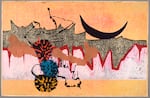
A 1959 Yoshida Chizuko color woodblock print titled, "Arizona Plateau," as provided by Portland Art Museum.
Courtesy of Estate of Yoshida Chizuko/Portland Art Museum
The Portland Art Museum already has one of the most significant collections of modern Japanese prints in North America.
On Sept. 27, it opened the first solo U.S. exhibition of the late artist Yoshida Chizuko (1924-2017).
Born in 1924, Yoshida Chizuko forged a place for herself in Japan’s male-dominated postwar art world. And though she married into the well-known Yoshida artist family — which produced three generations of influential woodblock print artists — critics say her work has been often overshadowed.
The new exhibition brings together more than 100 of Yoshida’s woodblock prints and paintings, many of which have never before been displayed publicly.
Portland Art Museum’s Asian art curator Jeannie Kenmotsu joins us to discuss the the avant-garde artist who pushed the boundaries of both painting and printmaking, her place in the Yoshida family legacy and why her work still feels modern today.
Note: The following transcript was transcribed digitally and validated for accuracy, readability and formatting by an OPB volunteer.
Dave Miller: This is Think Out Loud on OPB. I’m Dave Miller. We start today with a major exhibition that recently opened at the Portland Art Museum. It’s being called the first major museum retrospective to focus on the 20th century painter and printmaker, Yoshida Chizuko. It includes more than 100 works, many of which have never been displayed publicly before, and it’s part of an international reappraisal of a groundbreaking artist.
Jeannie Kenmotsu joins us now to talk about all of this. She curated this exhibit as the Asian art curator of the Portland Art Museum. It’s great to have you on the show.
Jeannie Kenmotsu: Thank you for having me.
Miller: Do you remember when you first saw or heard about the works of Yoshida Chizuko?
Kenmotsu: You know, I should remember ... I don’t think I do. She was someone that I think I encountered, maybe. I don’t want to date myself, but maybe in college, more than a couple of decades ago. I just thought her work was really beautiful. I always knew of her as a member of the Yoshida family of artists and just thought of her in that way. Then it wasn’t until a few years ago that I began to become more familiar with her work and was just so excited by what I was seeing. It was really so different and seemed really like things that I thought no one had really seen. And then I started to really pursue it, so here we are, six years later.
Miller: Six years – that’s how long ago it was when you started thinking about putting on a major exposition?
Kenmotsu: Yeah, in 2019, so a pandemic later and working across the Pacific Ocean with the artist’s family. It’s been a long time coming, but I’m so thrilled to be sharing it with Portland.
Miller: Why do you think this significant artist had never had a major show like this before?
Kenmotsu: Well, some of it is being a product of her times. This is a female artist who begins as a young artist. She was of this kind of last generation of women artists in Japan who were not allowed to matriculate to the major art universities. So she couldn’t go to the major art schools but had sort of other avenues of training and mentors. And then at a pretty young age, in her early 20s, immediately after the Pacific War, World War II, she is submitting her oil paintings to the big art establishment exhibitions and winning prizes, getting recognition and having her name in the newspaper. And this all would be a big deal for any young artist, certainly for a woman artist who hadn’t had access to training. And then on top of that, she, from the very beginning, was interested in abstraction, which at that time wasn’t something that was publicly on view that often.
So all of these things were just really incredible and she had this amazing start. But then, within a few years, she marries into the Yoshida family of artists who are supportive of her career. And she continues to make art, but 1950s in Japan is not the easiest time to have your name out there and as a woman artist. So I think just being kind of subject to that kind of infrastructure, you sort of fade away.
Miller: You got into a lot. I want to dig into some of these because there’s a lot there, but I’m curious just even about the history. Chizuko was only 21 years old when World War II ended. What was the Japanese art world like in the years immediately after this devastating war?
Kenmotsu: Well, like a lot of things, there was a lot of rebuilding that had to happen. There were art establishments, associations, which is kind of really critical at that time in the first part of the 20th century. There wasn’t a gallery system like we think of it today. But you were a member, often, of an association and a lot of them had a long running history. They continued after the war, but it took a couple of years for them to begin.
In addition, there were really basic things, like there were shortages of materials that you could use – oil paint became really scarce. There are stories that I’ve heard of that have been passed down, actually within the Yoshida family of artists, of artists lining up in the street to get their one tube of paint, like an allotment, and you didn’t get to choose what color you could get.
Miller: One tube?
Kenmotsu: One tube. And I don’t know if that was a weekly event, but it was like you got one at a time. So for some of the artists, I don’t know if anyone’s written about this, but maybe they had a phase of a lot of yellow.
Miller: That was your paint for the week or the month.
Kenmotsu: Yeah. So just the shortage of materials was a real thing. But I think at the same time, we do see this kind of zeitgeist of new avant-garde movements, different groups kind of forming. Particularly among young artists, it’s like, let’s start over. Let’s start fresh. And Chizuko was a member of one such group, a couple of different groups. They were led by one of her mentors, Okamoto Tarō, who had actually been in Paris in the 1930s. He was friends with … he got to know Picasso. He was really good friends with the surrealists like André Breton, Max Ernst and Man Ray, if you know any of those names.
And that’s really where he became a full-fledged artist. Then he came back to Japan in 1940, and after the war, he started this group called the Night Society, which would meet at this French restaurant on the outskirts of the west side of Tokyo. And they have these like, I imagine, cigarette-smoke-filled debates about Picasso or abstraction. Then they’d go bar hopping through the streets. And the other co-founder of the group, Hanada Kiyoteru, who was a writer, talked about that group as like they might become this night parade of demons. There was a sense of energy and kind of like, let’s revolutionize the art world.
Miller: If I’m not mistaken, both of those leaders were men: a writer and an artist. How open were these avant-garde writers, intellectuals and artists to a woman?
Kenmotsu: Good question. My sense is that this particular group was certainly one that was open …
Miller: As opposed to the more traditional societies or schools.
Kenmotsu: Right, where I think you see a much slower advancement of women entering the ranks. I think Chizuko was able to … she joined the group in their first year of founding. That said, a lot of her time with Okamoto as a mentor, it wasn’t the kind of formal training where she’s working in the studio and he’s hovering over her shoulder. A lot of their interactions took place at group critique sessions, and there are stories that she’s wrote about in her diary where she really is going to these group study sessions and it’s mostly men. And it is a little intimidating.
So when she has a success, which she does … in Okamoto, there was one painting, famously, where he said, “Oh, this is it, you’ve made it. This is abstraction. This is modern painting.” And she writes in her diary about that. That’s a really formative moment for her because she’s feeling like she’s made it, like she’s accepted.
Miller: And she’s gotten this validation.
Kenmotsu: Yes.
Miller: You mentioned that she married into this famous artistic family that went back generations, the Yoshida family. Who are they?
Kenmotsu: So, the kind of modern generation begins in the late 19th century with an oil painter, but it’s the second generation headed by Yoshida Hiroshi, who would have been Chizuko’s father-in-law. And he was a really well known and well established western-style oil painter, as opposed to traditional Japanese painting, which uses different materials of mineral pigments on silk versus oil painting on canvas.
He’s really well established as an oil painter, but then he also picks up woodblock printmaking and establishes his own kind of [inaudible] where he’s observed. He’s in control of the entire artistic process, even though he has hired a carver and a printer, and has a kind of a legion of artisans working. His prints are astonishingly beautiful. There are several in the show. I call them painterly because I think they have that quality. But they were very, very painstaking. I mean, they could be upwards of 100 different printings from the blocks of different colors to achieve.
So Chizuko enters this family that is well known for woodblock printmaking, as a result – although she wasn’t a woodblock printmaker initially.
Miller: But she became one and she became an extraordinary one. Can you explain just the craft of this? It’s an important piece of this. How do you make a woodblock print?
Kenmotsu: So it’s a relief technique – by which I mean, let’s say you have a flat block of wood and you’re carving into it, and then everything that’s left behind that’s raised in relief is what you print from.
Miller: You squeegee the ink on it and then you push that piece of carved wood with ink onto a piece of paper or something.
Kenmotsu: Yeah.
Miller: But that’s right. That’s just one color, one piece of a design?
Kenmotsu: Exactly.
Miller: How many different pieces of wood and different colors of ink might an artist use, like Chizuko, for a final print?
Kenmotsu: Traditionally, every single color you see is a separate wood block. So if you see 17 colors, you might be seeing 17 … or more, if they wanted to deepen color or degradation. Like I said, Hiroshi, sometimes 80 impressions, 100 impressions just to get that final print.
Chizuko was much more freewheeling, I think. I think because of her background as a painter, she might do some with quite a number of color-separated blocks, but she also was really avant-garde. She’s acknowledged as the most avant-garde member within the family. And I think she just was not interested in the reproductive quality of prints. For her, it was about the creative act, and in that, she had some other mentors and influences. This was very present at the time in the early 20th century, this idea of creative printmaking, of the printmaker as kind of atour. The individual artist, we think of that as kind of a fundamental given, but in traditional Japanese printmaking, that’s not necessarily the case.
Miller: So what was the role in traditional Japanese printmaking … The conception of the artist or of the art, how is it different?
Kenmotsu: Well, we use the word “artist,” but “designer” might be a little bit better in some ways because there’s this traditional separation of the labor. The designer really makes the design on paper and then it’s handed to a carver who is [an] exceptionally skilled, let’s say artist, in their own right, and then a printer. All of that is overseen by a publisher. So that’s kind of the traditional model.
Miller: A kind of artistic studio factory that can print out, that can make 100 perfect exact versions.
Kenmotsu: Four thousand.
Miller: That many?
Kenmotsu: Yeah, absolutely. So Chizuko emerges in this time of creative printmaking where it’s about this creative act on the surface of the paper. And then, in a way, you could think of it a little bit like painting. She didn’t tend to apply a brush to her prints, but she might do all kinds of other things that would be really difficult to make in multiple impressions, multiple prints. So, for example, she might take the end of a printing block, turn it on its side, paint that rectangular end and kind of apply it like a stamp on the surface, or cut out different shapes, apply paint to that and then print from that on the surface. So all of these different kinds of experimentation with printmaking, as a form.
Miller: Some of the prints that I saw in the exhibit, it wasn’t just different colors of ink, but that the paper itself was in relief, was three dimensional. How would she do that?
Kenmotsu: Yeah, in the 1960s, she got really interested in what we call blind embossing – blind because there’s typically no other color. But it’s still woodblock printmaking, it’s still relief, like I said. And she would dampen the paper, put it on the block and then painstakingly, along each of those grooves, press it in, so that when you get the final design, you’ve got this incredible abstract pattern in relief. And a lot of hers take this kind of imagery from the sea, which was an inspiration throughout her career. There are quite a number in the show with this kind of undulating form that she always says was sort of related to the contours of the clamshell.
Miller: You mentioned the ocean and waves is one of the visual lines that goes through decades of her work. What other themes stand out that were preoccupations for a long time?
Kenmotsu: Nature definitely emerges in different forms throughout her career. Another that is really prevalent is … She writes in her diary about this moment in 1951, where she’s on a sketching trip in the mountains with her husband Hodaka, her mother-in-law and some other artists, and she sees a butterfly going past. And there’s something about the nature of that kind of fleeting moment and observing the butterfly in its short life, and they both happened to be there. She makes a few works in the early 1950s of butterflies, but they really emerge in the 1970s as a major theme and become extraordinary.
Actually, she’s using different techniques at this time. She’s using photo relief etching in combination with color woodblock printmaking. So one of the things she’s doing, when I say photo relief, is she’s taking images usually from magazines and cutting them out, duplicating them, dozens and dozens of different images of butterflies, moths or flowers – which is another motif – and then layering them, basically making a collage. And then that gets transferred to a metal plate through photo processes, photo transfer. Then she prints that. So it’s actually incredibly time consuming. It’s much more time intensive than producing an oil painting, for example, or some of her woodblock prints. That was a theme that really ran through a lot of her work.
Another one that I do want to mention is music because she was sort of known for her passionate nature within the family. [She] tried to study violin, wasn’t very good at it, tried to become a dancer, sort of failed at that, and then became a visual artist. And music was something that just really inspired her throughout her career.
Miller: You said that it’s been six years or seven years since you had the idea you want to do this retrospective to when it actually is now up. What were the challenges in actually creating this?
Kenmotsu: Well, a global pandemic was one. A lot of this work, as you mentioned, hasn’t been seen publicly in decades. Some of it never in North America, quite a lot of it, some of it never at all. So getting eyes on it and being able to go, of course, to Japan and being able to see it was essential. I think I probably saw close to 800, 900 works of art. So, sort of not only choosing how to tell this story, which is another major challenge, but just the logistics of doing a major show internationally, getting the funding together, getting the works here, all of that – the kind of logistics that are normal for us, but could still present challenges.
Miller: What kind of relationships did you develop with her family members?
Kenmotsu: Really good ones. They have become really good friends. I think trust is really important in a show like this, not only in order to be able to access the family archive, but also, it’s been an honor to be interested to tell this story in its fullest form for the first time. They came last weekend when it opened and I think they really enjoyed it. They appreciate it. There’s ephemera and things from her life.
Miller: Did you walk through the exhibit with nobody else there, with her daughter or members of her family, for them to see it for the first time?
Kenmotsu: We did the second time. They came on a …
Miller: Oh, you weren’t the first time they saw it.
Kenmotsu: No, I wasn’t. One thing that’s a little bit impactful in the show is, I went pretty bold with the wall colors, which is a little outside of my comfort zone actually, but they remarked later that they felt like it was right, that it fit. And that was a risk for me, so that felt really good that they felt like that paid off.
Miller: Can you tell us about Chizuko’s trip to the Western U.S. and to Oregon, what she gained from it and how much Oregon there is in the art she made from that time?
Kenmotsu: In January, 1957, Chizuko, her husband and her mother-in-law …
Miller: Does that say something about her life? I mean, she married into this family, so if she’s going to go on a trip with her husband, her mother-in-law is going to come with her?
Kenmotsu: A honeymoon, no less – a second honeymoon. Yeah, so they go on this yearlong, round-the-world trip and they’re in the United States for about 10 months. In March and April, they were actually resident in Eugene, where they were part of this festival at the University of Oregon. Hodaka was teaching woodblock printmaking and Chizuko was teaching Ikebana flower arranging, and Fujio, her mother-in-law, who spoke really good English, was kind of her interpreter for the students.
One thing that I think is really interesting is Chizuko did make a couple of lithographs while in Eugene, but they’re not of the Oregon landscape actually. They’re of the desert in Arizona, which at first, I thought it was really interesting that she wasn’t captivated by our magnificent, gorgeous landscapes, but then I realized it’s very green here. We have rolling hills, we have misty days …
Miller: So maybe on the west side. Maybe she didn’t go to the Alvord Desert.
Kenmotsu: No, I don’t think she did. In fact, they spent most of their time on the west side of Oregon. So it looks a little like Japan, right? Whereas, Arizona was just such a foreign kind of landscape, so she made a lot of work based on Arizona.
Miller: Do you have any favorites among the nearly 100 pieces of … Oh, you had a pained face right now when I ask you that question. But I’m curious, if not favorites, a favorite for a day.
Kenmotsu: I mentioned that music was an inspiration. One favorite is we have two monotypes in the show, meaning truly unique, didn’t make another version.
Miller: Not one of 100, but one of one.
Kenmotsu: One of one, exactly. Good description. And one of them is called “Mambo.” We have it in a case actually, instead of framed on the wall, because it’s a little bit fragile. And it’s one that I think just captures this sense of like explosive energy of sound that I think she was going for. That one has long been one of my favorites. It’s called “Mambo” because in 1956, there was this Cuban musician who came in and toured Japan. She saw him in Tokyo and was just like dancing through the streets afterward, it was so impactful. And he had a hit named “Mambo,” so the work is named after that experience.
Miller: Chizuko died in 2017 at the age of 93. So, what … eight years ago or so, a number of years before your retrospective and a number of years before a smaller retrospective in Japan that just opened, not in a museum of PAM’s size. But I’m wondering if she lived long enough to get the public accolades and respect that she clearly deserved?
Kenmotsu: I think she got some. She continued to submit to these kind of annual exhibitions that they have in Japan throughout her life. She didn’t need to. It was a way of sort of supporting some of these exhibitions. And I should say her work has been in American museums since she made it. A work she made in 1954 has been … The Newark Museum, for example, I know collected one of her prints the same year she made it, 1954. So she’s sort of been lurking in our museums all this time throughout the world.
So in that sense, I don’t think she did get to experience what I wish she could have before she passed. Certainly, her oil paintings are kind of a revelation of this early avant-garde period of her life and I wish people had been able to know about that and ask her questions. I wish I could have asked her a lot of questions.
Miller: What’s one of the questions you wish you’d been able to ask her?
Kenmotsu: I might have asked her something like what you did earlier – what was it like as a woman in these spaces that were kind of a male reserve at that time? And what was going through your mind in these moments? I think I’d love to hear her kind of re-narrate that, looking back over six decades.
Miller: What has it meant to you to have this retrospective that clearly means so much to you and that you’ve worked on for a long time, to have it up now?
Kenmotsu: It means a lot. It’s been quite a journey to work on this and something that I wasn’t sure … It’s not a household name. It’s kind of an artist I have to explain every time. I’m very bad at the elevator pitch actually. So, to have the kind of support for the show that I’ve had both institutionally, with our sponsors and with the public – and family, of course – it’s been kind of a highlight of my career.
Miller: Am I right that some of the works in this exhibition are going to become permanent parts of the Portland Art Museum collection?
Kenmotsu: Yes, I can’t tell you exactly which ones yet because we’re in negotiations. But I think about 60 works will become part of our collection.
Miller: Wow, that’s really significant.
Kenmotsu: It’s very significant. We had about 10 before, so we will become by far the world’s largest repository of her work.
Miller: Jeannie Kenmotsu, thanks so much.
Kenmotsu: Thank you.
Miller: Jeannie Kenmotsu is the curator of Asian art at the Portland Art Museum and the curator of this major new retrospective of the groundbreaking Japanese artist, painter and printmaker Yoshida Chizuko.
“Think Out Loud®” broadcasts live at noon every day and rebroadcasts at 8 p.m.
If you’d like to comment on any of the topics in this show or suggest a topic of your own, please get in touch with us on Facebook, send an email to thinkoutloud@opb.org, or you can leave a voicemail for us at 503-293-1983.