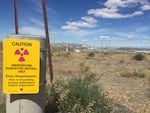
The Hanford Site in southeastern Washington is pictured in this 2020 photo. The nuclear reservation includes 56 million gallons of radioactive waste across 580 square miles.
Anna King / Northwest News Network
In September 2024, we packed up our van and drove about four and a half hours from Portland to Richland, Washington, to set up a mobile broadcast studio on the campus of Washington State University Tri-Cities, in partnership with Northwest Public Broadcasting.
We broadcast a week of shows that included conversations about the WWII and Manhattan Project history that created the radioactive waste from war-time plutonium enrichment at Hanford.
Our coverage from the region also included in-depth interviews with Indigenous leaders and a tour of the infamous B-reactor, along with conversations about the economy and culture of the region.
We listen back today to two of these conversations. The first is with Carolyn Pearce, a Ph.D. and chemist with the Pacific Northwest National Laboratory working on the science of the vitrification, the glassification process that will be used to turn some of the 56 million gallons of radioactive waste into radioactive glass logs for storage.
In the second half of the show, we revisit our tour of one part of the Hanford nuclear reservation. The 56 million gallons of waste are stored in 177 massive, underground tanks on 18 different “farms.” Most of the tanks are single-shelled, but 28 of them are double-shelled, which helps prevent waste from getting into the ground.
Karthik Subramanian, chief operating officer of Washington River Protection Solutions, the tank farm operations contractor, was our guide.
After the tour, we sat down with Brian Vance, who at that time was the Department of Energy’s top manager in charge of Hanford. He resigned in March of this year. Vance talked with us about tank integrity, the status of the vitrification plant and the overall cleanup progress.
The opening of that waste processing facility — which has now cost $30 billion — was thrown into doubt earlier this month, but the Department of Energy allowed the project to move forward.
On Wednesday, toxic nuclear waste began being turned into glass for the first time at Hanford.
Note: The following transcript was transcribed digitally and validated for accuracy, readability and formatting by an OPB volunteer.
Dave Miller: This is Think Out Loud on OPB. I’m Dave Miller. We’re listening back today to some of the conversations we had last year from Richland, Washington and the Hanford Nuclear Reservation. We went there in partnership with Northwest Public Broadcasting. Congress is deciding right now how much money to put towards the clean up of Hanford Nuclear Reservation and the 56 million gallons of radioactive waste stored there. Funding for the Pacific Northwest National Laboratories and the LIGO Observatory also hangs in the balance. But just this week, the long-awaited radioactive waste treatment plant finally began operating. We’re going to start our look back with a conversation about disposal.
The English writer Robert McFarlane in his book “Underworld” laid out the nuclear problem this way: “For as long as we’ve been producing nuclear waste, we have been failing to decide how to dispose of it.” And he added this: “Slowly, expensively, miraculously, injuriously, we have learned how to convert uranium into power and into force. We know how to make electricity from uranium and we know how to make death from it, but we still do not know how best to dispose of it when its work for us is done.”
Carolyn Pearce is one of the many people who’s helping to answer that question. She’s a chemist at the Pacific Northwest National Lab. Among her tasks right now, exploring the properties of ancient glass, substances that have survived for thousands of years, so that the U.S. Department of Energy can be confident in its plan to bind up radioactive waste in solid form deep into the future. We spoke with Pearce from Washington State University Tri-Cities. I asked if she could begin by describing the overall problem she was trying to solve.
Carolyn Pearce: So, here at the Hanford site, we have a legacy from plutonium production for the U.S. Department of Energy Weapons Program, where we have about 56 million gallons of liquid waste that’s historically been stored in 177 underground tanks out here at the Hanford site. And it’s the mission of the Department of Energy to convert that liquid waste into a safe form for disposal. And the way that they’re going to do that is by turning it into a glass, by vitrification.
Miller: Why was vitrification chosen? And this has been a project that’s been going on now for decades. The plan to vitrify, to glassify, to solidify this stuff – why was this chosen?
Pearce: It’s a mature technology and has been used around the world for encapsulating radioactive materials. And it’s basically because glass is by definition amorphous, so it doesn’t have a crystalline structure. And so it is very accommodating for other elements within its structure. Elements like technetium and iodine that are radioactive can sit inside that glass structure and that makes it a much more robust waste form.
Miller: Am I right that it’s incredibly hard to even know exactly what’s in these tanks?
Pearce: We have an idea of what’s in the tanks based on the inventory of what went into them, and there have been sampling campaigns to analyze the constituents. But the problem is that they’re in a radiation field – a continuous radiation field – generating reactive species that continue to change and generate new chemistries within the waste. So that is our problem. We know we have a snapshot of what the waste is now, but we have to know how it’s going to change as we move forward into the future. And that’s something that we’re still learning about.
Miller: How do you do that? I mean, if it’s always changing, how do you know what it’s going to be like an hour from now or 100,000 years from now?
Pearce: There have been efforts made to monitor over time. We know that radiation will consume certain chemicals and generate others, so we can make predictions and models based on radiation chemistry. But there is also investment still in fundamental science through the Office of Science, through IDREAM, to really look at how radiation in these low-water, very alkaline environments changes the chemistry. So we’re still learning to get that predictive understanding for years to come.
Miller: You mentioned that vitrification is not new and that it’s already been used for nuclear waste?
Pearce: Yes.
Miller: So what’s different about Hanford? I mean, we’re talking about a project that has had some stops and starts, some huge red flags, reports a decade ago saying there are a lot of issues with this. If it’s already been done, what’s different about what you’re trying to do here?
Pearce: I think that two of the things that are different about Hanford are just the scale – no one has built a waste treatment plant on this scale for vitrification before – and then also the variability of the chemistry. Even within the U.S., at Savannah River, the chemistry is not as complex as here at Hanford. So, whereas they have a vitrification program there and we can learn a lot from that, the difference in chemistry here in the different tanks causes more technological challenges.
Miller: And just to be clear: vitrification, it doesn’t change anything about the radioactivity of this waste, right?
Pearce: Correct.
Miller: It just immobilizes it?
Pearce: Yes.
Miller: Why is that so important? I mean, if it’s still going to be radioactive, why is turning it into a solid such an important thing to do?
Pearce: That’s a great question. So, right now, the waste is in a liquid form. And there are sort of different forms of the waste within the tanks: it’s present as a sludge; and a supernatant, which is liquid; and then a salt cake which precipitated out of the liquid. But with it being in a liquid form, there is a potential for those tanks to leak, and some of the single shell tanks – so they only have one shell of steel – have already leaked waste into the subsurface. And they’ve all now been emptied of all that liquid waste and it’s all now in double-shell tanks, but they have also a finite lifetime. And so if we can convert it into a vitrified waste form, where we have been able to model the performance over hundreds of thousands of years, it’s a much safer alternative to leaving it in the liquid form that it’s in now.
Miller: You mentioned hundreds to thousands of years. What is the time frame that you’re thinking about?
Pearce: So we’re really thinking about the time frame of the performance assessment for the disposal facility where that low-activity waste glass will end up. And the time frame for that is being able to predict performance over about 1,000 years. But we do want to understand much longer time frames because the major radionuclides in the low activity waste are technetium-99 and iodine-129 that have half-lives of around 2,000 and then 2 million years, respectively. And so we do want to understand the behavior on much longer time scales.
Miller: How do you wrap your head around a half-life of 2 million years?
Pearce: It’s very challenging. And I think that’s why these analogs are just so important because we can look into the past millions of years, right? We have examples of natural obsidian glass that has been in the environment for millions of years. And we can look at how that has changed over time. And that’s what’s going to give us confidence, looking ahead to those millions of years, that the waste will be disposed in a glass form.
Miller: All right. So let’s talk about that sort of historical work that you’re doing to think about how the deep past can inform the deep future. So obsidian is one example you’re talking about and people all around Oregon, and I think in Washington, too, can see that from volcanoes. What have you learned from obsidian?
Pearce: We’ve been taking samples with a permit from the Deschutes National Forest from the Newberry Volcano just outside Bend. And that’s of interest to us because, actually the big obsidian flow – the last major event – was on the order of 1,500 years ago, so it’s in the right time regime for us to look at with regards to the disposal facility.
Miller: A baby in terms of geological time, but helpful for you.
Pearce: Yes, absolutely. So what we’ve learned from that is that the glass is incredibly durable. We’ve been able to look and quantify the alteration layers that are on the order of microns – so, the thickness of human hair – over those time scales. But we’ve also learned, through looking at multiple analog sites, that the surface of the glass can be colonized by the local microbial community. Understanding that interaction is also part of our work in these natural environmental settings.
Miller: What does that mean? So microbes or bacteria – they could basically live their lives and in a sense, eat the rock. What does that mean if the rock, or glass in this case, is highly radioactive waste?
Pearce: That’s what we’ve been working to understand. Now, the low-activity waste that will be disposed of in the integrated disposal facility at Hanford will not have a significant heat associated; it’s not heat-generating waste because it’s low-activity waste. And the radionuclides that are present – the type of radiation that they emit, their beta emitters – that won’t necessarily be able to reach the exterior of the waste form. So the organisms could potentially colonize the outer surface and not be significantly impacted by radiation fields, which would be the case with high-level waste, which is heat generating and has radionuclides that have the potential to emit radiation that could reach that biofilm on the surface.
Miller: Before we hear more about other places you’ve gone to look for analogs, as I’ve been thinking about the problem you’re trying to solve, an analogy I came up with is car manufacturers or tire manufacturers who are trying to simulate wear and tear. So they can just have a tire do the equivalent of 100,000 miles while it’s not going anywhere. Are there ways that you can do the same: approximate the passage of time very quickly?
Pearce: Yes. Yes, absolutely. So that is, in fact, what is done; there are accelerated aging tests that are conducted on these glass waste forms in the laboratory, where we use things like temperature as a proxy for time frames. And that is how the glass compositions are formulated, based on the performance of the glasses in some of these accelerated aging tests. But of course, that’s not representative of the actual disposal environment. So we need to combine what we learn from those accelerated aging tests and understand the mechanisms of alteration, and then verify that with what we actually see from samples that have sat in a relatively constant temperature in the environment for thousands of years.
Miller: Can you tell us about a trip you took to a hillfort in Sweden?
Pearce: Yes, absolutely. This program is supported by the Department of Energy Office of River Protection, and the glass program is led by Albert Kruger. And he met, at a conference, a gentleman called Rolf Sjöblom, who actually worked on Swedish nuclear waste disposal. And they discussed this material that’s present at the hillfort as a potential analog for low activity waste glass. Because at the hillfort, the ancient people – pre-Viking people around 1,500 years ago – had the technology to take the granitic boulders, which was the local geology, and then pack a different type of rock, amphibolite, between them and set fires to make temperatures high enough – around 1100 degree C – to actually melt that amphibolite and fuse the granite blocks together to fortify hillfort. So it’s actually a glassy material that’s holding together those granitic boulders.
Miller: And what did you learn when you looked at that early human, glass-like substance?
Pearce: So what we learned was, it was incredibly durable, because it was the part of the wall that had been vitrified that still remains and you can still see today. Once again, we got a permit from the Uppsala County Council to work with the Swedish archaeologists and actually do an excavation of the wall of the hillfort to take samples. And when they got to the vitrified region, they had to use sledgehammers and pickaxes to try and get through that material because it was so durable, holding the wall together. And that was just a really visual example of glass doing its job over a very long period of time.
Miller: It’s interesting to think that, assuming that the archaeologists are right, the reason for that glass was defense, which is in a sense, in a roundabout way, the same reason for the work you’re doing now – I mean, the clean-up after an enormous World War II and then Cold War build-up of these weapons. What was it like to be there and to be touching or seeing this old human technology as you’re trying to figure out a very new human technology?
Pearce: It was a fascinating experience and I would certainly encourage anyone to visit the site; it’s called Broborg in Sweden. And it has a very particular atmosphere. It feels like many things took place in that space and that there was just a lot of history – and history that we don’t know, because the hillfort was built before written word. And so there’s no record of why the hillfort was built.
There’s still debate in the literature as to why they vitrified the walls. Could it just have been an accident [like] a lightning strike or a cooking fire? But I think if you go there and see the very deliberate way in which these box-like structures were created around the circumference of the fort and just the strength of this vitrified wall, it’s certainly – based on our findings – suggest that it was intentional to support the defense of the hillfort.
Miller: And as many mysteries as there are there, that was only, in quotes, what, “3,500 years ago” or so, right?
Pearce: Fifteen hundred [years ago].
Miller: Only 1,500 years ago. But we’re talking about half-lives in the tens or hundreds or millions of years. I know you’re a chemist, you’re not an archaeologist or a linguist or a graphic designer, but those kinds of people have all been brought in to think about signage or symbols to tell future humans, future whoevers, who most likely are not going to speak any languages or reading languages that we know of now. The message that we want those future creatures to understand is: do not enter, do not touch, do not eat, go away, this is a place of danger and will be a bad place forever – essentially, in terms of the way our brains think. How do you do that in a way that those creatures will understand?
Pearce: Well, I think that’s a fascinating question, and I certainly don’t have the answer. But I can say that we did learn a lot from the hillfort because it was abandoned for many years and no one really visited it or knew of its existence. And part of that was because of folklore. There were all these tales of trolls and monsters that guarded this site. So people stayed away from it until very recently. I think we can learn from that; that there’s this generational storytelling that we could pass on, perhaps not even through the written word but through spoken word as …
Miller: Taboo.
Pearce: Yes. To explain why it’s not appropriate to be in this site.
Miller: It’s not treasure here; it’s death.
Pearce: It’s death, yeah.
Miller: How do you think about the work that you’re doing in the context of climate change? Because we’re talking here about disposing of waste from a production of plutonium for bombs, but there is a lot of waste from existing power plants and there would be more if there were more nuclear power.
Pearce: I absolutely think nuclear power is part of the solution to the climate problem and to our mixed energy sources of the future. But we do have to solve this problem and I’m passionate about that. I’ve worked here, I’ve worked at the University of Manchester in the UK on deep geological disposal facilities for that waste. So I think it’s a problem that we have to solve, and that’s going to require not just scientists but also real community engagement and an understanding of the benefits of safely disposing of these materials so that we can have a clean energy future.
Miller: What’s at stake in the work you’re doing right now?
Pearce: I think, what we can learn from the work that we’re doing right now, we’ll learn from it at Hanford. That’s the main thing that I think we can take away from what has happened here, is learn about the decisions that were made and the implications for the future. And then use that knowledge that we’re developing about the different waste forms to help inform disposal of other waste from energy production around the world.
Miller: Maybe this is not exactly the way engineers and scientists thought about this in the ‘40s, and ‘50s, and even the decades after that, but the sense I get is that relatively early on, they knew that the disposal systems they had in place were inadequate. But they were working with urgency that they, especially in ‘44 and ‘45, saw a kind of existential threat – and certainly, that was the feel in the Cold War as well.
So, in the sense, it seems like the idea was: engineers or scientists will have a better solution in the future, but we have to do what we have to do right now. There were a ton of ramifications that came from that, many of them negative. I’m wondering if you have that same thought, or if you see yourself and the hundreds of other scientists all around here as being a permanent solution? Or if you’re also hoping that humans that follow will figure out a better way?
Pearce: I always hope that the humans that follow will find a better way. And I believe that they will. But, I really believe that we have so much to learn from the technologies that have developed, not just to vitrify the waste, but also to remove radionuclides from the groundwater through the pump-and-treat facilities. There’s just a massive knowledge base that’s developed here. And I think we need to use that going forward for things like generating new energy sources, and understanding how we can generate energy from different materials, and improve our nuclear power plants to reduce the burden on the waste. And I think that’s our duty: to really learn from that and make that happen.
Miller: Carolyn Pearce, thanks very much.
Pearce: Thank you.
Miller: That was Carolyn Pearce, a chemist at the Pacific Northwest National Laboratory, talking about the effort to create a long-term storage system for millions of gallons of radioactive waste. We spoke last year as part of our series of conversations focusing on the legacy and the future of the Hanford Nuclear Reservation.
Fifty-six million gallons of radioactive waste are stored in 177 massive underground tanks. About a third of those tanks are known to have leaked. One of the biggest cleanup projects at Hanford, when it’s already taken an estimated $30 billion and decades of work, is to transfer that waste out of those tanks and turn it into a solid glass form for long-term disposal at a place known as the vitrification or Vit Plant.
After years of delays and cost overruns, that plant became fully operational this week. Now, before waste can be turned into those logs, it’s moved to double-walled tanks. We got a tour of that tank farm almost exactly one year ago. Karthik Subramanian was our guide. He is the chief operating officer of Washington River Protection Solutions – that’s the contractor that manages the tank farms. A tank farm doesn’t look like much from ground level. It actually reminded me of the roof of an office building with a bunch of boxes and exhaust pipes on top. So I asked Subramanium to give us a sense for what was below the surface.
Karthik Subramanian: These tanks are about a million gallons in volume, and they’re about 85 feet in diameter, about 30 feet tall. And then they are buried with the top of the tank at about a 12-foot level, between 9 and 12 feet depending on where you are on the dome. So they’re buried quite a bit underground. And then each of those tanks is completely secondary contained in another tank.
Miller: With an air gap between them, and some kind of sensors, too?
Subramanian: Yes. So in the air gap, we do have temperature sensors, as well as leak detection. So if we see any of that happen, it all reads in our control room and we respond to it immediately. Whether it be just a communications issue or if there’s a real event, then we respond to that.
Miller: That’s very different from the original single-walled tanks built in the mid-‘40s that were supposed to last for 20 years.
Subramanian: That’s exactly right. The single-shelled tanks do not have an annular space. So, as I said, one of the important parts of our mission is to retrieve it from those tanks and put it in the double-shelled tanks. And like I said, high success in east area, two tank farms completely finished. And now we’re on to our last one in east area.
Miller: This is a kind of job where if somebody messes up at work, it could be catastrophic for a lot of people. How do you keep people focused?
Subramanian: As in any nuclear industry, there’s a lot of layers of procedural compliance to ensure that there are multiple layers of defense against any errors that would have impact. This is an old system that’s been put in place – it’s called Conduct of Operations. We have multiple layers of defence against any errors that may have impact. We have procedures that are meant to support the folks doing the work. And those procedures are constantly reviewed, evolving, and to ensure that we are procedurally compliant. So between the staff … like I said, multiple layers of defense in ensuring that any errors are not catastrophic, as you say. And in fact, we have metrics that we use that we track even small errors or small events, so we prevent those along the way as well.
Miller: Do you lead your home life in the same way?
Subramanian: [Laughs] Yes.
Miller: The reason I asked that is that I heard that people in Richland put safety goggles on when they chop onions. When they mow their lawns, they put on boots that go up to their thighs and helmets to mow their lawn.
Subramanian: It is a culture of safety. We say it all the time, when we have safety introductions to most of our meetings, “we take safety home with us.” It could be anything from just driving, not running yellow lights, or it could be when you’re cutting the grass, wearing safety goggles when you cut the grass. So absolutely, I take it home with me. In my mind, you behave in a way that you want other folks to behave, and that safety doesn’t stop at the fence.
Miller: But I think you can understand why there would be skepticism. After decades of secrecy, and in some cases obfuscation about mishaps, there’s a gap of trust in the public about a lot of what happens here, whether it’s DOE or contractors. Do you recognize where the skepticism or fear comes from?
Subramanian: Yeah, absolutely. So I think that the steps we are taking there is that we need to be forward in educating the public on the work that we are doing here, as I mentioned about the technologies and the engineering work and the operations that we’re doing. We have the opportunity to go do that. In contrast to maybe 30-40 years ago when there was a secrecy, I presume.
Now, we’re taking steps, we in the department are taking steps to educate the public on the work that we’re doing. Not just the public, but all stakeholders. And so that’s where we’ll see, in my opinion, that trust grow.
Miller: How did you get into this line of work?
Subramanian: I started in the national lab system doing research on tank waste processing for the NNSA. I started work at Savannah River in waste processing. I think what interested me most about Hanford is just the scale.
Miller: So what scares a lot of people is what attracted you to this place, the scale of this problem? That’s why you want to be here?
Subramanian: Absolutely. What we want to do from a scale standpoint, and a nobility of the mission standpoint, those are the two things that attracted me. So if you’re an environmentalist and you want to really help the environment, nobility of mission and scale, what more can you ask for?
Miller: Are you an environmentalist?
Subramanian: I consider myself one. Otherwise, I wouldn’t be here.
Miller: What does it mean to you to say that you’re an environmentalist?
Subramanian: To me, personally? I think that we’ve been given this environment and it’s our responsibility as a human race to protect it. It’s kind of that simple.
Miller: That was Karthik Subramanian. He is the chief operating officer of Washington River Protection Solutions.
A pipe goes from that tank farm we toured, to the huge vitrification plant that just opened. That plant was the next stop on the tour. We saw the huge melters that are used to turn liquid waste into solid but still radioactive glass. And we saw an example of the steel canisters, weighing more than 14,000 pounds when filled, that hold that glass.
Chris Musick is the deputy director of the factory, which is officially called the Waste Treatment and Immobilization Plant Project. Over several decades, the public was periodically told that the plant would be operational in the next few years, but those dates have all come and gone. So I asked Musick, when we talked last year, when he thought this project will finally be operational.
Chris Musick: We have a really aggressive schedule. Right now, we’re talking to go in hot in August of ‘25.
Miller: What do you mean when you say aggressive?
Musick: We have a lot to do. This is a plant … you’ve been through it, it’s very large and complicated. We’ve just got a lot of methodical steps that we want to go through. And we wanna make sure that our people, our paper and our plant is all ready to go before we go hot. We’ve been working really closely with the Department. So there’s just a lot to do between now and then. I’m not saying we’re not confident that we’ll meet the August date. I just want you to know there’s just a lot of things and steps that we need to go through and we’re making good progress every day, making history every day.
Miller: Chris Musick is the deputy director of the Waste Treatment and Immobilization Plant Project, which we toured last year. I should note again that the plant did not open in August, as Musick had hoped, but it did open on Wednesday.
We also had the opportunity to speak with the head manager of the Hanford site for the Department of Energy. At the time, that person was Brian Vance. He agreed to be interviewed only if we provided him the exact list of questions in advance. Even though we had never done that for a public official, we thought the conversation was important enough that we made an exception.
I began by asking Vance to give us a sense for the complexity of managing the hundreds of different toxic chemicals in all their forms at the Hanford site.
Brian Vance: Well, I think as we think about how we manage a broad risk portfolio, which is what we’re here to do, we work very closely with our contractor partners. We have a tremendous outreach to national laboratories. Pacific Northwest National Lab is right here with us, we have a relationship with them, Savannah River National Lab. And through the National Academy of Sciences, lots of different resources and lots of different ability to bring really smart people to our site, to evaluate the situation we’re working our way through, and help us to prioritize that work in a way that we can work on the right risk elements of the site, with the dollars we receive, trend the risk profile down as aggressive as you can, which creates the safest place for our workforce and our community.
Miller: So that’s the issue of complexity. There’s also just the mind-boggling volume: 56 million gallons of radioactive waste in these underground tanks, in 18 different sites over almost 600 square miles. The size of this site alone is staggering. How do you think about the scale of this work?
Vance: We break it into three basic product lines. One is the tank waste product line that you spent time yesterday seeing, the tank farms and the waste treatment plant, that’s a part of it. There’s also the risk reduction product line, which is facility demolition, soil remediation, groundwater treatment. And then it’s the infrastructure that underpins that entire work scope that we have to clean up the site. Because without roads, water, power, sewer, can’t clean up. All of those go into how we break the site into more reasonable chunks, and then work it from a risk priority perspective in that way.
Miller: What are the nightmare scenarios for you? What are the kinds of worst case scenarios that might keep you up at night?
Vance: My biggest fear – and Karthik talked about it a little bit – is the safety culture that surrounds how we do work. My biggest fear is someone getting hurt, doing the work on the site. We’re asking up to roughly 12,000 people to support the cleanup mission here. And all of those things that we have in place to keep people safe while doing this work, there’s always the very slight possibility that one of our processes, one of our procedures, one of our protocols won’t work as we anticipate it. And we have a strong safety culture, which basically requires workers to stop when they’re confronted with something they don’t expect. All of those things together create my ability to sleep at night. And that really is the culture of the site and the commitment for health and safety.
Miller: Correct me if I’m wrong, but it seems like what you’re saying is your biggest fear, the scale of that is about a workplace accident, as opposed to saying some kind of tunnel collapse or bigger infrastructure problem that could lead to a radiological problem that goes well past Hanford. That isn’t what you said.
Vance: I’m less worried about that than I am about the health and safety of our workforce. We have very robust programs, processes, procedures on our site to deal with the range of chemical and radiological issues that we have to clean up. Those processes are very robust, very effective. And the people that do that work are top of the line. So from that perspective, we’re managing the site to fully mitigate, or mostly mitigate, the risk of something like that – what you framed as a doomsday outcome.
Miller: Yeah.
Vance: I think that’s an almost infinitesimal possibility on my site, based on the way we operate.
Miller: This site, for very obvious national security reasons, was born in secrecy. And the sense I get is that secrecy has been embedded in the culture for many of the decades that have followed, including when workers and the public were not alerted in timely fashions to leaks or other problems, or releases of radiation. It’s often, in the past, taken whistleblowers for the truth to come out. How do you think about the balance of secrecy and openness now?
Vance: I think openness and transparency are two of the things that I’m most proud of, that we’ve spent considerable amount of time investing in, not only with our community, but with regional stakeholders, the Tribal Nations, the national community as well. Multiple examples – we wanna talk about the successes we have on the Hanford site, and we have a lot of successes.
But we also wanna own when we have less than successful outcomes. Like this summer, we announced a small leak from Tank T-101 in the T-Farm. From a timeliness perspective, the process that identified that tank as potentially leaking. My determination was, from a conservative perspective, we’re gonna call it a leaking tank and we’re gonna communicate right away.
Miller: How do you think that would have been handled in the 1950s, or ‘60s, or ‘70s?
Vance: Different time, in a national security posture, that was very, very different. My sense – and I’m a little bit younger than that – was that the community would not have been told. Today, my commitment to our community and really a broad range of stakeholders is we’re gonna be communicating, we’re gonna tell them what’s going on the site, good, bad, indifferent. Make sure that if it’s not what we wanted it to be, if it’s less than good news, we’re gonna own it, we’re gonna be transparent about it. We’re gonna tell people what we’re doing about it and why it’s not a risk.
Miller: One of the phrases that I’ve heard about this week and that’s come out on our show is “low activity waste” and “high activity waste.” And it’s worth saying that the vitrification plant that we visited yesterday – we heard a little bit of tape from that tour – the idea is it will hopefully soon be up and running to process low activity waste. But both of these kinds of waste are radioactive. What’s the difference between them?
Vance: Well, there’s interesting definitions on how they’re described. High level waste is typically described by how it’s formed, which is spent nuclear fuel or reprocessing spent nuclear fuel to drive products like plutonium. We do have the high level waste facility being constructed. In essence, what we’re doing now is finalizing the commissioning process to be able to start vitrifying low activity waste next year. And then we have a plan to drive the design of the high level waste facility to 90% complete by the end of 2027. And then transition into full construction in ‘28, to meet the consent decree milestones that came out of the host agreement with the State of Washington to start treating that part of our tank waste.
So, in 10 years, we’ll be treating both fractions of the waste. In some ways, the difference is whether it can be contact handled, which means you could be close to it, or not. High level waste is remote handled. Low activity waste that you saw is contact handled. So the radiological level is a little bit different.
Miller: What do you think is a bigger engineering challenge overall: making plutonium on an industrial scale when it had never been done before – I’m talking about the Manhattan project in 1943-1944 – or cleaning up the waste from decades of that plutonium production?
Vance: It’s a great question. I think the new science, that was nuclear in 1943 that started the Atomic Age, [was] uniquely challenging because it had never been done before.
Miller: And they did it in 11 months or so.
Vance: They did, and their risk profile was based on war in the Pacific, war in Europe ...
Miller: When you say risk, meaning, what they were subjecting themselves to was based on what they saw as a kind of existential threat ...
Vance: Yes.
Miller: … combined with not nearly the kind of knowledge that we have today about risk?
Vance: Correct.
Miller: But, I’m talking less about risk. Maybe you can’t disentangle risk from the engineering problem. But the reason I asked is because they were able to do something that had never been done by humans in about a year or so, they accomplished their goal. We are decades and decades, and billions and billions of dollars into figuring out what to do with the waste that was generated, and we’re not there yet.
Vance: Well, when you look at the focus of the time, which was on the national security mission, they were under tremendous pressure because of the world situation to produce plutonium, to preserve the nation, in many ways. And so as a new science, they made decisions based on the situation they had at the time, with the knowledge they had, not recognizing that their actions would create a much more complicated and complex cleanup in the future. So when the national security mission drove, environmental science, environmental cleanup of the future was not a part of the calculus.
When we transition, 1989, to the cleanup mission, now we have a whole body of evidence behind us, the effects of ionizing radiation, the impacts of different chemicals and how they interact, the difference of radionuclides and how they interact. And we had to apply all that knowledge under a different safety paradigm to be able to progress the cleanup mission. It’s gonna take a while.
Miller: It’s tempting to look at the past and say, “Man, we know so much more than they did. They did the best they could, but they left us with a huge mess. But now we know so much more.” That’s one way I can imagine looking at it. Another is to look at this from even further away, and take some version of humility from it and imagine what people 80 years from now will think about you. When I say “you,” I mean all of us.
Do you do that? Do you imagine how the future will view the best technology we have now and the decisions you’re making now?
Vance: I hope as they look back in the future – however that’s defined – and they think about the cleanup mission that we’re executing at the Hanford site, they’ll recognize that the team that is progressing the mission today learned from the past, strove to enhance our ability to safely conduct the cleanup mission, being protective of our workforce and our community, and built a team that was committed to the success of a very daunting mission and performed very well in a very complex environment. We’re striving for excellence every day. We still have a lot to learn. But I think at the end of the day, the progress we’ve made is important, is impactful and we’re set up from a trajectory of the site perspective, I think, for a very exciting next 20 years of the cleanup mission.
Miller: That was Brian Vance. When we spoke last year, he was the Department of Energy’s top manager in charge of Hanford. Vance has since resigned. His replacement, Ray Geimer, took over last month.
You can listen back to the other conversations from Hanford and find earlier coverage by clicking the Hanford tag at the bottom of the webpage for today’s show.
“Think Out Loud®” broadcasts live at noon every weekday and rebroadcasts at 8 p.m.
If you’d like to comment on any of the topics in this show or suggest a topic of your own, please get in touch with us on Facebook, send an email to thinkoutloud@opb.org, or you can leave a voicemail for us at 503-293-1983.