Airport runways need to be smooth and flat so planes can take-off and land safely. But if the ground under the runways is sinking, that surface can dip and crack, requiring expensive repairs.
Researchers at Virginia Tech did a satellite analysis of 15 of the country’s busiest airports and found that Portland’s runways are subsiding. The analysis shows the rate varies along the runways, but at its highest, PDX is sinking relatively quickly — second only (of the airports studied) to San Francisco.
The satellite monitoring technique is called InSAR, short for Interferometric Synthetic Aperture Radar. It works by shooting radar signals from the satellite down to the surface of the earth, where it bounces back up into space. The altitude of the land is determined by how long it takes the signal to make the roundtrip. By doing multiple measurements over time, the researchers can calculate the movement of the ground.
The Portland International Airport is located on artificial fill and volcanic soils on the smooshy Columbia River floodplain. Fill often includes things like dirt, mud, and rocks that are brought in to level and stabilize the ground before building on a site.
The satellite analysis found a maximum subsidence rate of 6.5 millimeters per year, meaning over the course of a decade, parts of the runway could sink up to 3 inches. Some runway sections wouldn’t be expected to sink as much. And this varied rate of sinking can be particularly damaging to paved surfaces.
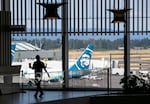
In this file photo, a person walks on the upper mezzanine of Portland International Airport's remodeled main terminal, with an Alaska Airlines plane in the background, Aug. 14, 2024. A recent satellite analysis shows sections of PNW airport runways are subsiding. The Port of Portland says they’re monitoring closely and haven’t seen impacts.
Anna Lueck / OPB
From the airport data collected, the research team characterizes the long-term risk of damage to sections of the PDX’s runways as “high.”
In an emailed comment, the Port of Portland, which manages PDX, said the Port is familiar with the study’s findings. Yet in practice, they’ve not found that subsidence has impacted runways or affected maintenance costs.
“Our operations team drives the runways multiple times a day for visual monitoring,” said Port media relations manager Molly Prescott in the email. “We have close inspections every month as part of our pavement management program, in addition to annual visits from [Federal Aviation Administration] inspectors.”
As of the last inspection, she said, “PDX meets all federal airport safety standards.”
Previous research from the Virginia Tech research group found the city of Portland as a whole is also subsiding as the loose soil it’s built on compresses. But the rate is very slow and not really grounds for alarm.
In the recent study, the group found the Portland airport is not alone in the Pacific Northwest when it comes to facing subsidence.
Their analysis found that Seattle’s airport is facing a similar situation, with a high-end subsidence rate of around 5.5 millimeters per year. The varied subsidence pattern along the airport runways at Sea-Tac creates a “very high” potential for causing infrastructure damage in specific areas at the airport, according to the study.
The researchers say their satellite monitoring technique could be a cheap and minimally disruptive way to identify and head off subsidence hotspots at airports before they lead to trouble.
The research is published in the journal Earth and Space Science here.
In these All Science Snapshots, “All Science. No Fiction.” creator Jes Burns features the most interesting, wondrous and hopeful science coming out of the Pacific Northwest.
Find full episodes of “All Science. No Fiction.” here.