Alix Rabbas unpacks some belongings at her assigned bed at Portland’s Salvation Army Female Emergency Shelter, or SAFES, in Portland, Sept. 23, 2025. The shelter is a fundamental component to Mayor Keith Wilson’s homelessness plan.
Kristyna Wentz-Graff / OPB
Alix Rabbas was on her feet all day. From dropping off heavy bags at a storage facility to making it to a day center in time for lunch, she had been running errands across town since dawn. At 7 p.m. on a recent Tuesday, the 58-year-old stood in line with a dozen other women outside a downtown Portland shelter.
“I’m exhausted,” said Rabbas, who has slept nearly every night at the Salvation Army Female Emergency Shelter, or SAFES, for six weeks.
“We all are. This life wears you out,” she said, leaning on a wobbly, three-wheeled cart packed with her possessions. “But the consistency of having a place to come to every night that’s safe. I find myself thinking, ‘I can’t wait to get to my bed.’”
This shelter, at the corner of Southwest Ankeny Street and 2nd Avenue, is a fundamental component of Mayor Keith Wilson’s homelessness plan.
Wilson entered office in January with a sweeping plan to end unsheltered homelessness in 11 months. To reach that goal, he proposed quickly opening a number of nighttime-only emergency shelters.
While roughly 7,000 people currently live outside in Multnomah County, Wilson’s plan relies on opening 1,500 new shelter beds by Dec. 1, adding to the roughly 3,000 beds already funded by the city and county. As of late September, he’s built space for about 630 beds in five emergency shelters.

A woman carries her belongings on a street near the facility.
Kristyna Wentz-Graff / OPB
Before Wilson’s tenure, publicly-funded nighttime-only shelters were rare in Portland – only being occasionally used during weather emergencies. Now a cornerstone of the city’s homelessness plan, it’s worth asking: How is this new shelter model addressing the city’s homelessness crisis?
SAFES was one of the first emergency shelters to open under Wilson’s leadership, starting operations Jan. 7. The city has paid the Salvation Army $5.6 million to run three emergency shelters this fiscal year – $1.5 million toward SAFES alone.
The Salvation Army had operated a women’s shelter in the building in the past, but shut it down after losing city funding in 2019. Before closing, it was open 24 hours a day, offering warm meals, showers, laundry, lockers and social services on site. When it opened in January, shelter regulars were surprised by the reduced offerings.
“It’s pretty different now,” said Margie Gordon, 69, who has been living outside in Portland for more than two decades. “They don’t do much for you, there’s no time to.”
A new model

A woman rests on her assigned bed after checking in.
Kristyna Wentz-Graff / OPB
SAFES is now open from 8 p.m. to 6 a.m. The building offers 100 twin beds, divided between three floors. The beds are set up in tidy rows in a large room on each floor, with the headboard of one bed touching the base of another. If a person spends one night at the shelter, they’re guaranteed a bed the following night.
But this reservation system hasn’t felt necessary since the shelter opened due to low use. According to the Salvation Army, about 45 of the 100 beds are usually occupied on a given night.

Justin Moshkowski, executive director of Multnomah County Shelters for the Salvation Army.
Kristyna Wentz-Graff / OPB
The shelter is run by roughly five Salvation Army staff members each night.
Guests are given snacks – like a small bag of chips and jerky – and a cup of water before going to bed. The shelter recently made showers available, but offers no laundry or lockers. Visitors cannot bring drugs or alcohol into the shelter. The women are discouraged from bringing in more than two bags of personal items.
Justin Moshkowski is the executive director of the Salvation Army’s Multnomah County shelters. He said there’s some flexibility in what people can bring in.
“It sort of depends on the situation,” Moshkowski said. “If we get somebody with a walker, where they are hanging all their bags off of it, of course we’re gonna let them in.”
The shelter has no services on site, like case workers to help connect people with health care, housing or work. A bulletin board offers phone numbers and addresses for some programs.
‘It’s easy to get lost’
Wilson has characterized his emergency shelter strategy as a “first step” for people ready to move into housing. But getting people into housing or other programs is not SAFES’ top mission.
“First and foremost we want people to be off the streets,” said Maj. Maggie Laubach, who oversees all Salvation Army social services in the Portland metro area. “We recognize that women are even more vulnerable when they’re on the streets, so we want them to have a safe place where they feel loved, they feel seen, where they can come and they can rest.”
Laubach said that finding housing for people at the shelter is the city’s responsibility. She said sometimes city staff stop by to offer help to people who use the shelter. Three women who’ve stayed at the shelter for more than three weeks said they had never seen a city outreach worker.
Rabbas, one of the first in line outside the shelter on a recent visit, said that’s a good thing.
“I think it works for a lot of people because they don’t force you into a program,” she said. “They’re not trying to get you into some process. It meets you right where you’re at.”
Rabbas has tried to get into housing in the past, but said she was rejected for various reasons. The process of trying to get out of homelessness has become more burdensome than just trying to survive each day, she said. Many of the women in line with Rabbas that day had a similar story.

Maureen Slossar, 53, has a smoke outside the Salvation Army Female Emergency Shelter after arriving for the evening.
Kristyna Wentz-Graff / OPB
“It’s hard, you have to pay close attention,” said Maureen Slossar, 53, who has been homeless on and off for a few years. Slossar said she’s probably put her name on every housing waiting list possible during that time.
“It’s a lot of waiting. And then somebody calls you back, but then someone steals my phone and when I finally call back it’s too late,” she said. “It’s just easy to get lost.”
The average age of a SAFES visitor is 45. Many of them have lived unsheltered for a long time. Many staying at the shelter on Tuesday evening appeared to have untreated physical and mental health issues.
Slossar had a broken wrist and said lugging her few possessions around every day made it hard to heal. Several women staying at the shelter told OPB about their fears of being surveilled by the government and appeared to switch in and out of psychosis as they shared their experiences. Two women said they had worked for the CIA, and had their lives threatened. Navigating that frightening perception seemed to overshadow their focus on leaving homelessness.
Many SAFES visitors have stayed at different shelters across Portland, with mixed experiences. Several told OPB that they have been kicked out of some shelters for being disruptive. All visitors who spoke with OPB said they felt welcome SAFES.

Beth Satterlee, 64, rests on her bed. Those seeking shelter may begin lining up at 7 p.m. and the doors open at 8 p.m.
Kristyna Wentz-Graff / OPB
“If you’re desperate, this is a good option,” said Lori Waltman, 54, who sat on a couch as she waited for a shower Tuesday evening. “And a lot of these women are desperate.”
SAFES staff say they’ve adapted to visitors’ needs over the past nine months.
“We had to learn about training that is needed to address the very unique circumstances that come with serving this population,” said Laubach.
She said that includes training about how to handle human waste and bed bug infestations – state-mandated staff training that The Oregonian/OregonLive.com found hadn’t been enforced for months at the Salvation Army’s other overnight shelter in Northeast Portland.
Laubach said she’s interested in offering mental health and substance abuse treatment at SAFES, after seeing the clear need among women who are using the shelter.
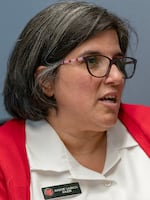
Major Maggie Laubach, Salvation Army divisional secretary for Portland Metro Social Services.
Kristyna Wentz-Graff / OPB
“We want to be able to equip our participants to really enter into a healing journey,” she said.
Wilson is also making plans to expand his homelessness strategy.
Last week, Wilson told OPB he’s “considering” resuming enforcement of the city’s anti-camping policy in November. That rule has been on hold while Wilson opens shelter beds. But now, he said, since the city has “consistent available capacity” in its emergency shelters like SAFES, he wants to start ticketing people who don’t move off the street into a shelter.
“We will ensure that every Portlander who wants a bed will have one,” he said.
An early start
Lights are turned off at the SAFES shelter at 10 p.m. Staff switch them back on seven hours later. Everyone must be out by 6 a.m.
At 5:30 a.m. on the morning after OPB visits the shelter, women begin to stream out of the building into the dark, empty downtown streets. A staff member told visitors to “have a blessed morning,” as they exited. The sidewalks are wet from powerwashing, a service that the city pays for outside of every emergency shelter, to assuage neighbors’ concerns about increased trash and human waste.
One woman in her mid-60s who asked to remain anonymous said she got about an hour’s sleep. Several women were talking to themselves all night, she said. One person was intermittently crying. She said she was also too nervous to sleep out of fear that someone would steal her bags.
She said she didn’t feel safe outside this early in the morning, and was going to wait by the front door until the sun came up in an hour.

A pair of shoes and a bag of belongings near a guest's bed.
Kristyna Wentz-Graff / OPB
“I don’t think this is right,” she said, her voice a whisper. “Do you think the mayor wants to be forcing women out into the streets in the dark?”
Rabbas said she got about four hours’ sleep, which “is better than usual.” Clutching a paper cup of coffee, she rattled off her day’s schedule: getting breakfast at another homeless center, getting her broken cart fixed at another, picking up items left at a storage facility.
“I gotta get moving!” she said, walking briskly down Southwest 2nd Avenue.
Not everyone leaving SAFES shared Rabbas’ energy.
One woman left the building and quickly crossed the street and unfurled a blanket across the wet sidewalk.
Within minutes, she was asleep.