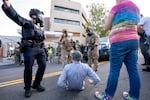
Federal agents surround a protester who fell near the Immigration and Customs Enforcement facility in Portland, Ore., on Sept. 28, 2025.
Kristyna Wentz-Graff / OPB
Nationwide polling suggests that about half of Americans oppose the deployment of National guard troops to American cities. But the poll also suggests that a significant number - 38% - do support deployment. Dan Mason is a National Committeeman for the Oregon Republican Party and former member of the Oregon Ethics Commission. He says while those are national poll numbers, he suspects they reflect Oregon, including its nearly 730,000 registered Republicans. Mason says he thinks Portland officials may be downplaying the city’s problems keeping the peace and protecting the U.S. Immigration and Customs Enforcement building in South Portland. He sees a potentially positive role for National Guard troops in the city. He joins us to tell us more about his views and what he’s hearing from his fellow Republicans in Oregon and across the country.
Note: The following transcript was transcribed digitally and validated for accuracy, readability and formatting by an OPB volunteer.
Dave Miller: This is Think Out Loud on OPB. I’m Dave Miller. Nationwide polling suggests that about half of Americans oppose the deployment of National Guard troops to American cities, but a significant number, 38%, do support their deployment. Dan Mason is one of them. He is the Oregon Committeeman for the Republican National Committee, the RNC, and a former member of the Oregon Ethics Commission. He joins us now. It’s great to have you on the show.
Dan Mason: Good to be with you, Dave.
Miller: What went through your mind when you heard last weekend that the president was going to federalize 200 members of the Oregon National Guard and then send these troops to Portland?
Mason: I think as somebody who represents over 720,000 registered Republicans in the state of Oregon, I heard a lot of feedback that people were excited that the Portland police would have reinforcements to protect a federal building in downtown Portland that they have seen, for the better part of four or five years, have violence towards the building itself, the employees and folks that work at that building, and overall community disruption that’s taken place, frankly, in the last few weeks down there.
Miller: Just to be clear, as you say, as somebody who represents 700,000+ Republicans, you’ve heard this – and you agree? It’s not just that you represent them, but that you yourself are on board?
Mason: I think that the building needs to be protected, and I think that if you can free up Portland police so they can focus on other areas of the city and not have to constantly respond to all the activities in downtown Portland after dark … There’s one thing to welcome peaceful protests during the day or during that or during hours that would be reasonable to express your constitutional rights in ways that do not damage property or injure other individuals. But I think a lot of this stuff is taking place after 8 or 9 p.m, or later.
The governor, if she was truly exhibiting leadership, she’d go “Look folks, let’s do our protesting during the day. Let’s not give them a reason to need to protect that building after dark hours or late in the evening, where most of the violence really takes place.” And I think you would have probably universal approval from folks. But unfortunately, there’s more of an anti-Trump attitude that if Trump is for something, the Democrats in Oregon have to be against it. So you don’t get reasonable perspectives that would, I think, temper some of those emotions.
Miller: Why federal troops? In 2020, when the protests were much bigger and much more violent, the National Guard was not federalized. The Trump administration brought in more than 700 different versions of essentially federal law enforcement, whether it was ICE agents, Federal Protective Service officers, federal marshals, Customs and Border Patrol, but all versions of law enforcement as opposed to the military.
Mason: Well, I think Ted Wheeler probably wishes he would have more willingly accepted the federal police during that period, because of the national reputation that Portland took massive hits on since then. Whether it’s the great restaurants that we’ve lost … A lot of the businesses that have relocated out of there in the last four or five years, a big chunk of that was because of the level of violence that stemmed from those and the mayor’s inability to really welcome the federal assistance that was being offered at the time.
So I think the history proves it hurt the city by not quelling that the way that they should have, especially early on. And I think that that’s what I hear from a lot of people that are reacting to some of the videos that they see of the federal building still being under assault by what people refer to as “peaceful protesters.” Most people would say that those don’t look peaceful. Most of the peaceful protesting is not taking place at 9, 10 o’clock at night. I think that history shows if Ted Wheeler would have made a different decision on that, the city of Portland, the Portland metro, would have been well better served. And this might be part of the reaction to that mistake from years ago.
Miller: Well, just to be clear, but we’re not talking about Ted Wheeler five years ago, we’re talking about the president now. Let me put it this way, do you think it’s necessary to do the building protection that you’re talking about by federal troops, as opposed to any other alphabet soup of what is lawfully law enforcement?
Mason: Well, Dave, your prior guest did an excellent explanation of the Oregon National Guard and them possibly just protecting those buildings down there. That should be welcomed, especially if the Portland police are overwhelmed with their ability to respond to what’s happening in downtown Portland in that area. And that, I would think, should be welcomed.
Miller: But they haven’t said that they are overwhelmed. I assume you’ve heard the Portland police are not in favor of this?
Mason: They’re definitely having to balance the constituency that does not want that. But I’ve seen the Portland police union representative talk about the situation in ways that they could use some help, some support.
If you just go back, average Oregonian that lives outside of the Portland metro looks at downtown Portland and does not see it as safe as it used to be. I think you see that with the closing of restaurants, the moving of businesses that’s a result of years in the making, even though it has been improved. I live in the Portland metro, but I often hear people going “look, I’m not gonna go downtown Portland, it’s not that safe” from their viewpoint. These are the anecdotal stuff that may not show up in your average survey. But you have people that don’t feel that it’s safe, whether it’s crime, whether it’s dealing with the homelessness, whether it’s dealing with the drug folks that are homeless. And if I go downtown to dinner, is something gonna happen to my vehicle? Am I gonna have to be assaulted by somebody who’s lit up on drugs?
There’s a variety of those situations that creates the narrative of it’s not safe, the police need support, the federal building has been assaulted, a lot of these protests are taking place out there. They get pretty aggressive. We’ve seen those aggressive videos. Why shouldn’t the federal government protect federal property with federal troops?
Miller: I want to turn in a bit to those questions you’re bringing up there about the narrative of Portland as an unsafe place. I do want to come back to that. It’s a really important one.
But just to stick with the California piece for a second, as you brought up – that’s what we heard before the break [with Rebecca Ellis]. So, as we talked about, a federal judge in California did rule last month that the Trump administration had broken federal law in the way troops were used.
This is part of that ruling, he wrote: “the evidence at trial established that defendants,” meaning the federal government, “systematically used armed soldiers whose identity was often obscured by protective armor, and military vehicles to set up protective perimeters and traffic blockades, engage in crowd control, and otherwise demonstrate a military presence in and around Los Angeles.” “In short,” he wrote, “defendants violated the Posse Comitatus Act.”
This is something that people who are fearful or against the deployment of federal troops in Portland … this is one of the things that they’re worried about, that these troops will be engaging in activities that are prohibited under federal law. Why are you not worried about that?
Mason: Well, I believe that if there was issues that have been addressed in a way that should not be repeated in a situation in downtown Portland. And I think you would worry about a variety of situations. I’m worried that you’re gonna continue to have assaults on federal buildings without additional measures of security. I think that’s reasonable, because people in the state of Oregon have watched four to five years of protests taking place downtown Portland by the federal building – they’ve continued to escalate. They’ve escalated obviously more with the election of President Donald Trump. And I think it’s reasonable to want to add additional security, because the police, it looks like they’re overwhelmed.
I know that Senator Merkley talked in your first segment about peaceful protests consistently. And I’ve seen a lot of peaceful protests in downtown Portland. Those typically take place during the day and things get a lot aggressive at night. I think it is reasonable to want to help secure those buildings. So going back to what took place in LA, if there were issues, you’d expect, as any organization would, [to] learn from any issues or failures, adjust accordingly and be better going forward.
Miller: Another point that we’ve heard – including from Reporter Rebecca Ellis, who covered it – is that the presence of federal troops actually took what had been overall, numerically, a relatively quiet situation and inflamed it, made it actually a bigger deal and made the protests themselves more violent. If your overall point here is that these federal troops need to come in to calm the situation down and to put it under control, are you not worried that some members of protest groups will actually become more emboldened and it’ll have the opposite effect?
Mason: If Portland wasn’t a hotbed for regular protests, if this was a new situation … Because I think in LA, you didn’t have the same type of situation that we’ve experienced for four to five years in consistent, aggressive protests that take place towards the federal building after dark hours, so to speak. That is the difference and I think that is why there’s a lot of Oregonians that do want to see federal property protected, that do want to see the violence against the people who work at the building and the building itself not be under a constant threat. It would be wise for Oregon Democrat elected leaders to come out and say, “look, if you’re in peaceful protest, let’s do that, within reason, but don’t … ”
Miller: They’ve all been saying that. That’s been the main thing that’s saying. We heard that yesterday from a city council person who is very much against the mobilization. We’ve heard that from the governor. Their main line,“don’t take the bait,” is literally what they’ve all been saying, to protesters in particular.
Before we go, yesterday the president told the entire leadership of the U.S. military that he wants to use “dangerous American cities as training grounds for American soldiers.” What did you think of that line?
Mason: When I saw the clip of that, I think that looked like a throwaway line. It didn’t look like anything set in policy. So I couldn’t comment anymore.
I think you have a different situation in Chicago, where there is federal troops now dealing with a variety of things. And obviously, in the city of Washington DC, that has had troops and active military presence for the last month. And because the crime has dropped so aggressively since the start of that process – now, Washington DC is obviously a different city than Chicago or Portland – I think that definitely set a tone for if we want to create a safe city environment, this is how we will focus our efforts.
Miller: Dan Mason, thanks very much.
Mason: Thank you, Dave.
Miller: Dan Mason is the Oregon Committeeman for the Republican National Committee, the RNC.
“Think Out Loud®” broadcasts live at noon every day and rebroadcasts at 8 p.m.
If you’d like to comment on any of the topics in this show or suggest a topic of your own, please get in touch with us on Facebook, send an email to thinkoutloud@opb.org, or you can leave a voicemail for us at 503-293-1983.