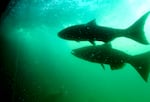
FILE: The salmon viewing area at the Bonneville Lock and Dam, August 2021.
Kristyna Wentz-Graff / OPB
Hatcheries, which release massive numbers of fish into the wild after raising them in captivity, have long been used to supplement fish supplies affected by human activity. But with the 18 dams on the Columbia and Snake rivers, they became more important to maintaining fish populations to fulfill tribal agreements and to meet commercial and sports fishing demands. There are now hundreds of hatcheries in the Northwest, run by federal, state, local and tribal governments. But many of them are aging, in need of repair or replacement.
Zach Penney is the director of strategic initiatives at the The Columbia River Inter-tribal Fish Commission. He says even before the Trump administration’s mass layoffs and broad cuts to the federal government, the Columbia basin had an infrastructure backlog of about $1 billion. Now, many vulnerable hatcheries are only able to survive with the help of volunteers. But Penney says, the hatchery system cannot continue without more sustainable funding, including more staffing and money for basic infrastructure. He joins us to share more about the factors that have led to the current situation and what he sees as the way forward.
Editor’s note: The first sentence of this post has been edited to more accurately describe the role of hatcheries.
The following transcript was transcribed digitally and validated for accuracy, readability and formatting by an OPB volunteer.
Dave Miller: From the Gert Boyle Studio at OPB, this is Think Out Loud. I’m Dave Miller. Fish hatcheries have long been used to boost fish populations in places where those populations have been reduced by human activity. But after the construction of 18 dams on the Columbia and Snake Rivers they became a vital tool, as the government struggled to fulfill tribal agreements and meet commercial and sports fishing demands. There are now hundreds of hatcheries in the Northwest. They’re run by a patchwork of federal, state, local and tribal governments. Many of those hatcheries are aging, in need of repair or replacement. All of that was before the second Trump administration’s mass layoffs and broad cuts to the federal government, which have further reduced staffing at some hatcheries.
Zach Penney is the director of strategic initiatives at the Columbia River Inter-Tribal Fish Commission. He has a PhD in fisheries, and he joins us now to talk about the present and the future of Northwest hatcheries. It’s great to have you on the show.
Zach Penney: Thanks for having me and giving me some time and space.
Miller: It’s a big ask, but I thought we could start by having you give us a sense for just how important hatcheries are to maintaining salmon and steelhead populations in the Columbia Basin.
Penney: Yeah, it’s a huge question. The Columbia River is the biggest salmon producer on the West Coast. It is nowhere near what it used to produce for historical runs, especially for wild fish. When the earliest dams went in, they knew, back when the Mitchell Act was made by Congress, that these dams were gonna have a major impact. So, hatcheries have been used for mitigation, for commercial fishing, for sport fishing, and also for tribes with treaty rights and just to meet the United States’ treaty and trust responsibilities.
So hatcheries are huge. Right now, they are kind of the only tool that we have for providing fish to catch, not just for tribes but for both commercial and sport fishermen. Columbia River fish, they all migrate north. They go up to places like Sitka, Alaska, where they support those troll fisheries. They come back [and] they support fisheries all along the coast of British Columbia, coast of Washington, Oregon, and all the way up to all the places they spawn in Oregon, Washington and Idaho.
Miller: How many fish stocks would just disappear if there weren’t hatcheries in the Columbia Basin right now?
Penney: That’s also a big question. The Columbia River has both stocks that are not listed under the Endangered Species Act and then lots of stocks that are. One of the issues people sometimes run into when they think about hatcheries is they paint hatcheries with a really broad brush. So there were some hatcheries that were definitely used, almost like agricultural techniques. They will release fish, they’ll come back, we’ll have a fishery on them.
But now, hatcheries are one of our best conservation tools, especially in places where stocks are at extremely low levels. And tribes have been in the forefront of using hatcheries to supplement the fish, not supplant them. So without hatcheries right now, there would be very few viable fisheries for tribes, for sportsmen, and for anybody who commercial fishes from down by Astoria and other places up into Alaska.
Miller: What were staffing levels and the infrastructure backlog like before the second Trump administration began?
Penney: Also a very good question. There was a billion-dollar backlog of infrastructure needs at a lot of Columbia Basin hatcheries. Some of these hatcheries are as old as the dams themselves. Bonneville Hatchery, I think, is pushing 100, if not over 100. So anytime you have concrete, running water and that amount of age, things break down. So, there’s been billion-dollar backlogs of needed maintenance – everything from water intakes to updating raceways.
Think about the technology that existed in the 1940s and look at your cell phone now. Hatchery science and the way we actually raise fish has changed so much that it isn’t just about fixing the old infrastructure, it’s also about modernizing the facilities so we can actually raise the best fish possible.
Miller: That’s infrastructure. What about staffing?
Penney: Staffing has also been a struggle. Before the rifts that happened in, I think they call this the Valentine’s Day Massacre …
Miller: … reductions in force?
Penney: Yeah, reductions in force, sorry, and also, deferred resignation or retirement programs, actually a lot of those are hitting this month. People are going off the payrolls.
Before all of that happened, appropriations for a lot of the federal facilities were either static or not quite making the cut. Because when you add in things like inflation and things like that, we’ve been having to make decisions every year at the hatcheries, like, “OK, we need to pay our people, we need to buy fish feed, and we might just have enough left over to buy these nets and make this one fix.” Usually, there’s significant infrastructure fixes that have to happen during very specific times of the year, because most of these facilities have fish on station at almost all times of the year.
So the staffing levels were adequate. But yeah, with targeted rifts and also as people decided to retire, we started to lose a lot of the federal workforce in these places – everybody who took care of the fish to the people who handle the administration. It was this huge hit, and a lot of these hatcheries are in somewhat rural areas. In some cases, we had facilities like out at Warm Springs National Fish Hatchery … for a period this last May, there was literally just one person running the hatchery with a little bit of help. So, in some cases, you can do that for a day or two, but long term, that’s completely unfeasible.
Miller: Just to put some numbers on it, the Spokesman-Review talked to Washington state government employees who talked to their counterparts, apparently, at the U.S. Fish and Wildlife Service, who said that they lost nearly a third of staff at five different hatcheries in the Columbia Gorge, including the Warm Springs one that you were just talking about. How much expertise has been lost, how much knowledge?
Penney: Yeah, it all depends on the positions, but for anybody who is in those higher-level management positions, it can be substantial. There can be leadership vacuums and things like that.
One thing to think about with hatcheries is hatcheries have their own type of seasons. Right now, we are in one of the busiest seasons that our Columbia Basin hatcheries are in. Most of our fish are fall spawners, so right now, all of the hatcheries that are dealing with their summer Chinook, their fall Chinook, the Coho are coming in … all those hatcheries need not just people to spawn the fish, but we have pathologists to make sure that we know that the fish are healthy. We also need other people to take genetic samples.
The hatchery process is highly involved, so we’ve actually had to bring in volunteers from the general public. The tribes and states have sent people, when they’ve been able to spare them, to help these hatcheries essentially get the work done so we can have fish for the next year.
Miller: That it’s interesting that you say “for the next year,” because is it fair to say that because of the life cycle of some of some of these fish – and there’s different years, different amounts of time that some of them spend out in the open ocean – that the impacts on returns now may not be seen for some number of years?
Penney: Absolutely. So, as you noted, different salmon species have different life histories, they’ll go out to the ocean for different years, and they all don’t return at the same time. Some return earlier, some return later. So the impacts that we’re gonna see in brood year ‘25, if there is a loss of production, it could be at Little White Salmon or somewhere else … I’m not saying there is gonna be loss of production, but those would be felt. For example, the life cycle of a Chinook salmon can range anywhere between two to six years. So beyond this current administration, we’re talking about into the late 2020s.
Miller: You’re also talking about having volunteers come and do work that used to be done by federal employees. What’s the connection between hatcheries and the federal government’s treaty-based obligations to support these reserved fishing rights?
Penney: You can almost see hatchery fish as Treaty fish. So the impacts that happened in the Columbia Basin. And there’s been a lot of impacts. I mean, there was early canneries, fish wheels. Then came the era of dam building, which had major impacts. Again, I noted earlier, look at the Mitchell Act. The Mitchell Act is more or less proof that we knew that the infrastructure put in for energy production, flood control was going to have a major impact on all anadromous fish.
Miller: It makes sense. If you’re putting a gigantic concrete wall, that fish that normally would go upstream, they’re going to be affected by that wall.
Penney: Yeah, absolutely. And even with fish passage … It’s actually easy for adult salmon, adults that have gone up and run laps around the Gulf of Alaska, for them to get upstream. The biggest impact usually is smolts trying to get back downstream.
Miller: What happens when these obligations aren’t met?
Penney: These obligations aren’t met, everybody suffers. So I completely avoided your earlier question about Trust responsibility and Treaty responsibility. Hatchery fish are Treaty fish, they’re food. So for the tribes, it’s significant. It isn’t just for food for subsistence, it’s food for ceremonies, and we’ve commercial fished since time memorial.
But also, the salmon that are in the Columbia Basin, everywhere those fish swim, they have an impact on a community. It could be people who love sport fishing at Buoy 10. It could be people who commercial fish all up in Alaska. It could be people as far up as Riggins, Idaho that love fishing for steelhead in the middle of winter, sport fishing. Everywhere these fish swim, they have an impact on not just tribal culture, but I would say, the communities of the inland Northwest as well as on our side of the Cascades.
Miller: Zach, thanks very much.
Penney: Thank you so much.
Miller: Zach Penney is the director of strategic initiatives at the Columbia River Inter-Tribal Fish Commission.
“Think Out Loud®” broadcasts live at noon every day and rebroadcasts at 8 p.m.
If you’d like to comment on any of the topics in this show or suggest a topic of your own, please get in touch with us on Facebook, send an email to thinkoutloud@opb.org, or you can leave a voicemail for us at 503-293-1983.