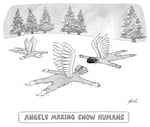
A cartoon from Portlander Tom Toro's new collection, "And to Think We Started as a Book Club..."
Courtesy Tom Toro
Tom Toro has just published a new collection of his New Yorker cartoons, “And to Think We Started as a Book Club.”
The cartoons are from the last 15 years his cartoons have been running in the magazine and are grouped in sections, from Life, Love and Family to Work, Tech and Weird.
Some comment on modern life wordlessly, like a teenager in the rain holding a mini-umbrella over his phone while he texts. Most combine graphics with commentary, like a man in a ragged suit sitting around a campfire with a few children captioned, “Yes, the planet got destroyed. But for a beautiful moment in time we created a lot of value for shareholders.”
Many, like the one pictured above with angels making “snow humans,” are what Toro calls pure palette cleansers, a much-needed break from weighty matters of the day.
Toro joins us to discuss how he approaches his art and what it’s been like to comment on the last 15 years for one of the nation’s most illustrious magazines on the occasion of its 100th anniversary.
The book is out Tuesday, and its official launch is at 7 p.m. Friday at Powell’s Books on Burnside.
Note: The following transcript was transcribed digitally and validated for accuracy, readability and formatting by an OPB volunteer.
Dave Miller: This is Think Out Loud on OPB. I’m Dave Miller. I am joined now by Tom Toro. He is a Portland-based cartoonist, children’s book author and illustrator, whose cartoons have appeared in The New Yorker for the last 15 years. The variety of his art and humor is broad and deep, from pure visual gags to clever observations about parenting, work, love and the absurdity of daily life. Toro’s cartoons have been put together in a new collection. It is out today. It is called “And to Think We Started as a Book Club.” Tom Toro, welcome to Think Out Loud.
Tom Toro: Thank you for having me. It’s an honor.
Miller: At the end of your acknowledgements, you shout out Bill Watterson and Gary Larson, the geniuses behind “Calvin and Hobbes” and “The Far Side.” What did they mean to you when you were growing up?
Toro: I’m glad you noticed that. They meant the world to me. I grew up as a child of the ‘90s. I can remember vividly waiting with eager anticipation for the arrival of the newspaper the following morning, to continue reading the adventures of “Calvin and Hobbes” and also Gary Larson’s “The Far Side” of course. And spending long summer days at my grandparents’ farm in Ohio, pouring over those early “Far Side” collections, just leafing through them again and again and again. So really, foundationally, they’re some of my earliest artistic influences – them and also the Disney movies of the 1980s.
Miller: You did mention those as well. I’m sorry to neglect them. So you said artistic influences. So even then, were you interested in making your own art, this kind of art, comic cells?
Toro: I was always interested in drawing. I would pause my VHS tapes of Disney movies and sketch down my favorite scenes. I would copy Calvin from the newspaper. It was a lot of mimetic art, like trying to learn what being a cartoonist was.
Miller: That’s how you start everything. Copy what you love and then eventually if you’re good, you find your own voice?
Toro: Yes. I say to young artists who are interested in how to break into cartooning or how to discover their own voice, lean into your influences. Don’t be afraid of copying them. It’s very much what I did when I was starting out. And then inevitably, when you aren’t able to completely mimic your influences, you start to realize that what you perceive as your mistakes are actually your style. That’s what makes your stuff original, the fact that you can’t directly copy your influences.
But the way that you’ve diverged, you start to lean into that more and you discover your own voice as an artist. But in the beginning, it was just a way for me to be in communication with those characters and to be in a sort of community with them, to copy them in my own way, and to just learn how to draw.
Miller: Were you a class cartoonist? I remember two kids in particular, in middle school, who had this magic ability to draw cartoons, and they would draw classmates and sort of lampoon us in fifth grade, in seventh grade?
Toro: In elementary school, I can certainly remember drawing in the margins of my binder and doodling during class. In a funny way, I think that the presence of the cartoons in The New Yorker magazine – I keep this metaphor in mind – the way that they’re embedded there among this Pulitzer Prize winning beautiful journalism, some of the best writing you’ll find anywhere. And down there in the corner, there’s a cartoon. And it intentionally doesn’t have anything to do with the journalism. It’s almost like a non-sequitur. I think of it as passing a note to a friend during class. Like it’s kind of a little elbow-in-the-ribs to the reader. There’s always room for that side of us, for the humor, for mirth. There’s like a moment for mirth.
So yeah, I was that kid who will be drawing notes, making notes for friends. I was also kind of a perfectionist so I would like to take the class project home and do it by myself, because I didn’t trust other kids to draw as well as I did. So I had that quality to me too, which might speak to the stubbornness that would later be actually beneficial to me when I was trying to break into The New Yorker. It took me quite a while.
Miller: I want to hear about that. But before we get there, you’ve said in the past that your plan was to become a filmmaker. You did go to film school in New York straight out of college. And then, you have said that you dealt with what seems like really debilitating depression, and eventually left film school, moved back with your parents. How much serious cartooning had you done before that, cartooning with an idea towards this could be a career?
Toro: That’s a really great question. I had never considered it a career path, although while I was studying film in college, as an undergraduate, I was also doing cartoons for the student paper. So those things were always kind of in tandem. That was actually my first little taste of what it was like to have a readership.
I remember walking through the dining hall one day and overhearing a student chuckle at a cartoon that I had done. While I was considering myself more on the filmmaking path, that was a really validating moment, to actually have touched somebody with the work that I was publishing.
Miller: So is “chuckle” what you would most reliably hope to evoke in terms of a sound? It’s not a guffaw, it’s not rolling, literally falling out of your seat. It’s a chuckle?
Toro: Right, right. There’s a little bit of a joke. There’s the classic knock against New Yorker cartoons that like they’re “not funny,” right? I think that some people like to say that because they’re a little bit erudite. They’re a little bit clever. So they’re not the sort of overacting Sunday morning comics style of cartooning. They’re a different genre and I sort of joke that they’re calibrated so that the business people reading The New Yorker on the subway ride to work in the morning won’t embarrass themselves by laughing out loud.
You want to have that little soft chuckle. It’s more of a knowing kind of intimate moment. My cartoons are created in intimacy with my own thoughts and my own craft. And then they’re sort of enjoyed by people who are maybe laying in bed at night, reading The New Yorker, before they fall asleep. So it’s kind of like an intimate moment of communication in a way.
Miller: OK, but to go back … So in college, you did do this while you were still assuming that your future was as a filmmaker?
Toro: Yes.
Miller: And then what changed when you were back home and cartooning? What were those days like?
Toro: I went directly to graduate film school in New York City out of college, still pursuing filmmaking as a craft. I learned pretty quickly that the storyboards I was drawing for the films were better than the films I was making from the storyboards. Creativity in a social context, trying to get performances from actors, that kind of thing, was an uncomfortable thing for me and I felt sort of limited in that way. So I felt that derailed what I had thought was going to be my artistic career path, as a filmmaker. It coincided with a deep sort of feeling of lostness and depression that came over me in my mid-twenties.
So I ended up back at home. I was kind of part of the boomerang generation. The Great Recession hit pretty much immediately after I went back home. And the way I’ve come to think of it is, I might not have been able to articulate it to myself at that time. But returning to cartooning, pursuing it in a more serious way was almost a way for me to excavate my sense of humor that had been lost during my mid-twenties, when I was a little bit taking myself too seriously as an aspiring filmmaker and just as an adult moving through the world. I had lost that playful quality that had been with me earlier in my life.
It was learning the art form and studying The New Yorker very seriously, because I set my sights, almost immediately, on getting into The New Yorker. I started studying the way the cartoons had evolved over the years. This is the 100th anniversary of The New Yorker Magazine. There’s a lot of work to look back at and be inspired by. It was just a process of rebuilding and rediscovering my sense of humor and my voice as an artist.
Miller: What was it like to be trying to make jokes? In a sense, I think of cartoons as the visual version of a standup’s one liner. I mean, there’s a variety of what cartoons can be, single-panel cartoons can be. But it seems more like a joke than a long story. What was it like to do that when you were in the throes of depression?
Toro: It was difficult. I mean, it took a real intention and working in tandem, of course, with therapy and all those sort of things. I’m not going to prescribe to anybody that pursuing cartooning is the antidote to that.
Miller: That work alone could be a solution?
Toro: Right, but it was very much … Also, the support of my family meant the world. I had that to lean back on, so I’m very, very grateful for that. I wouldn’t be here today if it wasn’t for the support of my family. But it took a large amount of intention to really focus on that and it was a learning curve too. I went back and I honestly picked up again the books that I had so loved as a kid. I reread “The Far Side” and reread “Calvin and Hobbes.”
Miller: And this is like in your late twenties?
Toro: Yes, in my late twenties. I started taking it more seriously as a craft and of studying it as how it achieves communicating to me that feeling that I get of joy, of buoyancy, of mirth, levity, playfulness and all those sort of things. And yeah, it just took work. It’s funny, cartoons are meant to be instantaneous. You open them up, you enjoy them, they’re like a spark. They’re a moment that happens, especially single-panel gag cartoons, where the entire joke has to be communicated to you in a moment.
But a lot of work goes into them. A lot of work goes into the composition, the craft, the writing. You’d be amazed – maybe you wouldn’t be – at how much rewriting goes into what seems like a very deceptively simple one-line caption. And part of it was that the work was meaningful. I liked that it took labor. I could apply myself to something. I could throw myself into this craft. That was very important to me to have a task.
Miller: The number that blew my mind when I heard it is the number of cartoons that you submitted to The New Yorker before your first one was bought, before they said “yes.” They said “no” 609 times and submission number 610, comic number 610, they said “yes” to. What kept you going?
Toro: Gosh, I mean, I had chosen it as my path out of my parents’ house, trying to become a professional cartoonist, trying to build a career as a freelancer, essentially. So I think it was stubbornness, for one thing. That definitely helps. But it was also just an inner belief that this was something I could do. I knew I had something there worth cultivating. And when I say that number, 610, it’s important to also caveat that by saying that not all of them are undiscovered masterpieces.
I was very much learning the craft as I was submitting and I was actually using the weekly submission process to The New Yorker as homework to myself to keep at it, to develop the habit of cartooning. Because it really is just a matter of the 10,000-hour rule, right? Like you really just apply yourself to it, you get better over time. So I was evolving as I was doing the submissions in real time. But yeah, it took 610 and they finally bought one from me.
Miller: Were they giving you any feedback, like this is good, but work on this or more of this, less of this, or was it more of a void?
Toro: It was a void. I mean, I was in California sending stuff by mail to The New Yorker offices. And I would get back the packet of print out cartoons with just the form index card rejection with Eustace Tilley on it saying, “thank you, but we don’t have any need for these at this time.” [It was] just a very short curt dismissal. After doing that for about a year, I think I wasn’t terribly discouraged because I knew they weren’t there yet. I knew my work wasn’t quite ready. So I agreed with the rejection in a way, internally, even if it was still a sort of hope to break in.
But I eventually took a visit to New York and went back, for the first time since I had left in despair and depression, to go into the offices and meet with the editor in person because I wasn’t getting any feedback. It was just thumbs up, thumbs down – mostly thumbs down, all thumbs down. So then I went to the Roman Colosseum. I finally met the editor. At the time, it was Bob Mankoff and I met with him in person. He was very sort of sphinxlike, looked through my things, very unexpressionist and did not choose to take any of that particular batch I brought in. But then he sat down with me and just talked for 10 minutes about cartooning and the craft of it. It was sort of an out-of-body experience because here was this person who may or may not hold my fate in his hands, and I was trying to pay attention at the same time as I was watching myself trying to pay attention. You know, one of those moments.
But I came away from that experience ... He said, “You’re smart, you have a voice, there’s something you’re going for there. This style is not really gonna work for us. So if you want to keep submitting, you need to figure out your own voice. You need to find out what makes you uniquely a cartoonist and cartoon for yourself first and foremost, and then keep submitting, but make yourself laugh. You’re trying to make me laugh. Make yourself laugh.” So on the flight home, I kind of scrapped what I was doing. And when I look back on that …
Miller: Did that ring true to you when he said that? I feel like I’ve heard versions of that advice from other people and stories. I can imagine thinking, “well, yeah, I’ve been trying to have my own voice and this is not helpful advice.” It seems like the kind of thing that everyone says, but in reality, it’s really hard to do. I’m wondering how it hits you?
Toro: It’s one of those things where the criticism that you get, which is the most valuable, is the criticism that secretly concurs with your own suspicions. Where I knew that I had almost been trying to overengineer what I was doing, in almost desperation to get accepted by The New Yorker. Whereas what I should have been doing is observing the world and observing my perspective on the world. So I set aside what I had learned and learned and learned, and studied and studied and studied. And now it was time to sit back and pay attention.
How am I reacting to things? What is my opinion of things? Just loosen up a little bit. I was being very rigid. Literally, the way I was drawing the lines were very sort of tense and I had to just loosen up, not only in my perspective, but in my penmanship. So I took that to heart, went back and just started ... I had been still in that phase of mimicking my influences. When I go back and look at those first probably 100, 150 that I submitted to The New Yorker, they’re very “Far Side”-esque. They’re very Gary Larson-esque.
But I knew I still wanted to get into The New Yorker and what you’re trying to do is two things. You’re trying to have your own unique style, but you’re trying to also be suitable to the magazine. So there’s sort of two eyes of the needle that you have to thread to make it in. So it helped to have a specific destination in mind to kind of keep me on track, but I knew that in order to succeed and get accepted by The New Yorker the way that I wanted, I would have to also discover my own perspective and voice in a much more unique and honest way.
Miller: What was it like when you finally got that “yes?”
Toro: It was great. It came by email. My life changed by email. When you get an “OK” from The New Yorker, that’s literally what it says in the subject line of the email, it says, “OK.” [Laughter] So you’ve been working for two-and-a-half years and you get, “OK.” So then I opened it up.
Miller: You’ve beaten us down. OK.
Toro: Exactly. So one of the fun things is you don’t know which one in the batch they’ve taken until you open up the email, obviously, and see the attachment. They took the cowboy one. There’s one of two cowboys sitting at a bar and behind them there’s a cowboy about to enter the saloon doors. You see his upper half above the saloon doors. Below the saloon doors, there’s nothing visible. And one of the cowboys at the bar says, “that there’s one bowlegged cowboy.” His legs have spanned the arch of the doorway.
I think that one worked because it kind of obeyed the fundamental rules of cartooning, where the image presents a visual incongruity that the caption solves for you. So it’s just a good setup and a good punch line. And it was done in a way that was clean, not over cluttered with the composition, and yeah, that was in 2010. They gave me my first “OK.”
Miller: In what form do your ideas normally come to you?
Toro: That’s a great question. Cartoons are a pairing of image and writing, so I would tilt more toward the writing in a way. I was an aspiring writer for a while. I have unfinished novel manuscripts sitting in my desk drawers. I’ve done a couple short stories for various publications. So I do have a sort of writer’s brain. I love wordplay. And also, I’m a dad. I have a 10-year-old, so dad jokes, pun-based dad jokes are often close to my heart. You have to elevate them a little bit to get them into The New Yorker, but the writing of it will often come first.
I’m not a big doodler. I find that my synapses move faster than my fingertips, so I like to let an idea rattle around in my brain a little bit. And yeah, it often helps just to give yourself a little task. Halloween is coming up, so what’s a Jack O’Lantern joke, what’s a Frankenstein joke, that kind of thing. So you prompt yourself. Also, one thing that’s been very important to my craft is, funnily enough, I heard an interview with James Taylor, the musician. Terry Gross was interviewing him, and she said, “how’d you learn to play the guitar?” And he said, “I had very boring summers as a child.” And I loved that.
Miller: What’s the value of boredom?
Toro: It’s a diminishing resource. It’s a rare and precious resource in our culture. With digital devices following us around, there’s a constant tug on our attention.
Miller: It’s funny to call it diminishing. I mean, it could be an unlimited resource if we would let it, right? I mean, anybody is free to sit around without anything in their hands. It’s just hard to do that.
Toro: It takes will. It takes an effort.
Miller: OK, so it’s diminishing, but what is the benefit of boredom? What good can follow from it?
Toro: If we’re able to push through the urge to seek distraction then your mind will start to entertain itself. And then you’ll enter almost a sort of imaginative, playful mind state. Oftentimes, I’ll sit down for a brainstorming session, and honestly, every day, every week, I’m convinced I’m tapped out of cartoon ideas. I will not come up with anything new. I’ve done it all. There’s nothing more I can excavate for myself. And then something will happen.
And it’ll push you. You’ll sit there, you won’t get discouraged, you’ll try not to get discouraged, you’ll try not to reach for the phone, you’ll try not to read the scroll through The New York Times homepage. Even though as enjoyable as that is, at the end of an hour, you’ll have read all the articles and you’ll have no cartoon ideas. You just have to push back that almost internal barrier and get into a mind space where there’s only me and I have to entertain myself, and let the mind start to play. And I like how the play happens, where the play comes from, I’m less clear about, but I know that that’s the state you need to enter.
Miller: Many, maybe most of my favorite cartoons of yours have, they’re really funny, but there is some element of darkness to me that I love, that comes either visually or with the caption, or the combination of them. Is there a connection for you between humor and the dark side?
Toro: Certainly. I mean, that was the sort of origin of my adult sensibility. Coming out of depression and finding a way through that and being able to navigate it, not curing it, but being able to navigate it and live in harmony with it, almost in a way through, having equal parts humor in it. I’m a huge admirer of Charles Addams. I love Charles Addams’ work, creator of “The Addams Family,” obviously, but his stuff for The New Yorker has a deeply macabre sensibility. Yet they are some of the best cartoons you’ll ever encounter. If you have the pleasure of leafing through a Charles Addams collection, I highly encourage you to do it.
Actually, I was honored. I got a really good blurb for my book from Anderson Cooper, fellow journalist. He said it had flashes of Charles Addams’ dark humor, which I felt really flattered by. And I think that we’re mortal creatures, right? I mean, that’s kind of the curse and the gift of being human, as we know that our time on this earth is limited. And I think being able to approach it with a sense of humor and levity is very important.
One of my favorite cartoons in the collection is there’s someone standing at a gravesite of a relative that they’ve just inturned. He’s looking at his phone and the caption reads, “Auto reply, I am dead and will have limited access to email,” which will probably be my email away message when I eventually pass away. [Laughter] But it’s that kind of work ... it’s very funny, right? And we think that death is something mournful, especially in American culture, where we’re not comfortable dealing with death. Other cultures have a healthier relationship to it than we do. But I feel like humor is one way to, I don’t know, dull the edge of the grim reaper’s scythe.
Miller: Tom Toro, congratulations. The book is amazing. Thanks so much for coming in.
Toro: Thank you very much.
Miller: Tom Toro’s new collection of cartoons is called “And to Think We Started as a Book Club.” He is also the author of numerous children’s books. He is a Portland-based cartoonist.
“Think Out Loud®” broadcasts live at noon every day and rebroadcasts at 8 p.m.
If you’d like to comment on any of the topics in this show or suggest a topic of your own, please get in touch with us on Facebook, send an email to thinkoutloud@opb.org, or you can leave a voicemail for us at 503-293-1983.